Showing posts with label church. Show all posts

Monday, April 6, 2015

Fighting the Bad Fight

Christianity's ongoing battle with atheism and secularism is not only misguided, but also not what God intended for His church.

I recently heard a story about the evangelist Billy Graham. What piqued my interest was how almost overnight he transitioned from relative unknown to household name. One day he showed up to the tent where he was holding a series of meetings and discovered a gaggle of news reporters who were eagerly writing down everything he said. When he inquired as to what caused all this interest, he discovered that he had caught the eye of media mogul William Randolph Hearst, and the rest, as we say, is history. Mr. Hearst never divulged the reason for his interest in Graham, but the historian who was telling the story stated that it had a lot to do with current world events, namely the rise of communism as a world power.

You see, the Soviet Union had successfully test fired a nuclear bomb, and Mao Zedong had recently taken over China. Communism now posed a real threat to the American way of life, or at least that is how many perceived it. Atheism being one of the main tenets of Communism, a key way to fight against it was a revival of religion in the United States. Hearst most likely saw in Graham a person who could spearhead such a revival. This revival that Graham participated in came about in a large part as a means to counteract the perceived encroachment of atheistic communism. Religion (i.e. the Judeo-Christian belief system) was essentially a weapon meant to ward off those who would seek to undermine American ideals.

The popularity of "this Christianity as a weapon" concept has in a large part caused the downfall of true Biblical Christianity because it has made the religion popular again on a grand scale. Christianity was never meant to be popular. The Roman emperor Constantine's supposed conversion did more damage than all the persecution up to that point because by making Christianity popular it brought in a sense of entitlement. This sense of entitlement causes adherents to the religion to do whatever it takes to preserve their popularity, including countless atrocities committed in the name of God, but more subtly it causes Christians to be on the continual lookout for battles to fight as a means of promoting the Christian brand.

One can hardly escape hearing about some ideological battle that Christians are fighting: creation vs. evolution, the "War on Christmas", abortion, gay marriage, the list goes on and on, all the while neglecting Jesus' words and example to the contrary. A prime example is His declaration to "be of good cheer, for I have overcome the world." That's right, Jesus said that He has overcome the world, meaning that we don't have to, so why do we insist on trying to accomplish such a feat?

When Jesus was on the earth, His focus was on relieving people from religious oppression, not secular oppression, so why do His professed followers focus so much on the secular aspect? The simple answer is that it is easier to look out than to look within. Personal attacks are much easier to accomplish than personal growth because growth requires sacrifice, and sacrifice is uncomfortable. Despite the fact that Jesus sacrificed not only His comfort, but also His very life, we would rather give up as little as possible and attack those who threaten our comfortable way of life.

You can probably see where I'm going here. For multiple reasons, the professed followers of Christ have decided to go against His teachings and as a result are trying to compensate for the church's shortcomings by attacking those outside of the church; the very ones Jesus told us we should be trying to reach.

Now is high time for Christians to stop fighting the bad fight of unbelief and start fighting the good fight of faith, and see what wonders God will work in our lives and in the lives of others.

Wednesday, November 2, 2011

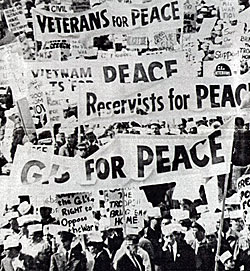
Building a Better Protest

Courtesy personal.kent.edu/~bsmith30/TheSixties/
Want your protest to turn into a movement that truly changes the world?  Start by looking at one that accomplished such a feat.

Many public protests have come and gone.  Some have had a temporary change on society while others have simply faded into obscurity.  Then there are those that have made such a widespread impact that we cannot picture a world in which they did not occur.  It is one such protest/movement that we will look at in this post, and we will also glean some tips on how to increase the impact of whatever one you decide to join or start. The movement I have in mind is none other than the Protestant Reformation, and here's how it made such a difference.


Empowered the Powerless

Back in the day, for much of the Christianized world, the Roman Catholic Church was the only show in town.  It had a religious monopoly that was established at the expense of the common person.  No doubt many people felt the weight of this oppression, but felt powerless to do anything about it.  The Reformation built on this frustration and gave those feeling powerless a voice. A frustration that had been in existence for some time before Martin Luther came on the scene.

Didn't Reinvent the Wheel

Many people most likely believe that the Protestant Reformation originated with Luther and the 95 Theses (which he posted 494 years and two days ago).  While events definitely progressed more rapidly as a result of Luther's words and actions, his objections to the Roman Catholic Church's abuse of power echoed those of  John Huss, who echoed John Wycliffe's views.  Both of whom lived almost 200 years before the German monk.  Luther's original course of action differed from many modern movements in that he didn't intend to discuss his views with the general public.

Started at the Top

Although Luther posted his famous theses in a public place, he wrote them in Latin, a language not widely spoken or understood outside of educational and religious institutions.  He wanted to debate with those in power, those who could facilitate lasting change, not with his fellow Germans, who could do relatively little.  When I state "fellow Germans" I mean that loosely because Luther was in actuality part of the system that he deemed to be corrupt.

Worked from the Inside Out

Luther understood, either cognitively or intuitively, that reforms are often best facilitated by those inside of the institution.  His radical views eventually led to his departure, but that shouldn't negate the fact that he originally intended to reform the system as an insider.  He saw himself as someone who could rebuild from the inside rather than demolish from the outside.  The promulgation of these suggested reforms was greatly enhanced by a new technology at the time; the printing press.

Used Technology to His Advantage


The advent of the printing press made it much easier to disperse Luther's and his allies' views.  The 95 Theses, being translated into German a few months after their posting, made their way into the hands and minds of the common people.  Their once unspoken concerns became spoken, and many were emboldened by the fact that someone was actually standing up to such a powerful organization.

Dynamic Leadership

The Reformation would have never gained any ground if Luther had caved under the immense pressure from the religious hierarchy.  The people needed a dynamic spokesperson, and they got one in Martin Luther.

A Perfect Storm

Centuries of frustration coupled with a dynamic leader and new technology changed an entire religion for the better.  Therefore if you want a better future for the world, or at least your part of it, take some tips from the past.  You'll never know what can be accomplished unless you try.

Friday, September 23, 2011

[Featured Post] Worship As It Sometimes Is

This featured post comes from Michael Hyatt's Intentional Leadership blog.  It is funny yet sad at the same time.


Do you ever find yourself worshiping God and not really meaning it? This very funny video is a good reminder that we need to align our hearts with our words.

Monday, August 15, 2011

Book Review: The Jesus I Never Knew

Photo courtesy goodreads.com
Phillip Yancey challenges the reader to take a second, third, and fourth look at Christianity's most talked about, yet most frequently misunderstood, subjects; the life and ministry of Jesus Christ.

Yancey starts off this book with his first encounter with the concept of Jesus.  A scene not too unfamiliar to those who grew up in a Christian environment.  Since I fall into that category, I can identify with it as well.  I used the word "fall" almost unconsciously, but it fits so well.  As children, we don't have much control over where we go, what we do, or what type of home we grow up in.  With our undeveloped skepticism, we believe whatever comes from the mouths of those in authority regardless of its truthfulness.  Sadly, as we grow older, we discover that those in authority have not been completely honest with us.  This was the case with Philip Yancey.

Yancey grew up believing Jesus to be one who had "no sharp edges at all--a Mister Rogers before the age of children's television."  Those of you who did not grow up in the United States, or simply did not watch "Mister Rogers' Neighborhood" most likely will not be able to fully grasp the power of that illustration.  As one who watched the program extensively growing up, I know exactly what picture Yancey tried to portray.  Mister Rogers was the ultimate nice guy, and his show followed his personality.  In researching for this post I came across the program's opening theme, something I hadn't seen for a very long time, and I couldn't help but feel a warm sense of peace as I watched it.  Young Philip felt that same peace thinking about Jesus, the problem being that was where his concept of Jesus ended.  As Yancey grew up his concept broadened, sometimes exponentially, and this book details what he discovered about this Man Who was God.  What did Yancey discover?

Yancey found out that Jesus is more than we think He is, and when you think you have Him figured out, something else comes along that completely contradicts what you first thought.  Jesus lived a life of apparent contradictions: the Sinless One Who was a Friend of Sinners, powerful men and evil angels would cower in His presence or simply run away, yet little children and outcast women were drawn to Him, and never wanted to leave His side.  A friend of mine described Jesus as a "human magnet", a fitting description indeed for those were seemingly His opposite were drawn to Him, yet those who were seemingly His equal were repulsed.

While other books exist about Jesus' life that I would place in higher esteem (namely one in particular), The Jesus I Never Knew helped to remind me that simply because we have learned something as a child doesn't necessarily make it true, and that we should keep our minds and hearts open to God's leading.  For although we most likely will have to give up long cherished ideas, the new ones that we accept will be much, much better.

Sunday, August 14, 2011

Featured Post: Corporate Identity and God's Blessing

This featured post comes from Ted N. C. Wilson, president of the Seventh-day Adventist world church via the Adventist News Network.

Commentary: Corporate identity and God's blessing

Church membership and leadership must unite to receive latter rain
Luke tells us twice that the disciples were of one accord as they prepared for the outpouring of the early rain (Acts 1:14; 2:1). The fact that he would mention it twice suggests that unity within the church is a very important step in preparation for the outpouring of the Holy Spirit. There is an aspect to unity presented throughout Scripture that is seldom recognized or addressed in our church -- the role of corporate identity.

First of all, look at an example of corporate identification and then at two aspects of this phenomenon, which are crucial in the preparation for the latter rain:

First, the example: God made it absolutely clear that the Israelites were not to take any spoils for themselves in Jericho's fall and that the silver, gold, and the bronze and iron vessels were consecrated to the Lord (Joshua 6:18, 19). But Achan stole 200 shekels of silver, a wedge of gold and a Babylonian garment (Joshua 7:21). God's anger burned against Israel, and in the next military engagement, Israel lost 36 men and suffered a shameful defeat. When Joshua cried out, "Why, Lord?" the answer was short and to the point: "Israel has sinned" (Joshua 7:11). The whole nation suffered and men lost their lives because one Israelite disobeyed -- corporate identity.

Now, two illustrations that impact directly upon our plea for the latter rain:

First, when the 12 spies returned to give their report about the promised land, Caleb and Joshua were positive and said, "Let us go up at once and take possession, for we are well able to overcome it" (Number 13:30). However, the 10 spies said they could not take the land because there were giants in it and they felt like grasshoppers. The nation believed the 10 and turned against their leaders who were positive that God would fulfill His promise and give the land to them. God's response? Back into the wilderness for 40 years. Moses, Aaron, Caleb, Joshua, and those who supported them had to return to the wilderness because of those who refused to believe God's Word -- corporate identity.

The second illustration takes us to the time of Jesus. Now the roles are reversed. The common people of Israel were flocking to see and hear Jesus. They were bringing their sick to be healed. There was a growing belief among them that Jesus was the promised Messiah but not so among the leaders. They were jealous of Him and plotted His death. During His trial, Pilate asked, "Shall I crucify your King?" The chief priests responded, "We have no king but Caesar" (John 19:15).

Concerning the priests' attitude, Ellen White says, "Thus by choosing a heathen ruler, the Jewish nation had withdrawn from the theocracy. They had rejected God as their king. Henceforth, they had no deliverer. They had no king but Caesar. To this the priests and teachers had led the people. For this, with the fearful results that followed, they were responsible. A nation's sin and a nation's ruin were due to the religious leaders" (DA, pp. 737-738) -- corporate identity.

In the first illustration the leaders suffered because of the rebellion of the people. In the second illustration the people suffered because of the rebellion of the leaders. God deals with us individually when it comes to our own salvation. But God deals with His people as a corporate group when it comes to carrying out His instructions for the advancement of His work.

What is the lesson to be learned?

God deals with His church today as a corporate body. If we are to receive the latter rain power of the Holy Spirit today, the body and the leadership must be on the same page. God has been ready for years to give His people the latter rain. He has been waiting for us to get ourselves together. If we would only press together in seeking the promised power, pray for each other and stand united, shoulder to shoulder, the power would be given, the work would be finished quickly and we would enter the kingdom soon. It will happen and the glory will be given to God alone.

Wednesday, June 15, 2011

Featured Post: Outreach is the Fuel for Revival

This Featured Post comes from Mike Jones of Portland, OR.  Mike is a seminar leader on how to reconnect with missing church members (reconnectnow.org). He is also author of the re-released book "Help, Lord, I Blew It Again" (2010, Pacific Press).
You can find the original post here.

Commentary: Outreach is the fuel for revival

Without ongoing community impact, revival is short-lived and self-absorbed
Calls for revival coming from our denomination's leadership are gratifying, but we must never forget the importance of outreach.

I'll never forget a revival that swept my home church back in 1969 in Worthington, Ohio. I had just left the ranks of cultural Adventism, having made an adult decision for Christ at the age of 30. Adventist businessman-turned-revivalist Emilio Knechtle had become my mentor, and at my suggestion, the church invited him to hold a weekend series of meetings. The result? A revival broke out.

That revival resulted in our launching approximately a dozen small prayer-study groups. Some groups studied various books of the Bible, while others used Christ-centered books such as church co-founder Ellen G. White's Steps to Christ. A new spirit permeated the church and lives were changed for the better. It was wonderful. For a while.

But a year later, our revival had mostly ended.

Why? Because our focus was mostly on us. We wanted to strengthen our walk with Jesus -- a good thing. But, regrettably, we weren't doing the works of Jesus -- not a good thing. You see, outreach is the fuel that keeps revival fires burning, and outreach wasn't happening with us.

There's nothing new about this. White once reported on a revival that happened in Battle Creek, Michigan in 1893, which faded when the students didn't engage in outreach. I will never forget the revival that swept the campus at Andrews University in 1971, my first year as an instructor there. It was powerful, impacting both students and faculty. But it didn't last, either.

Jesus underscores the importance of outreach: "Heal the sick, raise the dead, cleanse lepers, cast out demons," he says in Matthew 10:8. But those ideas simply weren't on our plate back in 1969. We weren't impacting our community. We were so happy enjoying our sweet little revival and the new closeness many of us had with each other that we didn't do much else except maintain our groups.

Regrettably, it wasn't long before we were back in our Laodicean twilight zone. We liked what had happened and didn't want to lose it.

Jesus warned in Mark 4:18 that "the cares of this world and...the desire for other things" would, if permitted, choke the Word, causing it to be unfruitful. That's what happened to us. Over time, some of us even left the church, including me.

Today I'm back and believe I have revival in my life. But outreach is what's keeping it alive. As I encounter people in my church and community with fractured relationships, some homeless and others mentally ill, among other issues, I come face to face with a huge problem. I'm not up to the task. I'm inadequate.

But that inadequacy is proving to be quite a blessing. Because my sense of inadequacy these days drives me to my knees and to God's Word. Every morning I tell Jesus, "It's your son Mike down here in the war zone of Planet Earth, and I am desperate for your presence in my life." As I pray, I plead for God's power and wisdom and grace (His adequacy) to be manifest in my encounters.

Without a doubt, the one-two punch of prayer and Bible study, when combined with outreach, is what fuels the fires of revival.

"But I'm not good at outreach," you may say. "I wouldn't even know where to begin."

Let me help you.

You can begin by asking people questions, even ones you don't know. Perhaps it will be the bank teller. Or the cashier at the super market. Or the guy at the car wash. Or someone in the pew in front of you.

"How are you doing? How's everything going in your life?" you ask. Then you simply listen. More than a few will tell you about some pain in their life. You'll hear, "My mother died last week," "I'm recovering from a stroke," or "Our house is in foreclosure."

You'll think, Yikes, what can I say? And all you may be able to say is, "I'm so sorry. I'll be praying for you." And so you will, keeping in mind you'll try to connect with them again.

Even if you're not preaching an evangelism series in a far-away country, I assure you these kinds of seemingly small encounters -- listening to someone's pain -- will drive you to your knees, where revival takes place. It's also evangelism of the highest kind.

The great theologian Francis Schaeffer said it well in replying to his teenage son, Frankie, who had asked him his secret for turning so many people's lives around. "It isn't what you say to someone that matters so much. Knowing how to listen to people is what helps them."

If listening to people in pain is a key to keeping revival alive, then let's start today.

What do you say?

Monday, May 9, 2011

The Good Old Days?

In these days in which people's rights seem up for grabs there is a tendency to wish we could go back to the good old days when people had more freedom to live as they chose to live.  However, upon further research I have discovered that people's freedoms have been eroding away for quite some time.

Some time ago I picked up a book at a Christian book store entitled The Rights of the People, a book on the subject of religious liberty written in the late nineteenth century and reprinted in 1998.  As I have been making my way through it I have been impressed by the depth of thought of it's author, Alonzo T. Jones.

The most recent chapter I have read is entitled "Religious Right Invaded" in which Jones explains how despite the tireless efforts of the founders of this country to separate religion from government (which he maps out in the previous chapter) that in such areas the nation has gone backwards.  He went so far to state that there has been "a counter-revolution".  He stated that this counter-revolution was accomplished and consummated in a U.S. Supreme Court decision from February 29, 1892 (for full text of the decision go here).

As is often the case (no pun intended), this decision came into being as a result of a challenge to an existing law.  In 1887 Congress passed a law that forbade any alien to come to the U.S. under contract to perform any kind of labor.  The reason for this law was that many corporations were going to Europe and finding people to come here and work.  The company would pay their way, and because of this they required the laborers to work for next to nothing.  This was depreciating the amount Americans could get paid for their labor, so Congress passed a  law stating
"Be it enacted by the Senate and House of Representatives of the United States of America in Congress assembled, that from and after the passage of this act it shall be unlawful for any person, company, partnership, or corporation, in any manner whatsoever, to prepay the transportation, or in any way assist or encourage the importation or migration, of any alien or aliens, any foreigner or foreigners, into the United States, its territories, or the District of Columbia under contract or agreement, parol or special, express or implied, made previous to the importation or migration of such alien or aliens, foreigner or foreigners, to perform labor or service of any kind in the United States, its territories, or the District of Columbia."
A problem arose when Trinity Church Corporation employed a preacher in England to come to the States and preach for them.  This act was seen as a violation of the aforementioned law and the U.S District Attorney prosecuted the church.  The U.S. Circuit Court decided that the church was guilty.  Naturally, there was an appeal taken to the Supreme Court.  The Supreme Court reversed the decision on the grounds that the term "laborer" or "laborer or service" was intended to refer to manual labor, not a professional service.  All the Supreme Court had to do was reverse the decision on those grounds, but they went above and beyond what was necessary, and that is where all the troubles began.

The Supreme Court stated, "But, beyond all these matters, no purpose of action against religion can be imputed to any legislation, state or national, because this is a religious people. This is historically true."  Having made such a statement they then had to back it up, and by so doing started down a very slippery slope.  For not only were the people of this nation "religious", but they were also "Christian".  Jones stated in a somewhat satirical tone that the people therefore are now all Christians regardless of whether  they were Jews or non-believers because the highest court in the land declared them so.  He then states that the very absurdity of the suggestion only demonstrates that the court should have nothing to do with such manners.  He continues by stating that people are not made religious by law, judicial decision, nor historical precedent, which brings us to the historical "support" the Supreme Court gave to show that the people of the U.S. are indeed a religious people.

Jones stated that the historical reasons given are at best suspect and at worst complete misinterpretations of the original statements.  The first historical reasons given were from European nations (i.e. Spain and England). Jones points out that the Spanish rulers (Ferdinand & Isabella) who commissioned Columbus were in fact the same rulers who established the Spanish Inquisition.  To say that the language of these rulers has the same meaning as the U.S. Constitution takes quite a bit of stretching of the imagination.  The statements regarding the British monarchy would have quite a bit more weight if in fact the U.S. was still under British rule, but it most definitely is not subject to British sovereignty.

There are many other historical reasons given, and Jones takes time to refute them all, but this is beyond the scope of this post.  I will however touch on the reason for which Jones saves his strongest language, the ruling declares that the United States Constitution reaffirms the thought that this nation is a religious nation.  To this Jones states, "To say it is absurd is not enough, it is simply preposterous."  He goes on to write that there is another consideration that magnifies that one, namely the fact that the court leaves out Thomas Jefferson, James Madison, and George Washington from the place where they rightly belong, and drags "Ferdinand, Isabella and Elizabeth into the place where they do not and cannot by any shadow of right belong[.]"

There is much more but Jones sums the entire ruling in this way.
"The United States . . . was turned from the 'new order of things' to which it was committed by our revolutionary fathers, and to which it stands pledged by the great seal of the government itself, and was thrown into the evil tide of the old order of things.   And thus this enlightened nation, the example and glory of the world, was caused to assume the place and the prerogatives of the governments of the Middle Ages in embodying in law the dogmas and definitions of the theologians, and executing the arbitrary and despotic will of the church."
So while it is nice to wistfully look back at times gone by and wish that things were like they used to be, it is important to realize that even in the good old days the situation was not as rosy as we thought it was.

Wednesday, September 8, 2010

View From the Outside

Sometimes we need to ask ourselves what our church would look like through someone else's eyes.

A week or so ago I visited a church that I had only attended a couple of times before, and I couldn't help but make some observations. However, before I get into that, I'm going to give some background information. I am a firm believer that friendliness and openness are key components that add to the overall quality of the church experience, and, naturally, the lack of these components can put a somewhat negative spin to that experience. That being said, let's get into what I encountered.

I arrived at church as the first worship service was nearing an end (this church had two worship services). Simone was taking care of something at the time, so I decided to walk around the building a little bit. I decided to take a passive role regarding my interactions, that is, I wasn't openly friendly while at the same time conducting myself so as to appear approachable. The interesting thing was that during this time nobody approached me or even said "Hello" to me. It wasn't until some time later when the worship service was completed and I was seated for Sabbath School that an older gentleman came to me and welcomed me to the church.

This series of events would not have caught my attention had not just a few days earlier I had gone to an auto parts store. I had hardly two steps into the store when one of the employees called out "Welcome to _____!" A phrase that was repeated by that same person whenever someone walked into the store. The contrast between that prompt greeting and the delayed greeting I received at the church was startling.

I don't harbor any negative feelings, but I can't help but wonder if my attitude would be different had I been a true outsider, someone who had never been to that church before, or any church before my visit there. Would I have been treated differently if I wasn't dressed like an insider (shaved, combed with shirt & tie)? The more I think, the more questions come to mind, and I'm sure that some come to your mind as well.

The key conclusion I drew from this experience is that surely God's church can do better than an auto parts store. If someone were to feel unwelcome there it probably wouldn't be a problem if they could find the right part for the right price, but if someone were to feel unwelcome when they walk into a church, well, now, that's a problem.

My point in sharing all this with you is not to place blame, but hopefully to increase our awareness of how we treat the people that walk through our church doors. Because if we want those who are outsiders to our church to become insiders, well maybe we should act more like auto parts store employees.

Tuesday, July 20, 2010

Written From Rome

We can learn a lot from Paul's prison letters.

This chapter deals with two letters written by Paul during his prison term in Rome. The letter to the Colossians and the letter to the Philippians. E.G. White goes into a fair amount of detail regarding the content of these letters, but I will just touch on certain points so as to not rewrite the chapter.

The Colossian believers had to deal with the entrance of those who were spreading false doctrines. Something that, sadly, is still prevalent in the church today.
The warnings of the word of God regarding the perils surrounding the Christian church belong to us today. As in the days of the apostles men tried by tradition and philosophy to destroy faith in the Scriptures, so today, by the pleasing sentiments of higher criticism, evolution, spiritualism, theosophy, and pantheism, the enemy of righteousness is seeking to lead souls into forbidden paths. To many the Bible is as a lamp without oil, because they have turned their minds into channels of speculative belief that bring misunderstanding and confusion. The work of higher criticism, in dissecting, conjecturing, reconstructing, is destroying faith in the Bible as a divine revelation. It is robbing God's word of power to control, uplift, and inspire human lives. By spiritualism, multitudes are taught to believe that desire is the highest law, that license is liberty, and that man is accountable only to himself. pg. 474
We may not always see blatant examples of such belief systems in or churches, but if we look with open eyes, we can see the fruits of such beliefs. We can see interpretations of the Bible that are based upon tradition and human philosophy that do nothing more than cause confusion. However, what strikes me most about the above statement is the phrase "that man is accountable only to himself". So many people live that way even if they profess an accountability to God. To live a double life is to have no life at all.
The work of gaining salvation is one of copartnership, a joint operation. There is to be co-operation between God and the repentant sinner. This is necessary for the formation of right principles in the character. Man is to make earnest efforts to overcome that which hinders him from attaining to perfection. But he is wholly dependent upon God for success. Human effort of itself is not sufficient. Without the aid of divine power it avails nothing. God works and man works. Resistance of temptation must come from man, who must draw his power from God. On the one side there is infinite wisdom, compassion, and power; on the other, weakness, sinfulness, absolute helplessness. pg. 482
Despite his most unfavorable circumstances, Paul was able to write some masterpieces regarding practical godliness, and we would do well to take the time to read and ponder these prison letters.

Monday, July 5, 2010

A Liberal Church

God wants our church to be more liberal, but not in the way you may think.

I have decided that in addition to sharing with you my thoughts on the Psalms that I will also post my thoughts on other books I have been reading. I have been reading the book "The Acts of the Apostles" by E.G. White and decided that I should start sharing from there as well. I have found that by sharing my thoughts with others that I have been blessed because it does something for me to put my thoughts into words. So with that being said, here we go.

The chapter I have just read has the same title as this post. I find it's subject especially pertinent in today's society because it deals mainly with something we think about regularly, money. (I will only share brief paragraphs from this chapter. I strongly encourage you to read it in it's entirety, and you can do that here.) The first paragraph that struck me is as follows.
As God's work extends, calls for help will come more and more frequently. That these calls may be answered, Christians should heed the command, "Bring ye all the tithes into the storehouse, that there may be meat in Mine house." Malachi 3:10. If professing Christians would faithfully bring to God their tithes and offerings, His treasury would be full. There would then be no occasion to resort to fairs, lotteries, or parties of pleasure to secure funds for the support of the gospel. pg. 338
I have had the pleasure of visiting many churches in my relatively short life, and it seems that almost everywhere I went there was a shortage of money. Up economy or down economy, the situation was still the same. Some churches went to some creative means to procure money for their various ministries, but here Mrs. White wrote that all those means would be unnecessary if the members simply returned a faithful tithe and offering.

A former professor of mine, who was also a pastor, shared with the class an interesting pattern. He, or an invited speaker, would preach on tithing and stewardship, and subsequently the amount of tithe would go up. However, the level of offerings would go down. The people still gave the same amount just in different proportions. He came to the conclusion that you cannot get people to give more simply by preaching to them about giving. You get people to give more by preaching to them about the love of Christ. A thought that is also found in this chapter.
He whose heart is aglow with the love of Christ will regard it as not only a duty, but a pleasure, to aid in the advancement of the highest, holiest work committed to man --the work of presenting to the world the riches of goodness, mercy, and truth.  pgs. 338, 339
 An interesting concept is that you will give more to God's work if you are closer to Him and at the same time by giving to God's work you will become closer to Him.
Even the very poor should bring their offerings to God. They are to be sharers of the grace of Christ by denying self to help those whose need is more pressing than their own. The poor man's gift, the fruit of self-denial, comes up before God as fragrant incense. And every act of self-sacrifice strengthens the spirit of beneficence in the giver's heart, allying him more closely to the One who was rich, yet for our sakes became poor, that we through His poverty might be rich.  pg. 341
It's a win-win situation.

To sum it up, God's church would be a very different place if we were simply more liberal.

Saturday, February 21, 2009

An Emotional Christian is Not an Oxymoron

During the Bible study at church this morning, one of the things we talked about is the role of emotions in people who are called by God. The subject of emotions is something that has been on my mind for quite a while.

I've done a sermon series of sorts on the subject, mainly focusing on negative ones (anxiety, fear, and anger). I focused on these not because I like being negative, but because the negative ones are the cause of a lot of confusion, esp. in Christian circles. I think that many of us have the convoluted idea that it is bad for a Christian to have strong emotions; that somehow we are to rise above them to the point where we are unaffected. Sadly, such concepts are not found in the Scriptures.

The Bible is full of emotional people, and often God does not chastise them for being that way. A prime example of this is Elijah. During the whole Mount Carmel experience, he was riding pretty high. Shortly afterward, he was pretty low, but did God tell him to get a hold of himself because he had things to do? No, He let him sleep, gave him some food, and let him sleep some more, so that his emotions could recover. Emotions, in and of themselves, are not a bad thing. They are not some sort of design flaw; a glitch in the system. God gave us emotions because He Himself is emotional.

There are many examples of God expressing emotions, even supposedly negative ones. In the Ten Commandments God depicts Himself as "a jealous God", and there are other accounts of Him being angry, sad, vengeful, etc. Many people think that such things are confined to the Old Testament portion of the Bible, that when you get to the New Testament it's all "Gentle Jesus, Meek and Mild". However, a further reading shows that this is far from the truth.

In the New Testament you read about Jesus overturning tables, brandishing a whip, confronting hypocritical leaders, and casting out demons. (I have an active imagination, but even I have difficulty picturing Jesus doing such things with an even tone, and an expressionless face.) You even have Jesus expressing such things as loneliness in the Garden of Gethsemane. Someone once told me that I shouldn't be lonely because I have God with me, but then how does one explain why Jesus wished His disciples would have prayed with Him even for a little while. He had His Father, but He still wanted His friends there as well.

So now you may be thinking, "O.K. I get it. Emotions are not bad, but how do I deal with all these conflicting feelings that I have?"

1. Acknowledge your feelings: Don't think as though you can just dismiss them as though they do not exist. You are just fooling yourself if you think that'll work. It just causes more problems.

2. Try and think as to why you feel this way:
This is not always easy because there is often a lot of overlap (your emotions from one thing go into another unrelated thing), but with some practice you can do it. For example, yesterday I was frustrated with myself because I forgot to do something. Then someone asked me to do something small, and I felt angry at them. I wasn't angry with them, I was still feeling the emotions from the previous incident.

3. Be in control: This overlaps a bit with the previous two. Remember that you don't have to do what your emotions tell you to do. Their advice is not always correct.

4. Be under His control: The most important rule. Many times we get emotional when our selfish desires are thwarted. The only way to overcome this is through the power of God. God will help you if you simply let Him.

All this may be an oversimplification of the matter, but it helps me get a handle on this topic. Don't think this is the final word on the matter. Feel free to share where you agree and/or disagree, and what can be changed. Don't worry, you won't hurt my feelings.