Showing posts with label fear. Show all posts

Friday, June 29, 2012

[Featured Post] Marriage and Scooby-Doo (and the Freedom of Mystery)

This featured post comes from the blog Untangled: A Psychologist's Reflections on Therapy and Life

Marriage and Scooby-Doo (and the Freedom of Mystery)

Scooby Doo Mystery 
They’ve messed up Scooby-Doo. 

When I was young, you could always count on “the gang” to solve the mystery. The monster always turned out to be some rich-white-male capitalist trying to rip off somebody. I liked Scooby-Doo, because there was a mystery, followed quickly by solutions. In the newer episodes for a new generation, the monsters turn out to be…monsters. The mystery never really gets solved. The point of the show is to experience the mystery, rather than to solve it. 

But my kids love it. They prefer mystery to solutions.

Maybe I need to learn how to love mystery again. Maybe we all do. Our marriages and our world may even depend upon it…

I’m not alone in my quest for solutions.

Just last night, I sat in my living with a group of friends—our children playing outdoors in the June twilight, echoes of laughter drifting on the breeze through open windows—and we talked about the ways we try solve even the most uncertain and mysterious of human experiences. Does a particular feeling mean we made the best job decision? Does our children’s happiness confirm we moved into the right neighborhood? Does a sense of accomplishment mean I have used my time wisely?

Uncertainty everywhere. Mystery everywhere. And all of us on the endless hunt for solutions, for answers to the timeless, unanswerable questions.

While our kids played.

Why do we yearn to solve the mystery? I think we search for solutions because they bring the illusion of certainty, and certainty brings a sense of safety. And we will go to incredible lengths to feel safe. In fact, we have been encouraged to do so from the womb.

Before we were born, most of our parents were purchasing the safest, most disaster-proof crib on the market. They were installing plugs in the light sockets and putting mouth-sized things in cupboards out of reach.

And once we could speak, they plied us with questions, searching for answers. Our parents wanted us to explain our every emotion, and they wanted to know what possessed us to do this or that. Our teachers were always looking for a specific answer, because standardized tests don’t measure mystery.

And the world knows we will pay an awful lot to purchase a feeling of safety. From the moment we earned our first paycheck, businesses were selling us the solutions they create. So, we have become convinced that iPhones are the answer to our disconnectedness, or that a particular neighborhood is the answer to our children’s education and future. Or we settle on a particular theology or a particular church, so we won’t have to wonder anymore. Or we eat kale and expensive vitamins and we think we have found the answer for perfect health.

We seek solutions because they make us feel safe. For a while.

But, inevitably, something happens:

An accident.

Or a diagnosis.

Or an affair.

Or maybe nothing happens, and we simply notice the gnawing sense of unease has returned—the questions are back, and we resume our desperate scramble for answers.

You see, as it turns out, solutions do not bring the peace and freedom for which we are so desperately searching.

Last week, I was in the kitchen finishing the dinner dishes, when my eight-year-old son, Aidan, walked in to the room. He was wearing a flannel bathrobe, with eyeglasses slightly askew, and he was holding a book about the 9/11 terrorist attacks. (Parenting fail?)

A little gray hair and a pipe, and he might have been an elderly man enjoying his retirement.

Of course, what came out of his mouth only added to the effect. He said, “Daddy, the thing I love about God is that the more you think about him, the more questions you have. And I love questions and mysteries.”

Out of the mouths of babes.

His words ruptured me—they were truth and art and revelation, and they took my breath away. But even more than the words themselves, I was struck by the sense of peace and freedom with which they were uttered.

Because having solutions does not bring peace and freedom.


Peace and freedom come when we relinquish solutions and revel in the mystery.

When we stand on the threshold of mystery, we will be afraid at first, because it feels chaotic and dangerous. But if we can stay there, if we can dip our toe into the waters of mystery, we may be transformed. 

We may become like children again.

My two-year-old daughter, Caitlin, has just entered the “why stage.” She asks the question, “Why?” with impunity. And in the end, with dimples popping and a glimmer in her eye, she always answers herself in this way: “Because that’s the way it is supposed to be.”

That answer is enough for her. 
 
She’s not asking the question in order to find the answer—she’s asking because her eyes are opening up to a vast, glorious world, and her questions are an expression of wonder in the mystery of it all. Her questions don’t require answers. They only require asking. 

How might we enter into this kind of mystery and revel in it? I think we can begin by dipping our toes into the on-going, unsolvable mystery of the people to whom we’ve committed our lives. I think our marriages could be a training ground for a people learning to revel in the mystery. Because the truth is, we are all walking mysteries, even to ourselves. If we can never fully know our own depths, how can we expect to fully comprehend the depths of another? Our husbands and wives are bottomless mysteries that defy solving, and we are left no choice but to live in their mystery.

What would happen if we became like children again, reveling in the mystery of the people we are married to, rediscovering the joy of asking questions—not in order to nail down answers, but simply as a way to honor the glory in the people next to us and to acknowledge the wonder in the world around us?

I think we might be transformed into a childlike people, trading the safe harbor of feeble, temporary answers for the vulnerability and wonder of endless questions. I think we might live our relationships and our lives soaked in the freedom and peace of a child discovering. We might stare long at a spider web and wonder at its complexity. We might look at a night sky and marvel at the vastness. We might look into the rebellious eyes of our child and melt at the mysterious universe behind them. We might trade in the violence of certainty for the awe-inspiring peace of the mystery, and in doing so we may unleash freedom in our marriages, and in our families, and in our friendships, and in a world captivated by the need for certainty.

So, tonight, fall asleep next to your spouse. But in the morning, allow yourself to awake to a stranger. Awake to the mystery of another wondrous creature, and become like kids again, forsaking the safety of certain-answers and reveling in the multiplication of questions.

Tomorrow, unleash some mystery into the world, and live in the peace and freedom of it.

Thursday, June 28, 2012

[Video] Worse Than War

In this documentary Daniel Jonah Goldhagen probes the how and why of genocide, and more importantly what should be done to stop it.

I logged into my youtube account a couple days ago and someone I forgot that I was connected with had recommended this documentary therefore making a link to it appear on my home page.  The timing of this was quite interesting because recently I have been thinking a lot about genocide, discrimination, etc.  I found this video to be both fascinating yet difficult to watch.  Before watching be prepared to go through a wide spectrum of emotions.  Here it is.  Feel free to share your responses in the comment section.

Thursday, June 21, 2012

[Book Review] I'm Not Leaving. by Carl Wilkens

In his first person account of the 1994 Rwandan genocide, Carl Wilkens challenges the reader to not only end genocide, but also the selfish attitude that leads to it.

Genocide, to those familiar with the term it brings to mind stories and pictures we would rather forget.  Yet we must remember it if we are to put a stop to it and prevent it from reoccurring, and that is one of the goals of this book.  I'm not leaving. comes from a unique perspective in that Wilkens was the only American to remain in the country of Rwanda while the Hutu tribe sought to exterminate the minority Tutsi tribe.  You will find very few statistics in this book because numbers are so large as to have very little impact on our lives.  Rather this book focuses on the stories of the people involved on both sides of the divide.  This paragraph from the book summarizes this thought well.
"While the stories written here happened during the genocide, this book is not really about genocide. It is more about the choices people made, actions people took, courage people showed, and sacrifices people gave in the face of genocide."

His story begins with probably the most difficult choice anyone would have to make.  The choice for Carl to put his young family in a departing truck while he stayed behind in a country on the brink of disaster.  He goes on to talk about how his life was constantly in danger despite his association with the humanitarian organization ADRA, how so many others risked life and limb to help those who were less fortunate (mainly orphans), and how he often received assistance in his work from the very people carrying out the massacre.

However, these stories almost never happened.  Soon after the killing started, a murderous mob appeared at the gates of the Wilkins' home with the intention of killing the entire family.  This mob was fended off not by a show of force, but by stories.  Little grandmothers and mothers with babies in their arms told the mob how the Wilkinses helped them when they had problems and how the Wilkins children played with their children.  Carl and his family had reached out to those who were different than they were, and because of this their lives were spared.

I'm not leaving. flies in the face of a world embroiled in an "us versus them" mentality (Something I wrote about recently as well as some time ago).  I had the privilege of hearing Wilkens in person and talked about people having the attitude of "the other" in the sense of how much better the world would be if the other were not in it.  He said that we all are in danger of harboring such thoughts, and we need to realize that there is a world outside my shoes.

I would recommend this book to anyone and everyone.  You can order a copy of it here.

Monday, July 11, 2011

What is In Your Hand?

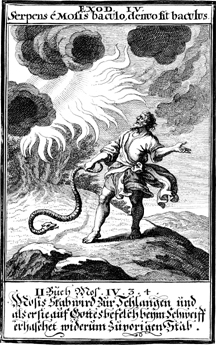
Courtesy Pitts Theology Library
We make a lot of excuses not to follow God's plan for our lives, and those excuses mean very little to God.

Moses answered, “What if they do not believe me or listen to me and say, ‘The LORD did not appear to you’?”   Then the LORD said to him, “What is that in your hand?”
   “A staff,” he replied.
  The LORD said, “Throw it on the ground.”
   Moses threw it on the ground and it became a snake, and he ran from it.  Exodus 4:1-3

I had to laugh a little bit when I read that text, and I'll tell you why.  God told Moses via the burning bush that He had decided to deliver His people from Egyptian bondage, and that Moses was to be the one to tell Pharaoh that this was going to happen.  Moses wasn't excited about this new assignment, so he tried to convince God that He should look elsewhere.  (You can find the entire conversation in Exodus 3 & 4.)  One by one Moses kept making excuses, and one by one God kept knocking them down.

  • Moses:  Who am I to go and say these things to Pharaoh?   
  • God:  You won't be alone.  I will be with you.
  • Moses:  What if the Israelites ask "What is this God's name?"   
  • God:  Tell them "I AM has sent me to you."
  • Moses:  What if they don't believe that You actually sent me?   
  • God:  Throw your staff on the ground, and it'll turn into a snake then back into a staff.  If that doesn't work, put your hand in your cloak and it will become leprous and then be healed.  And, if those two don't work, take some river water and pour it on the ground and it will become blood.
  • Moses:  You know, I've never been a good speaker.   
  • God:  Who made your mouth?  I will help you speak and teach you what to say.
  • Moses:  I still would feel better if you sent someone else.   
  • God:  Oh, alright!  Take your brother with you.  He's already on his way to meet you, and he will speak for you.

We may not be called like Moses to help deliver a nation from slavery, but we all could be doing more in regards to following God's plan for our lives.  God has already promised that He will be with us.  So stop making excuses, and do what He has asked you to do.

Sunday, July 11, 2010

Paul's Last Journey to Jerusalem

Those who work for God should not have any fear.

The title of this chapter indicates that most likely it's story comes from near the end of Paul's life because of his willingness to travel it would take a lot for something to be his last journey anywhere.  He had high hopes for the work there.
Paul greatly desired to reach Jerusalem before the Passover as he would thus have an opportunity to meet those who should come from all parts of the world to attend the feast. Ever he cherished the hope that in some way he might be instrumental in removing the prejudice of his unbelieving countrymen, so that they might be led to accept the precious light of the gospel. He also desired to meet the church at Jerusalem and bear to them the gifts sent by the Gentile churches to the poor brethren in Judea. And by this visit he hoped to bring about a firmer union between the Jewish and the Gentile converts to the faith. pg. 389
However, he soon found out that such hopes would be quite difficult to achieve.
 Having completed his work at Corinth, he determined to sail directly for one of the ports on the coast of Palestine. All the arrangements had been made, and he was about to step on board the ship, when he was told of a plot laid by the Jews to take his life. Ibid
Therefore, he decided to take his time in getting to Jerusalem, and made what turned out to be a farewell tour.

Upon reaching the city of Miletus, he discovered that he had some time before the next ship, and took the time to speak to the believers there. His message there is one all workers of Christ can apply to their lives.
"Wherefore I take you to record this day, that I am pure from the blood of all men. For I have not shunned to declare unto you all the counsel of God." No fear of giving offense, no desire for friendship or applause, could lead Paul to withhold the words that God had given him for their instruction, warning, or correction. From His servants today God requires fearlessness in preaching the word and in carrying out its precepts. The minister of Christ is not to present to the people only those truths that are the most pleasing, while he withholds others that might cause them pain. He should watch with deep solicitude the development of character. If he sees that any of his flock are cherishing sin he must as a faithful shepherd give them from God's word the instruction that is applicable to their case. Should he permit them in their self-confidence to go on unwarned, he would be held responsible for their souls. The pastor who fulfills his high commission must give his people faithful instruction on every point of the Christian faith, showing them what they must be and do in order to stand perfect in the day of God. He only who is a faithful teacher of the truth will at the close of his work be able to say with Paul, "I am pure from the blood of all men." pgs. 393, 394
All those who work for God, not only just pastors, should seek to give a complete message. Too many times, I hear about ministers who only give messages that people like to hear. Messages that promise prosperity and peace without any real sacrifice on their part. I am reminded of an interview from some years ago between a prominent preacher of this kind of gospel and Larry King. Note the following exchange.
OSTEEN: I have thoughts. I just, you know, I don't think that a same-sex marriage is the way God intended it to be. I don't think abortion is the best. I think there are other, you know, a better way to live your life. But I'm not going to condemn those people. I tell them all the time our church is open for everybody.

KING: You don't call them sinners?

OSTEEN: I don't.

KING: Is that a word you don't use?

OSTEEN: I don't use it. I never thought about it. But I probably don't. But most people already know what they're doing wrong. When I get them to church I want to tell them that you can change. There can be a difference in your life. So I don't go down the road of condemning.
 Paul, in contrast, did not mince words in regards to sin as anyone who even just skims his writings can discover. He wasn't afraid to call sin by it's right name, but always did it with love and the guidance of the Holy Spirit.

Paul wasn't afraid to point out sin, and he definitely wasn't afraid to suffer for the sake of the gospel. His friends sought to prevent him from going to Jerusalem, but to no avail.
"When we heard these things," Luke continues, "both we, and they of that place, besought him not to go up to Jerusalem." But Paul would not swerve from the path of duty. He would follow Christ if need be to prison and to death. "What mean ye to weep and to break mine heart?" he exclaimed; "for I am ready not to be bound only, but also to die at Jerusalem for the name of the Lord Jesus." Seeing that they caused him pain without changing his purpose, the brethren ceased their importunity, saying only, "The will of the Lord be done." pg. 397
Lord, help me to be as fearless in my Christian duty as Paul was.

Monday, July 5, 2010

Dealing with Bad News

Psalm 112:1 & 7  1 Praise the LORD. Blessed is the man who fears the LORD, who finds great delight in his commands. 7 He will have no fear of bad news; his heart is steadfast, trusting in the LORD.

If we fear God we will have nothing to fear.

Psalm 112 is another praise psalm. It is interesting to note that the original Hebrew for "praise the LORD" is more familiar to you than you think. The Hebrew words are "Hallelu Yah" so you know more Hebrew than you think you know.

Verse 7 jumped out at me because it deals with bad news. I don't know which is worse, hearing the bad news or the anticipation that precedes it. I remember a relatively recent experience in which I was told by someone that they had bad news for me. I don't know what was racing faster, my heart or mind as I wondered what that news would be. However, here the psalmist states that the one who fears the LORD will have no fear of bad news. I am reminded of a previous psalm regarding fear in which I posted that when I am afraid I can turn to Him.

In a world full of bad news it is comforting to know that we don't have to be afraid, we can simply trust in the LORD.

Thursday, May 6, 2010

What Can God Do for You?

Psalm 56:4 In God, whose word I praise, in God I trust; I will not be afraid. What can mortal man do to me?

Whenever I am afraid, it would be good to remember what God can do for me in comparison to what man cannot do to me.

David was once again in trouble.  (As a side note, I find it interesting that here David is fleeing for his life and in all sorts of situations, and is writing these songs.  Not something the average person would be doing.)  However, even in the midst of all these situations, he turned his eyes toward God. I guess that what it means to be a man after God's own heart.  I see that as a challenge to all men, and women.  What do we do when we are in trouble?

In this verse David asked a very important question, "What can mortal man do to me?"  It's somewhat of a rhetorical question because the answer is obviously, "Not a whole lot."  I like to break it down a little bit as to what man can do in comparison to what God can do.
  • Man can take away my money, but God owns "the cattle on a thousand hills".
  • Man can take away my freedom, but if I have the truth, it will set me free.
  • Man can take away my family, but if faithful, I will see them again.
  • Man can take away my life, but He is "the resurrection and the life".
Thank you Lord for being the One I can always turn to when I am afraid.

Tuesday, February 9, 2010

Educational . . . Advertising?

I have awakened from my blogging slumber (my last post was months ago) because I picked up something educational, while watching the Super Bowl of all things.  Well, I didn't learn anything from the game itself, but I did learn something from the advertisements, especially one in particular.

The ad I found interesting, that seemed to put an exclamation point on a general theme, was the one for the Dodge Charger entitled "Man's Last Stand" (look it up if you haven't seen it yet).  I did a simple web search for the ad and found out that a lot of other people have opinions about it, and many are not positive.  Most of the negativity came from women, but one man strongly implied that it was the most offensive ad overall.

Why all the negativity?  Was it because it talked about men who do what they are told, are tired of it, and because of what they go through, they should be able to drive a cool car, or was it because it spoke to something deeper.  I personally liked the ad, not simply because I like cool cars but also because it spoke in a non-cartoonish way to an undercurrent of discontent among men that I had been aware of for sometime.  A discontent largely fueled by, dare I say it, the emasculation of masculinity.  Christian author John Eldredge had this to say on this subject in his book "Wild at Heart".
"Society at large can't make up it's mind about men.  Having spent the last thirty years redefining masculinity into something more sensitive, safe, manageable and, well, feminine, it now berates men for not being men. . . .  'Where are all the real men?" is regular fare for talk shows and new books.  You asked them to be women, I want to say.  The result is a gender confusion never experienced at such a wide level in the history of the world.  How can a man know he is one when his highest aim is minding his manners?"
He continues by saying that this mindset is also seen in the church, a church that tells men that they don't keep their promises, be spiritual leaders, talk to their wives, or raise their children.  However, if they try really hard, they can be a nice guy, as if this was the ultimate goal.  Then, to support this assertion, he asks the reader to look around at most churches in America, and they will find out that the men there are bored. They don't want to be dutiful, nice guys who as the Charger ad states, "say yes, when you want me to say yes, and be quiet when you don't want me to say no".  They want to be something more, but aren't really sure how to achieve that goal.

At the risk of oversimplifying things, the problem lies in the concept that you have to be one extreme or the other.  You have to be either a sensitive guy who is more like a girlfriend, or some testosterone-fueled maniac.  The key is that a man (esp. a Christian one) can be somewhere in the middle.  Jesus was both sensitive enough that children would actually want to be with Him, but strong enough to stand up for those who are downtrodden, (and flip over a few tables in the process).  For those who say, "Yeah, but Jesus was also God." look no further than David, the man after God's own heart.  One who was sensitive enough to take care of sheep, (and write some really melancholy psalms), but also when it came to standing for his God and his country wasn't hesitant to hack off a man's (Goliath's) head with a giant sword in order to make sure that he was dead.

In a nation where men identify more with Homer Simpson than William Wallace, Chrysler cries out, "Be a man. Drive the car you really want to drive!" But God cries out, "Be a man. Follow after My own heart!"

The road to true manhood may be simple, but no one said the journey to get there would be easy.

Tuesday, April 7, 2009

Are We Playing it Too Safe?

I saw one of those eHarmony ads that seem to be everywhere these days, and it got me thinking. The ads give me the impression that if one uses their program that they will find the ideal mate simply because their screening process is so thorough. If one were to join the site they wouldn't have to worry about finding that special someone. They will be lining up to meet them, and it would be just a matter of time before you and your soul mate will be grinning and gushing on one of those ads.

It made me wonder. Are we playing it too safe? Are we so afraid of getting our hearts broken that we will spend hundreds of dollars (the site is expensive) to simply get introduced to someone via an elaborate, copyrighted program? I think that people spend so much energy looking for that perfect someone because they are too afraid to risk their hearts with a person that may seem less than ideal. People often don't realize that even with all that matching that there are still risks involved. They still have to open themselves up and run the risk of getting hurt.

Even sincere Christians can fall into that trap. They think that if they pray hard enough, and live a Christian life that the right person will simply fall into their laps. That one day they will hear a knock at the door, and the person who knocked will say, "Hi, how are you? I am the one God has chosen for you to spend the rest of your life with." True, prayer will help us make better decisions, but we still have to put our necks out there sometimes. We have to take a chance and open up to people that may not line up 100% with our criteria. Prayer doesn't eliminate pain. It simply helps us grow through our painful experiences.

I think that our fear of failure may be standing in the way of our personal growth. I look back at my relationships that didn't work out (or for that matter, never even got off the ground), and I know that I am a better person because of the lessons I learned from those failures.

I am not advocating that single people should just go out and get into relationships with people they know for certain that are wrong for them. I am writing this for those people that are in the "should I, or shouldn't I" stage. Go ahead, and take a risk. You might get hurt, but you could be a better person because of that experience. You could find the person you always wanted, and at least you won't have to go through life wondering, "What if . . ."

Thursday, February 19, 2009

Is It All In Our Heads?

I have all but given up watching the news on TV as of late because the usual bad news is worse than usual, but during the commercial break of my sitcom rerun I switched over out of curiosity. They were talking about the usual stuff: how bad the economy is, how low the stock market is, etc. etc. After they ran their story about how some guy was ranting about how he didn't want his money used to help stupid people keep their homes that they couldn't afford, the news anchor was talking with their financial reporter in the studio. He remarked how it was all the foreclosures that started this whole economic tailspin. What was said next is what really caught my attention.

He mentioned how that he and the reporter often talk about the economy and that he was surprised to find out how many people actually pay their mortgage on time. The reporter then replied with this figure, 92%. (That's right, all this "Mortgage Crisis" is about the 8% of Americans who got in over their head and bought a home they couldn't afford.) The reporter continued and said that this just goes to show how much of today's economy is based on what might happen in the future. Companies, the people who run them, and the consumers that support them, are basically afraid that next month, next quarter, etc. might be worse than the one before and they act accordingly. We basically become a self-fulfilling prophecy; the cause of our own problem. Now I know that this is somewhat of an over-simplification, but you have to admit that if people were a bit less fearful, a bit less stressed out, things could be a lot different. Maybe not on a national scale, but definitely on a personal one.