Showing posts with label history. Show all posts

Wednesday, October 12, 2016

[Book Review] Tortured for Christ by Richard Wurmbrand


Warning: Reading this book may cause a sudden increase in your desire to serve God.

As a Christian living in the United States I have grown accustomed to have certain things, namely freedom to say and do what I want in regards to religion. Tortured for Christ tells of a time and place where such a thing was a faint memory.

Originally published in 1967, Wurmbrand tells of his experience being a Christian pastor in both Nazi, and later Soviet-controlled Romania. (The last half of that sentence should be an indication that the word "tortured" was not put in the title simply to pique one's interest.) He wrote mainly of his experience under Communism, referencing the Nazis only briefly, stating that the blessing of the Nazi occupation was that it taught the believers that physical beatings can be endured. Knowledge that would sadly become useful when the Communists came into power. However, the Communists did not come into power as you might think.

Seduction and Standing Up


Wurmbrand stated that the Communists did not come the Romanian church with guns blazing, but rather as a man who seduces a female for a one night stand. Sadly, for the most part, it worked. He wrote of a congress that was convened in the Romanian Parliament building where four thousand ministers of all denomination were gathered. They then voted Joseph Stalin, who was at the time president of the World Movement of the Godless and mass murderer of Christians, honorary president of this gathering of religious leaders. One by one these so called men of God stated how that Communism and Christianity were basically the same and then pledged allegiance to the Communist government. He then wrote,
"My wife and I were present at this congress. Sabrina told me, 'Richard, stand up and wash away this shame from the face of Christ! They are spitting in His face.' I said to her, 'If I do so, you lose your husband,' She replied, 'I don't wish to have a coward as a husband.'"
That last sentence pretty much sums up the attitude of the Underground Church that sprung up around that time. Christians fearlessly spread the gospel, and joyfully went to prison and certain torture and death. He told many stories of the believers, but the one that touched me the most was the arrest of a young girl by the secret police. They followed her for some time and waited to arrest her on her wedding day in an attempt to cause the greatest amount of suffering possible. She went peacefully, and left the church kissing her shackles all the while rejoicing that she was the bride of Christ. How many of us would have had the same reaction?

Surprisingly, despite suffering unspeakable tortures at the hands of the Russians they bore no ill will to their captors, rather witnessing to them, winning many to Christ. Wurmbrand put it this way, when a crocodile kills a man, its tragic, but we do not blame the crocodile because it was simply following its nature. He stated that many of these soldiers were so brainwashed that they were little more than animals and should be treated with pity rather than contempt.

The Bottom Line


Wurmbrand's main purpose in writing this book was to highlight the suffering, as well as the fervor, of the Underground Church. He wanted to wake up Christians in free countries to the need of helping their persecuted brothers and sisters. I know it accomplished that goal with me, and I hope that it will do the same for you. The book is offered free of charge from the organization "The Voice of the Martyrs" so what are you waiting for? Go to their website and order it today.

Monday, April 6, 2015

Fighting the Bad Fight

Christianity's ongoing battle with atheism and secularism is not only misguided, but also not what God intended for His church.

I recently heard a story about the evangelist Billy Graham. What piqued my interest was how almost overnight he transitioned from relative unknown to household name. One day he showed up to the tent where he was holding a series of meetings and discovered a gaggle of news reporters who were eagerly writing down everything he said. When he inquired as to what caused all this interest, he discovered that he had caught the eye of media mogul William Randolph Hearst, and the rest, as we say, is history. Mr. Hearst never divulged the reason for his interest in Graham, but the historian who was telling the story stated that it had a lot to do with current world events, namely the rise of communism as a world power.

You see, the Soviet Union had successfully test fired a nuclear bomb, and Mao Zedong had recently taken over China. Communism now posed a real threat to the American way of life, or at least that is how many perceived it. Atheism being one of the main tenets of Communism, a key way to fight against it was a revival of religion in the United States. Hearst most likely saw in Graham a person who could spearhead such a revival. This revival that Graham participated in came about in a large part as a means to counteract the perceived encroachment of atheistic communism. Religion (i.e. the Judeo-Christian belief system) was essentially a weapon meant to ward off those who would seek to undermine American ideals.

The popularity of "this Christianity as a weapon" concept has in a large part caused the downfall of true Biblical Christianity because it has made the religion popular again on a grand scale. Christianity was never meant to be popular. The Roman emperor Constantine's supposed conversion did more damage than all the persecution up to that point because by making Christianity popular it brought in a sense of entitlement. This sense of entitlement causes adherents to the religion to do whatever it takes to preserve their popularity, including countless atrocities committed in the name of God, but more subtly it causes Christians to be on the continual lookout for battles to fight as a means of promoting the Christian brand.

One can hardly escape hearing about some ideological battle that Christians are fighting: creation vs. evolution, the "War on Christmas", abortion, gay marriage, the list goes on and on, all the while neglecting Jesus' words and example to the contrary. A prime example is His declaration to "be of good cheer, for I have overcome the world." That's right, Jesus said that He has overcome the world, meaning that we don't have to, so why do we insist on trying to accomplish such a feat?

When Jesus was on the earth, His focus was on relieving people from religious oppression, not secular oppression, so why do His professed followers focus so much on the secular aspect? The simple answer is that it is easier to look out than to look within. Personal attacks are much easier to accomplish than personal growth because growth requires sacrifice, and sacrifice is uncomfortable. Despite the fact that Jesus sacrificed not only His comfort, but also His very life, we would rather give up as little as possible and attack those who threaten our comfortable way of life.

You can probably see where I'm going here. For multiple reasons, the professed followers of Christ have decided to go against His teachings and as a result are trying to compensate for the church's shortcomings by attacking those outside of the church; the very ones Jesus told us we should be trying to reach.

Now is high time for Christians to stop fighting the bad fight of unbelief and start fighting the good fight of faith, and see what wonders God will work in our lives and in the lives of others.

Monday, January 19, 2015

Ich Bin Adolf?

Adolf as a Child, Courtesy: wikipedia.com
Genocidal dictators aren't born, they're created, and they started out being a lot like you and me.

I recently viewed a documentary on the beginning of World War II, which of course talked a great deal about Adolf Hitler, and a somewhat disturbing thought came to mind; Adolf was once a regular person. Curious as to whether the facts support this thought or not, I did a little research.

A Regular Person

According to the United States Holocaust Memorial Museum, Adolf was born into a middle-class Catholic family. He pursued a career as an artist despite his family's insistence that he join the army. After his parents died, he bounced around quite a bit, supporting himself with his art until eventually joining the army in World War I. Most importantly, up until the end of WWI, his racism was nothing extraordinary, keeping in line with much of the general public at that time.


A Single Step

At this point you may be asking yourself, "What does this have to do with me? I'm nothing like Hitler." Sure, almost nobody goes to bed a law-abiding, tolerant person, and then wakes up a hate-filled mass-murderer. It's a process that one goes through. As the saying goes, the journey of a thousand miles begins with a single step. Many times that single step is a step in the wrong direction.

Jesus stated in His famous Sermon on the Mount that thoughts have the same weight as actions because thoughts are that first step. One does not set out to murder without first nurturing hatred to a person or group of people. Young Adolf got caught up the wrong crowd that encouraged the negative parts of his character, and the rest, as they say, is history. Sadly, history has a way of repeating itself.

Swimming Against the Current

Even one with only a passing knowledge of current events can see that there is a lot of hatred going around. Aside from those atrocities that make the national and international news, people are being killed everyday simply because they are different. Beyond that, the world-wide web often becomes a forum for people to spew hate-filled diatribes against those who simply disagree with their views. With hatred such as this being so prevalent, it's easy to allow yourself to go with the flow. In order to not be changed by that hate, one must swim against the current of popular opinion, even when that popular opinion has seemingly good intentions.

No God Zones

In a must-read article on the British website the Telegraph, Cristina Odone voices her valid concern about the potential creation of "no God zones" in which no public religious display will be allowed because such display might provoke an attack. The discrimination would be for their own protection. She continues by pointing out those who have taken steps in the wrong direction.
Secularists once sought only a separation between Church and State; today they want to purge all signs of religion from all public space: the staff at Charlie Hebdo said they did not want to hear the bells of Notre Dame mourning their colleagues’ murders. Salman Rushdie weighed in, saying religion, as a "maedieval form of unreason", is the enemy.
Instead of simply religious extremists being the problem, religion itself becomes the problem, and it doesn't take much imagination to see where that mindset can take you.

The Right Path

Young Adolf took such a mindset to the next level and ended up being one of the most reviled people in history. He kept nurturing that hatred until it controlled him. There is no room for such hatred in the Christian, even in small amounts. So I challenge you to make the right choices, to choose the right path. Such a choice will be difficult, but remember this, you can do all things through Christ Who gives you strength.

Friday, April 18, 2014

[Educational Links] Easter

I have decided to add a new feature to this blog. Instead of writing a full post, I will simply share some links on a certain topic. Enjoy.


Wikipedia has a surprisingly thorough history of Easter and the many ways in which it is observed.

The Wilstar website has more information regarding the various egg-related traditions.

The History Channel website also has a good overview of Easter, and a fun video that among other things explores how rabbits became associated with the holiday.

Finally, the allrecipes website has a collection of Easter-related recipes of varying levels of healthiness.

Do you have any other Easter-related information that you would like to share? Go ahead and share it in the comments section.

Monday, April 14, 2014

Prosperous Followers of a Humble God

Courtesy hellemanworld.blogspot.com

Although still far from the ideal, when it comes to living simple lives, the leaders of the Roman Catholic Church and their Evangelical counterparts seem to be going in different directions.


An Early Contrast


A favorite story of mine from the Protestant Reformation talks about an anonymous painter who painted what could be considered an early form of a political cartoon. The painting made a comparison between the "Triumphal Entry" of Jesus and a papal procession. As many of you know the "Triumphal Entry" was the time when Jesus entered Jerusalem shortly before his crucifixion. At that time, Jesus rode in on a borrowed donkey wearing his relatively simple clothes while the people honored him by waving palm branches (from where we get the term "Palm Sunday"), and placing some of their clothes on the path in front of Him. Alongside this depiction, the painter showed a customary medieval papal procession with the many cardinals and bishops in their rich robes astride highly-adorned show horses surrounding the pope on a decorative cart wearing his tailor-made robe and golden triple-miter crown.

Papal Reforms


A lot has changed from those days when the papacy seemed quite content to show everyone how much riches and wealth it had acquired. With the installation of the newest pope, the papacy has taken a different tack in appealing to the masses. Much has been written regarding Pope Francis' aversion to pomp and extravagance, so I will not rehash the details other than to say he goes to great lengths to at least appear to be like one of us. The pope strives to apply this philosophy to all levels of Roman Catholic leadership, and led to the resignation of the infamous "Bishop of Bling", as well as an apology from an Atlanta, Georgia archbishop who built a $2.2 million Tudor-style mansion for himself. No such apologies will be coming from Evangelical leaders here in the United States. In fact, one would get quite the opposite response.

Proponents of Private Prosperity


In case you haven't already figured it out, I'm referring to proponent of the so called "Prosperity Gospel" or "Prosperity Theology". Wikipedia defines the belief in this way.
". . . a Christian religious doctrine that financial blessing is the will of God for Christians, and that faith, positive speech, and donations to Christian ministries will always increase one's material wealth. Based on non-traditional interpretations of the Bible, often with emphasis on the Book of Malachi, the doctrine views the Bible as a contract between God and humans: if humans have faith in God, he will deliver his promises of security and prosperity. Confessing these promises to be true is perceived as an act of faith, which God will honor."
What makes this even more interesting is that many of the major organizations that promote such theology are registered in the United States as a "church" which not only gives them tax-free status, but also frees them from any legal obligation to disclose how they use money that they receive. (This is compared to being registered as a "religious organization" which still allows them to be tax-free, but they would have to file an IRS Form 990 to disclose their financial information.) Some Christians went even further and formed the Evangelical Council for Financial Accountability (EFCA). Accreditation with the EFCA gives a church or non-profit an opportunity to be even more transparent because members are listed on its website. (In case you are wondering which organizations do what, you can view a list of the thirty leading religious broadcasters here.) Sadly the majority of these "churches" shun transparency which leaves many wondering what they have to hide, and which God they truly follow.

A Much Different Picture


More importantly, which God do we follow? The humble itinerant preacher who had no place to call home, or the God who supposedly states that we should get as much wealth on earth as we possibly can? Although we may shake our heads in disbelief at these examples of extravagance, do we secretly wish that we had more money and possessions? Do we strive to be comfortable or seek to sacrifice? If a painter were to paint a picture of our life in comparison to the lives of the majority of today's society, how would we compare?

Wednesday, August 21, 2013

Unfinished Business

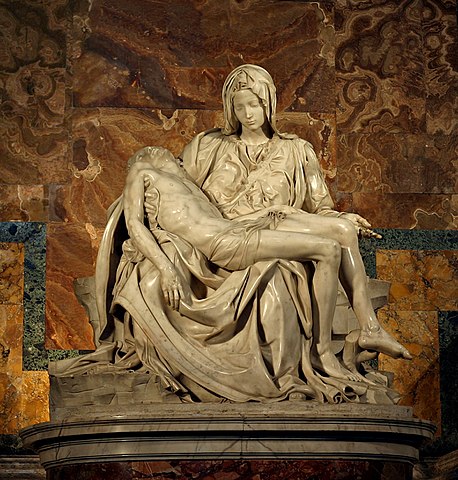
Courtesy wikipedia.com
There is nothing wrong with leaving a task unfinished.

This post continues along a similar theme as my last one in which I paused to consider accomplishing small tasks in favor of large ones.  Today I'm taking it one step further in asking you to consider accomplishing no task.  That's right, I'm talking about giving up.

A long time ago, I came across a book about Michelangelo.  My favorite sculpture has to be the one picture above in which Mary cradles a recently crucified Jesus on her lap.  I marveled at how the folds and wrinkles in the fabric looked like actual folds and wrinkles in fabric and not in marble.  Then further along in the book I discovered something else altogether.  A collection of photographs of his many unfinished sculptures.  Yes, even someone as talented as Michelangelo gave up on a project once in awhile.

Michelangelo could have thought about all the time that he put into those sculptures, and finished them in order not to let that time go to waste, but he did not think that way.  The sculptures didn't go the way he wanted so he gave up on them and moved on to something else.  We can get a lot more accomplished if we follow a similar route.  Don't get me wrong, I'm not talking about giving up every time a project gets challenging.  However, I'm sure if we took a long, honest look at the projects we currently have on our "Unfinished Business" list, some of them could be erased with no real loss to our quality of life.

Let's face facts.  We only have a finite amount of time and ability to accomplish what we want/need to accomplish.  By giving up on some of the unfinished business in our lives it makes space to focus on other tasks and relationships.  The most important of these of course being our relationship with God.  We can rest from our unfinished business knowing that He always finishes what He starts, and what He finishes are always masterpieces.

Friday, June 22, 2012

[Featured Post] The Price of Prejudice


Courtesy news.adventist.org
Many of us are a bit too young to remember when the Chamberlain case became worldwide news, but it serves as an illustration of the depths to which people can sink.

"You baby killer!" yelled the schoolboys at Julie as she walked to her Adventist School in Strathfeild in 1980. She ignored the taunts as she'd done every day since the Chamberlain case broke sensationally in the tabloids. But this time, as she walked, a half-full can of Fanta hurled by her head as the boys cheered.

Julie wasn't alone. Many Australian Adventists of the period have stories of harassment, from prank phone calls to public abuse. The hatred that underpinned the anti-Adventist bigotry was more than uncomfortable; it likely influenced the decision to prosecute the Chamberlains and the subsequent miscarriage of justice.

As we go through the process of healing the scars from that period, it's incumbent on us to evaluate carefully what we've learned about our national vulnerabilities in the process, as well as what we still need to learn.

What is particularly surprising about the anti-Adventist bigotry of the period is that it happened at all. Australia is, after all, one of the most diverse and tolerant societies in the world. We look at attacks on minorities around the world and shake our heads. The brutality, the tribalism, the ignorance and the scapegoating that undergirds the hatred spewed at minorities from 1930s Europe to modern-day Iran seems entirely remote and foreign to us. And if you had to pick an innocuous faith community, it would have to be the vegetarian, noncombatant, healthcare providing, granola-making and education-cherishing Adventists who had a century's worth of contributing to Australian society by the time the Chamberlain case broke.

If anyone could be safe anywhere, it would have to be a peaceful faith community with a long history and deep roots in a tolerant and progressive society.

And yet in our society, in our lifetimes, the tabloid press used the most debased and defamatory claims to whip up intense hatred of Adventist Christians. And this let lose the inner demons of many Australians. When Lindy Chamberlain was sentenced to a lifetime of hard labor three decades ago, it's reported that cheers were heard from pubs all over Darwin. It's chilling. But it happened. That is the result of hate filled propaganda mixed with a mob mentality, even in an enlightened society in modern times.

Wendy Harmer, the prominent comedian, graciously apologized on Tuesday for her role in promoting bigotry, noting that "such was the firestorm of hatred, all rationality was lost."

The most profound lesson we can learn from the Chamberlain case has nothing to do with dingoes or even the flaws in our justice system. The most profound lesson is something that we've learned about ourselves: we now know we can be turned into lynch mobs as easily as any other society at any other time.

So let's stand guard of ourselves. Because if there's one thing we can know with certainty, there will be another firestorm of hatred against another Australian community sooner or later. And unless we have the character and the courage to stand up against it, the results will once again be terrifying.
Next time around, as a Seventh-day Adventist Christian, I want to be there standing arm in arm with whoever is targeted, defending them, and in the process, defending what is best in our ideals and our national character.

--James Standish is the Communication director for the Adventist Church's South Pacific Division, based in Wahroonga, near Sydney. He previously served as secretary of the United Nations NGO Committee on Freedom of Religion and received an award from the American Sikh community for defending civil rights in the wake of 9/11.

Read the news story here.

Tuesday, June 12, 2012

[Book Review] Man's Search for Meaning by Viktor E. Frankl

Courtesy bn.com
Every so often I read a book that really gets me thinking.  Man's Search for Meaning is one of those books.

For my birthday I received a gift card for a book store (yes, they still exist) and as I was perusing their website I discovered Man's Search for Meaning by Viktor E. Frankl.  The paperback version was quite affordable, so I ordered it along with some other books so that I would not have money left over on my card.  My wife, daughter and I recently went on a trip that involved a lot of flying, so I brought it along with some other books so that I could make good use of my time.  I ended up completing the entire book on that trip and highly recommend it.

Frankl, a Jewish psychiatrist who survived the concentration camps of WWII, describes in the first part of the book what goes through the head of those who found themselves on the wrong side of Hitler's final solution.  His personal involvement and active mind gives the reader a unique perspective of what happened on the inside.  He didn't seek to shock people with stories of brutality and violence, but rather showed how that one can maintain their humanity in such a dehumanizing situation.

The second part of the book dealt with his method of psychotherapy called logotherapy.  Merriam-Webster defines logotherapy in this way.
"a highly directive existential psychotherapy that emphasizes the importance of meaning in the patient's life especially as gained through spiritual values"
In contrast to the Freudian method which places most of the emphasis on what has happened in the past affects your present choices, Frankl focuses primarily on how one's present choices affect what happens in the future.  When reading this part I would recommend taking frequent breaks, or at least not reading it when you are tired (like I did) because some aspects of his therapy take some effort to process.

I would recommend this to anyone, especially to history buffs who want more than simply names and dates, and to those dealing with difficult situations.

Wednesday, November 2, 2011

Building a Better Protest

Courtesy personal.kent.edu/~bsmith30/TheSixties/
Want your protest to turn into a movement that truly changes the world?  Start by looking at one that accomplished such a feat.

Many public protests have come and gone.  Some have had a temporary change on society while others have simply faded into obscurity.  Then there are those that have made such a widespread impact that we cannot picture a world in which they did not occur.  It is one such protest/movement that we will look at in this post, and we will also glean some tips on how to increase the impact of whatever one you decide to join or start. The movement I have in mind is none other than the Protestant Reformation, and here's how it made such a difference.


Empowered the Powerless

Back in the day, for much of the Christianized world, the Roman Catholic Church was the only show in town.  It had a religious monopoly that was established at the expense of the common person.  No doubt many people felt the weight of this oppression, but felt powerless to do anything about it.  The Reformation built on this frustration and gave those feeling powerless a voice. A frustration that had been in existence for some time before Martin Luther came on the scene.

Didn't Reinvent the Wheel

Many people most likely believe that the Protestant Reformation originated with Luther and the 95 Theses (which he posted 494 years and two days ago).  While events definitely progressed more rapidly as a result of Luther's words and actions, his objections to the Roman Catholic Church's abuse of power echoed those of  John Huss, who echoed John Wycliffe's views.  Both of whom lived almost 200 years before the German monk.  Luther's original course of action differed from many modern movements in that he didn't intend to discuss his views with the general public.

Started at the Top

Although Luther posted his famous theses in a public place, he wrote them in Latin, a language not widely spoken or understood outside of educational and religious institutions.  He wanted to debate with those in power, those who could facilitate lasting change, not with his fellow Germans, who could do relatively little.  When I state "fellow Germans" I mean that loosely because Luther was in actuality part of the system that he deemed to be corrupt.

Worked from the Inside Out

Luther understood, either cognitively or intuitively, that reforms are often best facilitated by those inside of the institution.  His radical views eventually led to his departure, but that shouldn't negate the fact that he originally intended to reform the system as an insider.  He saw himself as someone who could rebuild from the inside rather than demolish from the outside.  The promulgation of these suggested reforms was greatly enhanced by a new technology at the time; the printing press.

Used Technology to His Advantage


The advent of the printing press made it much easier to disperse Luther's and his allies' views.  The 95 Theses, being translated into German a few months after their posting, made their way into the hands and minds of the common people.  Their once unspoken concerns became spoken, and many were emboldened by the fact that someone was actually standing up to such a powerful organization.

Dynamic Leadership

The Reformation would have never gained any ground if Luther had caved under the immense pressure from the religious hierarchy.  The people needed a dynamic spokesperson, and they got one in Martin Luther.

A Perfect Storm

Centuries of frustration coupled with a dynamic leader and new technology changed an entire religion for the better.  Therefore if you want a better future for the world, or at least your part of it, take some tips from the past.  You'll never know what can be accomplished unless you try.

Tuesday, September 20, 2011

Going Nowhere Fast

Image: siraphat / FreeDigitalPhotos.net

 A lesson I have learned about time from using a GPS unit has spiritual as well as practical applications.

Someone once said that speed is the only truly modern sensation, and you don't have to look far to verify that statement.  The more modern a civilization, the faster we want to get places.  That's why we have made speed boats, high-speed trains, and supersonic jetliners.  Then, of course, let's not forget the automobile.

The first true automobile (a vehicle that could travel with passengers using its own power) was a steam-powered tricycle that traveled 2.25 miles (3.6 km) per hour.  Now we have modern production cars such as the Bugatti Veyron SS with a top speed of  267 mph (430 km/h).  Even the more recent emphasis on fuel economy has not deterred automakers from building electric race cars and hybrid supercars.  Even though we may not own such a speedy means of transportation, we often drive as though we do.  However, what do we actually accomplish when we go fast?  According to my experience with a GPS device, not much

The Illusion of Speed

For those of you unfamiliar with GPS (or Global Positioning System), GPS units receive signals from multiple satellites circling the planet then use some fancy math to determine the location and speed of the receiver.  A key element in automotive GPS units is the Arrival Time feature.  This feature uses information on the speed limits of the roads that you will travel to get from Point A to Point B, and gives a time when you will arrive at your final destination.  This time can be earlier or later depending on how fast or how slow you travel.  I discovered that in the only reliable way to make the arrival time earlier is to leave earlier, going faster makes little or no positive difference. 

Sure by going 10 or even 20 mph(km/h) faster you may gain a couple of minutes on your arrival time, but that gain quickly evaporates at the first red light, fuel stop, or encounter with law enforcement.  Aside from the potential criminal penalties, going faster burns more fuel and therefore increases the amount of money that literally goes up in flames (and you don't avoid that if you drive an all-electric car given this nation's penchant for using coal-burning power plants).  So by driving fast you feel as though you are accomplishing something, but that accomplishment is an illusion.  This principle translates well into the area of spirituality, but then the losses are much more serious.

Spiritual Speedsters

People, especially devout Christians, can be fooled into thinking that they need to make rapid spiritual progress in order to be a successful believer, but that couldn't be further from the truth.  The Bible often speaks about endurance and patience being positive traits.  The apostle John in the book of Revelation goes so far as to combine the two traits into the term "patient endurance"  In Jesus' parable of the sower, the seed that sprouted up quickly ends up dying off quickly representing believers who cannot endure persecution.


Rapid spiritual growth feels good.  We feel as though we are getting somewhere, that we are not being left behind.  However, like speeding in a car, it's an illusion.  This growth comes at a price.  We become unable to deal with unexpected troubles, and probably even more dangerous, we take the risk of becoming spiritually proud.  We tend to look down upon those who have not been growing so quickly, and we add condemnation to our superficial spirituality.  Our lives can quickly spiral out of control and if we come to our senses, it is only because we have hit rock bottom.

So do us all a favor and slow down.  Trust me, you will be glad that you did.


Have you had times that you paid the price for going too fast?  Tell us your story.

Sunday, August 14, 2011

Featured Post: Corporate Identity and God's Blessing

This featured post comes from Ted N. C. Wilson, president of the Seventh-day Adventist world church via the Adventist News Network.

Commentary: Corporate identity and God's blessing

Church membership and leadership must unite to receive latter rain
Luke tells us twice that the disciples were of one accord as they prepared for the outpouring of the early rain (Acts 1:14; 2:1). The fact that he would mention it twice suggests that unity within the church is a very important step in preparation for the outpouring of the Holy Spirit. There is an aspect to unity presented throughout Scripture that is seldom recognized or addressed in our church -- the role of corporate identity.

First of all, look at an example of corporate identification and then at two aspects of this phenomenon, which are crucial in the preparation for the latter rain:

First, the example: God made it absolutely clear that the Israelites were not to take any spoils for themselves in Jericho's fall and that the silver, gold, and the bronze and iron vessels were consecrated to the Lord (Joshua 6:18, 19). But Achan stole 200 shekels of silver, a wedge of gold and a Babylonian garment (Joshua 7:21). God's anger burned against Israel, and in the next military engagement, Israel lost 36 men and suffered a shameful defeat. When Joshua cried out, "Why, Lord?" the answer was short and to the point: "Israel has sinned" (Joshua 7:11). The whole nation suffered and men lost their lives because one Israelite disobeyed -- corporate identity.

Now, two illustrations that impact directly upon our plea for the latter rain:

First, when the 12 spies returned to give their report about the promised land, Caleb and Joshua were positive and said, "Let us go up at once and take possession, for we are well able to overcome it" (Number 13:30). However, the 10 spies said they could not take the land because there were giants in it and they felt like grasshoppers. The nation believed the 10 and turned against their leaders who were positive that God would fulfill His promise and give the land to them. God's response? Back into the wilderness for 40 years. Moses, Aaron, Caleb, Joshua, and those who supported them had to return to the wilderness because of those who refused to believe God's Word -- corporate identity.

The second illustration takes us to the time of Jesus. Now the roles are reversed. The common people of Israel were flocking to see and hear Jesus. They were bringing their sick to be healed. There was a growing belief among them that Jesus was the promised Messiah but not so among the leaders. They were jealous of Him and plotted His death. During His trial, Pilate asked, "Shall I crucify your King?" The chief priests responded, "We have no king but Caesar" (John 19:15).

Concerning the priests' attitude, Ellen White says, "Thus by choosing a heathen ruler, the Jewish nation had withdrawn from the theocracy. They had rejected God as their king. Henceforth, they had no deliverer. They had no king but Caesar. To this the priests and teachers had led the people. For this, with the fearful results that followed, they were responsible. A nation's sin and a nation's ruin were due to the religious leaders" (DA, pp. 737-738) -- corporate identity.

In the first illustration the leaders suffered because of the rebellion of the people. In the second illustration the people suffered because of the rebellion of the leaders. God deals with us individually when it comes to our own salvation. But God deals with His people as a corporate group when it comes to carrying out His instructions for the advancement of His work.

What is the lesson to be learned?

God deals with His church today as a corporate body. If we are to receive the latter rain power of the Holy Spirit today, the body and the leadership must be on the same page. God has been ready for years to give His people the latter rain. He has been waiting for us to get ourselves together. If we would only press together in seeking the promised power, pray for each other and stand united, shoulder to shoulder, the power would be given, the work would be finished quickly and we would enter the kingdom soon. It will happen and the glory will be given to God alone.

Tuesday, July 12, 2011

Hoping but Not Receiving

One of the reasons we don't receive God's power in our lives is that we are looking for the wrong kind.

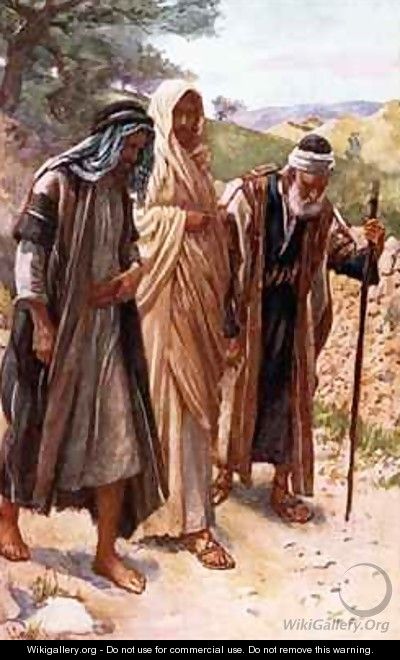
The chief priests and our rulers handed him over to be sentenced to death, and they crucified him; but we had hoped that he was the one who was going to redeem Israel.  Luke 24:20-21a

This statement comes from the conversation between Jesus and the two disciples on the road to Emmaus (read it in its entirety here).  People often overlook this part of the conversation in a rush to focus on other aspects of the story like "the good part" where Jesus reveals His identity and everyone gets all excited.  However, we do the story a disservice by neglecting the hoping part because therein lies the reason for the "downcast" faces, and, in a way, the reason they were so excited after the reveal.  They misunderstood the reality of Jesus' mission, but why?

These disciples, along with most of the Jewish people at that time, which, sadly, included the twelve, thought that the Messiah was to come and deliver the nation of Israel from Roman bondage so that they could have the easy life like back in the good old days of David and Solomon.  Despite Jesus' many statements regarding the true nature of "the kingdom of heaven", and His refusal to be crowned as an earthly king, they couldn't rid themselves of the idea that He "was going to redeem Israel", and set up an earthly kingdom.  Sadly, that concept, and ones similar to it, still hold sway among many of the current professed followers of Christ.

One modern departure from Jesus' true mission on earth exists in "prosperity theology" which promotes the belief  that all one needs to do to receive anything is "name it and claim it".  Adherents to this belief system use texts from the Bible as a means to receive anything from good health to a new house.  Interesting thoughts coming from professed followers of one who was essentially homeless, and spoke of riches as a hindrance to entering God's kingdom after telling a rich man to sell all of his possessions.

A more subtle, and therefore more dangerous, variation on this theme also exists.  That being the concept that the life of a Christian should be for the most part, free from problems and sacrifice.  This view continues despite statements from Jesus to the contrary like the one found in Luke 9:23-24 which states that His true followers "must take up their cross daily."  Apparently many of his followers today suffer from the same tendency towards selective hearing as did His disciples back then.  I say this because prior to making that statement, He told His disciples, "The Son of Man must suffer many things and be rejected by the elders, the chief priests and the teachers of the law, and he must be killed and on the third day be raised to life." (v. 22)  It doesn't get much plainer than that, yet not long after hearing that statement, we find the two disciples walking to Emmaus all downcast and such, saying "The chief priests and our rulers handed him over to be sentenced to death, and they crucified him; but we had hoped . . ."

In short, we don't receive God power in our lives because we look for His power to eliminate our problems (something He never said He would do) instead of to help us through them (something He often said He would do).

So if you start sensing the lack of God's power in your life, you should stop and ask yourself, "Am I looking for the right kind?"

Monday, June 13, 2011

Of Temples and Churches

Picture courtesy thejewishmuseum.org
Does the temple of ancient Judaism provide a pattern to be followed by modern Christianity?

My recent reading of my daily Bible reading plan has brought me to the part of the Bible that depicts the provisions for, and the building of, Solomon's temple (which can be found in 1 Kings 5-8).  Reading this account got me thinking again about the concept of how to build places of worship.  For a long while I have often thought about awe-inspiring places of worship only in the context of medieval cathedrals, but as I am writing this, thoughts of other buildings come to mind:  places such as Angkor Wat in Cambodia, the Parthenon in Greece, or the Dome of the Rock in Israel.  Regardless of who built them, and for what deity (or deities) they were built, they all have something in common, they all sought to give humanity a taste of the divine.

Solomon's temple certainly sought to inspire those who entered with the greatness of God.  The elements that struck me was the pair of golden angel statues in the Most Holy Place of the temple.  These statues were about 15 ft (4.5 m) tall, and each had a wingspan which was also 15 ft.  To give it some perspective, that is the same width of the average two-car garage in the U.S.  Now picture these statues standing side-by-side as you enter the room with a ceiling approximately 30 ft. (9 m) tall, and be sure to note that these angels were overlaid with gold.  Gold and bronze were used extensively throughout the temple complex, as well as polished stone and various types of wood.

Now how does one translate such impressive display to modern Christianity?  Now I am not advocating that Christians should model their churches after such a pattern.  By doing so, we could set up an obstacle between  people and God.  Those who are not Christians could see us as trying to show off in a world that so many people are struggling simply to survive, or as in the case of ancient Israel, the believers could become so focused on the structure as to lose sight for Whom it was built to honor.  In the same way, we should not go so far the other way so that our churches would be shabbily constructed that people would wonder if it would be safer to worship outside.  Hence the tension that is Christianity.

In a more figurative sense, the Bible states that believers are "temples of the Holy Spirit" (1 Corinthians 6:19).  We then have to stop and think, "What kind of temple am I?  Am I one that seeks to draw attention to myself rather than God?  Am I so 'shabbily constructed' in the way I act and talk that people wonder if it would be better to leave me alone?"  The only true solution to these questions is the Lord Himself.  As Solomon himself wrote in Psalm 127, "Unless the LORD builds the house, the builders labor in vain."

Monday, May 9, 2011

The Good Old Days?

In these days in which people's rights seem up for grabs there is a tendency to wish we could go back to the good old days when people had more freedom to live as they chose to live.  However, upon further research I have discovered that people's freedoms have been eroding away for quite some time.

Some time ago I picked up a book at a Christian book store entitled The Rights of the People, a book on the subject of religious liberty written in the late nineteenth century and reprinted in 1998.  As I have been making my way through it I have been impressed by the depth of thought of it's author, Alonzo T. Jones.

The most recent chapter I have read is entitled "Religious Right Invaded" in which Jones explains how despite the tireless efforts of the founders of this country to separate religion from government (which he maps out in the previous chapter) that in such areas the nation has gone backwards.  He went so far to state that there has been "a counter-revolution".  He stated that this counter-revolution was accomplished and consummated in a U.S. Supreme Court decision from February 29, 1892 (for full text of the decision go here).

As is often the case (no pun intended), this decision came into being as a result of a challenge to an existing law.  In 1887 Congress passed a law that forbade any alien to come to the U.S. under contract to perform any kind of labor.  The reason for this law was that many corporations were going to Europe and finding people to come here and work.  The company would pay their way, and because of this they required the laborers to work for next to nothing.  This was depreciating the amount Americans could get paid for their labor, so Congress passed a  law stating
"Be it enacted by the Senate and House of Representatives of the United States of America in Congress assembled, that from and after the passage of this act it shall be unlawful for any person, company, partnership, or corporation, in any manner whatsoever, to prepay the transportation, or in any way assist or encourage the importation or migration, of any alien or aliens, any foreigner or foreigners, into the United States, its territories, or the District of Columbia under contract or agreement, parol or special, express or implied, made previous to the importation or migration of such alien or aliens, foreigner or foreigners, to perform labor or service of any kind in the United States, its territories, or the District of Columbia."
A problem arose when Trinity Church Corporation employed a preacher in England to come to the States and preach for them.  This act was seen as a violation of the aforementioned law and the U.S District Attorney prosecuted the church.  The U.S. Circuit Court decided that the church was guilty.  Naturally, there was an appeal taken to the Supreme Court.  The Supreme Court reversed the decision on the grounds that the term "laborer" or "laborer or service" was intended to refer to manual labor, not a professional service.  All the Supreme Court had to do was reverse the decision on those grounds, but they went above and beyond what was necessary, and that is where all the troubles began.

The Supreme Court stated, "But, beyond all these matters, no purpose of action against religion can be imputed to any legislation, state or national, because this is a religious people. This is historically true."  Having made such a statement they then had to back it up, and by so doing started down a very slippery slope.  For not only were the people of this nation "religious", but they were also "Christian".  Jones stated in a somewhat satirical tone that the people therefore are now all Christians regardless of whether  they were Jews or non-believers because the highest court in the land declared them so.  He then states that the very absurdity of the suggestion only demonstrates that the court should have nothing to do with such manners.  He continues by stating that people are not made religious by law, judicial decision, nor historical precedent, which brings us to the historical "support" the Supreme Court gave to show that the people of the U.S. are indeed a religious people.

Jones stated that the historical reasons given are at best suspect and at worst complete misinterpretations of the original statements.  The first historical reasons given were from European nations (i.e. Spain and England). Jones points out that the Spanish rulers (Ferdinand & Isabella) who commissioned Columbus were in fact the same rulers who established the Spanish Inquisition.  To say that the language of these rulers has the same meaning as the U.S. Constitution takes quite a bit of stretching of the imagination.  The statements regarding the British monarchy would have quite a bit more weight if in fact the U.S. was still under British rule, but it most definitely is not subject to British sovereignty.

There are many other historical reasons given, and Jones takes time to refute them all, but this is beyond the scope of this post.  I will however touch on the reason for which Jones saves his strongest language, the ruling declares that the United States Constitution reaffirms the thought that this nation is a religious nation.  To this Jones states, "To say it is absurd is not enough, it is simply preposterous."  He goes on to write that there is another consideration that magnifies that one, namely the fact that the court leaves out Thomas Jefferson, James Madison, and George Washington from the place where they rightly belong, and drags "Ferdinand, Isabella and Elizabeth into the place where they do not and cannot by any shadow of right belong[.]"

There is much more but Jones sums the entire ruling in this way.
"The United States . . . was turned from the 'new order of things' to which it was committed by our revolutionary fathers, and to which it stands pledged by the great seal of the government itself, and was thrown into the evil tide of the old order of things.   And thus this enlightened nation, the example and glory of the world, was caused to assume the place and the prerogatives of the governments of the Middle Ages in embodying in law the dogmas and definitions of the theologians, and executing the arbitrary and despotic will of the church."
So while it is nice to wistfully look back at times gone by and wish that things were like they used to be, it is important to realize that even in the good old days the situation was not as rosy as we thought it was.

Monday, February 14, 2011

The Ultimate Valentine

"But my God shall supply all your need according to his riches in glory by Christ Jesus." Philippians 4:19 KJV

As of last night and especially this morning I had a desire to write something about Valentine's Day.  I didn't know exactly what to write until just a few moments ago.  If you only remember one thing from this post, I want it to be the fact that Jesus Christ is the Ultimate Valentine for you.

As is often the case, when a holiday comes around I like to look at its history.  So yesterday I went to the good people over at The History Channel to see what they had to say.  Here is what they said.


I won't go repeat much of what you just saw except the line at the end which states that even though you may not be able to purchase the gift that you want to give, the poets were right.  Love is really all you need.  It is the Ultimate Love that I want you to have.

Too much of this day is focused on the things of this earth:  gifts, cards, flowers, etc.  These things are all well and good, if done responsibly, and especially if you have someone to give these things to or receive them from.  For many people this day is a day of loneliness, a day of frustration, a day of despair.  If you are one of these people, and even if you are not, the Ultimate Valentine is for you.

The Ultimate Valentine is, naturally, Jesus Christ.  According to the Bible verse written above God will supply all your need according to His riches in glory.  Jesus Christ is the instrument in which God supplies all our need.

The Valentine gifts we receive and give are but tokens of our love and affection, but the gift God gave in the person of Jesus Christ was not merely a representation of His love, it was His love for us.  So if you are in need of something or someone this Valentine's Day look no further than the One Who emptied heaven itself so that we could have all the things that He has, and (most importantly) someday soon be where He is as well.

Monday, January 17, 2011

Something New, A Book Review (Roger Crowley's "1453")

I've decided to add a regular feature to this blog, and if you read the rhyming portion of the title, you've figured out what the feature is going to be.

A little over a month ago I stopped by a local bookstore in search of a book.  I was finally finishing up a book I was reading on the Spartans.  I say "finally" because it took me about 3 years to finish it (I had used the receipt as a bookmark).  I decided to search for another history book, but there were so many history books I had to narrow my search somewhat.  I wanted to read about something I had no significant knowledge about, which meant that U.S. history was out, and that narrowed my search quite a bit.  To make a long story short, I decided to purchase Roger Crowley's book 1453.  Needless to say, I was not disappointed.

One of the signs of a good story teller is the ability to to keep the listener/reader engaged in the story even when they already know how the story is going to end. One of the reviews on the back of the book said that the book "reads more like lively fiction" and that is definitely the case.  I read the book primarily at night, and I often had to force myself to put it down and go to sleep, which may not sound too unusual, but you have to remember that this is a history book.

So if you like reading, but find yourself a bit reluctant to pick up a history book that is not a novel.  Go to your local bookstore or follow the above link and pick up 1453.  I'm pretty sure that you will not be disappointed.

Tuesday, June 29, 2010

Learning From the Past

Psalm 106:6 We have sinned, even as our fathers did; we have done wrong and acted wickedly.


Those who fail to learn from the mistakes of others are destined to repeat them. That saying, in various forms has stuck in my mind for quite some time. So long, that I don't even remember the first time I heard it. However, that phrase could easily be the theme of Psalm 106. Like the previous psalm, this one gives some history of the Jewish people, but unlike Psalm 105, it focuses on the people's rebellion rather than on God's providence.

We, as human beings are prone to forget, and because of that forgetfulness we are also prone to wander from Him and His leading. As I was thinking about this concept the song "Prone to Wander" by Chris Rice came to mind. Some of the lyrics are as follows.
How can I be so prone to wander
So prone to leave You
So prone to die
And how can You be so full of mercy
You race to meet me and bring be back to life
As I was searching for those lyrics, I found the lyrics from a more familiar song which go:
O to grace how great a debtor daily I'm constrained to be!
Let Thy goodness like a fetter, bind my wandering heart to Thee
Prone to wander Lord I feel it, prone to leave the God I love
Here's my heart Lord, take and seal it, seal it for Thy courts above
I don't like wandering because I usually wander to places I should not be. If you feel the same way, the best way to keep from wandering is to learn from past mistakes; those of others, and those of ourselves.

Monday, June 28, 2010

Remember the Wonders

Psalm 105:5-6  5 Remember the wonders he has done, his miracles, and the judgments he pronounced, 6 O descendants of Abraham his servant, O sons of Jacob, his chosen ones.


Once again, the psalmist reminds us to remember.

As much as Psalm 104 was a natural psalm, Psalm 105 is a historical psalm. In this psalm, as in a previous psalm, the author uses history as a teaching tool. In this psalm, he retells some major historical points in Israel's history. He begins with Abraham and end with God's provision for His people in the wilderness following the exodus from Egypt.

The concept of retelling historical events resonates with me because I am somewhat of a history buff (one of my favorite channels is the History Channel), but this psalm is retelling history for a purpose other than just remembering facts. People tend to forget where they come from especially in regards to God's leading in their lives, and that is a tendency that needs to be broken. Along those lines, Ellen White wrote
"We have nothing to fear for the future, except as we shall forget the way the Lord has led us, and His teaching in our past history." --Life Sketches of Ellen G. White, p. 196 (1902).
However, as we remember how God has led us in the past, we need to avoid the temptation to become nostalgic. John Eldredge had this thought on the matter,
"The most unredemptive kind of remembering is what many people call 'nostalgia.' How sad to visit elderly friends and relatives to find them sitting around listlessly, pining for 'the good old days.' They have no life in the present and little vision for the future, because they are locked in the past." --The Sacred Romance: Drawing Closer to the Heart of God, p. 207 (1997).
So as we take the time to remember our history, let us keep in mind that it is a place of reference, not a place of residence.

Friday, June 18, 2010

Acknowledge Him

Psalm 95  1 Come, let us sing for joy to the LORD; let us shout aloud to the Rock of our salvation. 2 Let us come before him with thanksgiving and extol him with music and song. 3 For the LORD is the great God, the great King above all gods. 4 In his hand are the depths of the earth, and the mountain peaks belong to him. 5 The sea is his, for he made it, and his hands formed the dry land. 6 Come, let us bow down in worship, let us kneel before the LORD our Maker; 7 for he is our God and we are the people of his pasture, the flock under his care. Today, if you hear his voice, 8 do not harden your hearts as you did at Meribah, as you did that day at Massah in the desert, 9 where your fathers tested and tried me, though they had seen what I did. 10 For forty years I was angry with that generation; I said, "They are a people whose hearts go astray, and they have not known my ways." 11 So I declared on oath in my anger, "They shall never enter my rest."

In order to worship God we must first acknowledge, or, in many cases, remember who He is.

The act of worship is a powerful thing. It shows that the object of our worship is greater than us. When we get too full of ourselves, than our worship suffers. The psalmist here is reminding the reader/hearer exactly who God is. He is the greatest of all gods; the One who created and controls the natural world. It is only after stating those things is the concept of worship mentioned. We worship Him because He is our God, and we are under His care.

The psalmist then puts in a warning encouraging us not to be like those in the past who have hardened their hearts. He brings out a rather popular story from Jewish history found in Exodus 17:1-7 in which the people grumbled and complained due to the lack of water. They lost sight of the fact that God is in charge of the natural world, and the fact that He loved them enough to provide for their physical needs. The psalmist makes a direct correlation with this attitude and the fact that this complaining generation did not enter the rest of the Promised Land.

Help me Lord to truly and consistently acknowledge Who You are, and who I am, so that I may have an attitude of worship and not one of complaining.

Wednesday, February 18, 2009

My Official Entrance into the Blogosphere

I had been thinking about starting a blog for sometime, but now I have finally gone and done it. I have written blogs that were part of other sites, but I've decided to do it this way so that people who are not members of such sites can still read my miscellaneous ramblings.

I chose the title "Educational Litter" because of something that happened when I was in high school. I was walking around campus when I noticed a piece of paper caught in the grass. I picked it up and noticed that printed on it was an explanation to a Bible prophecy. I thought "Hmm, educational litter." and figured that this would be a good title if I ever were to have my own editorial column in a magazine (blogs, as we know them, did not exist at that time).

Today when I went to start this blog, I went through the process only to find out that there was already an account connected to my email address. I went through the password retrieval process, and found out that there was an empty blog with a title involving butter and toast. I deleted it and hopefully nobody will hijack this blog in the future. So if you start to see exceptionally weird posts being posted, you'll know why.