Showing posts with label laziness. Show all posts

Wednesday, November 16, 2016

Now What?


A brief guide on what to do in a post-election America.

This past presidential election has highlighted many divides in the United States. Now that the election is over a growing realization is settling in that we have to still live with each other. I have been thinking quite a bit as to the pain I have seen displayed on Facebook, and I posted my thoughts there regarding that subject. I garnered many positive responses to that post, but positive online responses mean very little without concrete actions to accompany them. So with that in mind, I will share some actions that we need to take. These will be from a Christian perspective, but even those without this perspective will most likely find something helpful.

Pray


The Bible states that we should "Pray without ceasing." Without prayer even the most well-intentioned response can can easily go awry. If for no other reason prayer is beneficial because it causes us to slow down and let our minds process the flood of information and emotions that bombard us. We need to keep in mind that prayer is much more than listing our grievances. It should involve a great deal of listening to what God has to say to us. While we're at, we should also do a lot more listening to each other.

Listen


Some of my Facebook posts led to someone (with views different than mine) contacting me privately regarding my motivation for posting the articles/videos that I did. This led to a conversation in which we came to the agreement that a major problem was that many people simply talk past each other instead of attempting to see the world from the other persons/groups point of view. Listening doesn't mean that you have to compromise your views, it simply shows others the respect that you would like them to show to you. You might be surprised to discover causes that both of you agree should be defended.

Defend Causes Not Candidates


Christianity has been done a great disservice by religious leaders that feel the need to promote one candidate or one political party over the other. Such pandering to political power causes many to think that Christians care primarily about winning elections instead of winning souls. I see no where in the Scriptures where Christians are told to aspire to political power. Doing so only corrupts both institutions, with Christianity taking the brunt of the damage. (Something I wrote about in previous posts.) Defending causes can be done in many ways, but the most obvious way is to . . .

Donate Time and Money


Your first priority should be your place of worship because let's face facts, the problems we face in this world cannot be solved by political means. Changes in attitudes come only through changes of the heart, and the best conduit of that change at least should be places of worship. If you discover that your religious leaders hold views that you believe to be wrong, talk with them. If you don't get satisfactory answers to your questions and concerns, prayerfully consider finding somewhere else to worship. However, don't give up on God altogether. The Devil often uses corrupt leaders to drive people away from God. Don't allow yourself to fall into that trap. There may also be other organizations that you're interested in supporting outside of your place of worship. You should support them as well with your time and money. If you can't support them in those ways, show your support online. Also, let's not forget another way to show your support is to . . .

Contact your Political Representatives


I put this one last for the reason I mentioned in the previous section, political action will only take you so far. However, that doesn't mean that you should totally neglect this avenue. Find out who your representatives are and contact them, and don't forget your local ones. The best way to get your message across is to go old school: telephone calls and snail mail. Electronic means of communication will generate an electronic response, often automatically. The higher level of interaction the greater the impact.

Whatever You Do, Do Something


We find ourselves at a key point in history, and our actions determine not only our future on this world, but also in the world to come. Regardless of your views of Jesus, one thing we can agree on is that He wasn't lazy. He went about doing good. For His professed followers to be spectators to this country's and this world's suffering does a disservice to the name of Christ, and should not be tolerated. So as you go about doing good, encourage others to do the same, and hopefully we can help bring an end to this suffering once and for all.

Thursday, July 28, 2011

Featured Post: Clutter and Newton’s First Law of Motion

This Featured Post comes from Erin Doland's blog Unclutterer, which "is the blog about getting and staying organized. A place for everything, and everything in its place is our gospel."

Clutter and Newton’s First Law of Motion

When uncluttering your home and office, chances are you’ll come across many objects you’ve thought about getting rid of dozens (maybe hundreds) of times, but never did.

For example, I’m allergic to Neosporin, yet I found six tubes of it when we were packing up for our move. I had regularly looked at those tubes in different parts of our house over the years — the medicine chest, the emergency kit in the kitchen, the medical kit in my gym bag — yet I didn’t get rid of them whenever I saw them and thought, “I should get rid of those.” I’m also not very sure how we came to own the ointment. My best guess is that my husband brought a couple into the house, maybe one or two came with a packaged medical kit, and one could have been left here by someone else.

In the case of the Neosporin, and all clutter, I believe Newton’s First Law of Motion can explain how it lingers for years in our spaces. An object (clutter) will stay at rest until a force (motivation) of equal or greater value acts upon it. The thought, “I should get rid of that,” is not a force of equal or greater value than the clutter. As unfortunate as it is, thoughts cannot move clutter. We can’t wish away our unwanted objects. We actually have to do something about them physically.

The other case of Newton’s First Law also applies here. An object (me) will continue in motion until a force (motivation) of equal or greater value acts upon it. Usually when I would see the Neosporin, it would be because someone or myself was injured. I was on a path to take care of the injury, not stop and deal with clutter. Then later, when maybe I thought about the Neosporin again, I could have been on a path to a meeting or to make dinner or to relax and watch a movie with my family. The motivation to clear the clutter wasn’t equal or greater than whatever else it was I wanted to be doing.

The only way to deal with the clutter in our lives is to break the patterns of inertia and muster up the motivation to do something about all the stuff we don’t want or need.

Surprisingly, the best way to create force (motivation) of equal or greater value to change the course of our clutter is to simply acknowledge that we have the power (velocity) to change the situation. After we think, “I should get rid of that,” the next thought should immediately be, “and to get rid of it I have to take action, now.” Then, take the action to get rid of the object. (Unless, of course, you’re dealing with an emergency. Deal with the emergency and then come back when you’re on a path to watch television or something equally benign.) Knowing that the object will not move itself and requires a force to act upon it can go a long way in helping you to clear the clutter you encounter regularly in your life.

It can be helpful to have five boxes in your laundry room or at the base of your closet when you’re just getting started on this process. Have one box for items to be returned to other people, a second box for items you wish to sell or Freecycle, the third box for charitable donations, the fourth should be a trash can, and the fifth box a recycling bin. When you come across a piece of clutter, pick it up and carry it to the closet. Decide which of the boxes is most appropriate for the piece of clutter, and then go back to whatever you were doing. When one of the boxes is full, deal with the items in all of the boxes. Take out the trash and recycling, drop off items to charity and to friends, and list the items you wish to sell or Freecycle.

The easier your system to handle clutter, the less force (motivation) it takes to get the unwanted objects (clutter) out of your home.

Monday, July 11, 2011

What is In Your Hand?

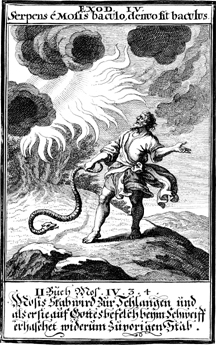
Courtesy Pitts Theology Library
We make a lot of excuses not to follow God's plan for our lives, and those excuses mean very little to God.

Moses answered, “What if they do not believe me or listen to me and say, ‘The LORD did not appear to you’?”   Then the LORD said to him, “What is that in your hand?”
   “A staff,” he replied.
  The LORD said, “Throw it on the ground.”
   Moses threw it on the ground and it became a snake, and he ran from it.  Exodus 4:1-3

I had to laugh a little bit when I read that text, and I'll tell you why.  God told Moses via the burning bush that He had decided to deliver His people from Egyptian bondage, and that Moses was to be the one to tell Pharaoh that this was going to happen.  Moses wasn't excited about this new assignment, so he tried to convince God that He should look elsewhere.  (You can find the entire conversation in Exodus 3 & 4.)  One by one Moses kept making excuses, and one by one God kept knocking them down.

  • Moses:  Who am I to go and say these things to Pharaoh?   
  • God:  You won't be alone.  I will be with you.
  • Moses:  What if the Israelites ask "What is this God's name?"   
  • God:  Tell them "I AM has sent me to you."
  • Moses:  What if they don't believe that You actually sent me?   
  • God:  Throw your staff on the ground, and it'll turn into a snake then back into a staff.  If that doesn't work, put your hand in your cloak and it will become leprous and then be healed.  And, if those two don't work, take some river water and pour it on the ground and it will become blood.
  • Moses:  You know, I've never been a good speaker.   
  • God:  Who made your mouth?  I will help you speak and teach you what to say.
  • Moses:  I still would feel better if you sent someone else.   
  • God:  Oh, alright!  Take your brother with you.  He's already on his way to meet you, and he will speak for you.

We may not be called like Moses to help deliver a nation from slavery, but we all could be doing more in regards to following God's plan for our lives.  God has already promised that He will be with us.  So stop making excuses, and do what He has asked you to do.

Wednesday, June 29, 2011

Seeking but not Finding

If Christians claim to read the same Scriptures and follow the same God, why does it seem that so many are lacking the truth?


The book Christ's Object Lessons, which is a relatively small book on the parables of Jesus, contains a chapter on "The Parable of the Hidden Treasure" (you can find the parable in Matthew 13:44).  The chapter, aptly titled "Hidden Treasure" contains subtitles covering various aspects of the parable.  As I read the section subtitled "Search for the Treasure" I came upon the answer to the aforementioned question.

The treasure in the parable represents God's word, and more importantly, a correct understanding of His word.  Why then do so many Christians lack an understanding of the Bible truth?  One could say, "That's simple, not everyone actually reads and understands the Bible even though they say that they do."   However, such an answer only contains part of the truth.  Why don't people truly read and understand God's word?  The answer to that question may be difficult for many people to accept.  The author of the book answers it in this way.
"[The word of God] is an inexhaustible treasure; but men fail to find this treasure because they do not search until it is within their possession. Very many are content with a supposition in regard to the truth. They are content with a surface work, taking for granted that they have all that is essential. They take the sayings of others for truth, being too indolent to put themselves to diligent, earnest labor, represented in the word as digging for hidden treasure. But man's inventions are not only unreliable, they are dangerous; for they place man where God should be. They place the sayings of men where a 'Thus saith the Lord' should be." pgs. 109, 110
 Very few people want to have such words as superficial, gullible, and indolent, associated with their character, yet such associations will exist if they do no put forth the diligent effort necessary to truly understand God's word.  So many professed teachers and spiritual leaders attempt to explain the Scriptures using their faulty human reasoning.  The author likens that to trying to give light to the sun with a torch.  God's holy word needs no such addition to make it truths known, and we need not to follow such leaders.  As Jesus once said, "Can the blind lead the blind?  Will they not both fall into a pit?" Luke 6:39

Thankfully, the effort to understand God's word does not go without assistance.
"The Holy Spirit, sent from heaven by the benevolence of infinite love, takes the things of God and reveals them to every soul that has an implicit faith in Christ. By His power the vital truths upon which the salvation of the soul depends are impressed upon the mind, and the way of life is made so plain that none need err therein. As we study the Scriptures, we should pray for the light of God's Holy Spirit to shine upon the word, that we may see and appreciate its treasures" pg. 113
 Help us, Lord, to trust in You, and You alone to lead us into all truth.

Tuesday, July 6, 2010

Laboring Under Difficulties

Those who work for God should not be a stranger to hard work.

When I read the title to this chapter, I thought that it was referring to Paul's problems (stoning, imprisonment, etc.) in the various mission fields. However, in the second paragraph of the chapter I discovered it was referring to something different.
Among the Jews physical toil was not thought strange or degrading. Through Moses the Hebrews had been instructed to train their children to industrious habits, and it was regarded as a sin to allow the youth to grow up in ignorance of physical labor. Even though a child was to be educated for holy office, a knowledge of practical life was thought essential. Every youth, whether his parents were rich or poor, was taught some trade. Those parents who neglected to provide such a training for their children were looked upon as departing from the instruction of the Lord. In accordance with this custom, Paul had early learned the trade of tentmaking.  pgs. 346, 347
The basic theme of the chapter is that manual labor is not something to be avoided.
Work is a blessing, not a curse. A spirit of indolence destroys godliness and grieves the Spirit of God. A stagnant pool is offensive, but a pure, flowing stream spreads health and gladness over the land. Paul knew that those who neglect physical work soon become enfeebled. He desired to teach young ministers that by working with their hands, by bringing into exercise their muscles and sinews, they would become strong to endure the toils and privations that awaited them in the gospel field. And he realized that his own teachings would lack vitality and force if he did not keep all parts of the system properly exercised. pgs. 353, 354
You may read that and say that this principle is only for those who wish to be pastors, evangelists, etc. My answer to that is that we are all called to be a minister of some sort, a witness for God wherever we go. Also, simply because we live in a society where a large percentage of the work is not physical as in making tents, it doesn't mean that if we work a white-collar job that we can be lazy. We are called to do our job to the best of our abilities.

What if we are one of the millions of people in this country that are unemployed? That is not a reason to be lazy either. Aside from the task of finding work, we can still be rather productive. Do jobs around the house that have been neglected for lack of time. Volunteer at various nonprofit organizations. Devote time to that exercise program that we know we should be doing. Staying active not only helps fight off depression, but also keeps your mind and body sharp for the time when we find a paying job.

There's always more that could be said, but I think the point is made. There is no such thing as a lazy Christian.