Showing posts with label Book review. Show all posts

Wednesday, October 12, 2016

[Book Review] Tortured for Christ by Richard Wurmbrand


Warning: Reading this book may cause a sudden increase in your desire to serve God.

As a Christian living in the United States I have grown accustomed to have certain things, namely freedom to say and do what I want in regards to religion. Tortured for Christ tells of a time and place where such a thing was a faint memory.

Originally published in 1967, Wurmbrand tells of his experience being a Christian pastor in both Nazi, and later Soviet-controlled Romania. (The last half of that sentence should be an indication that the word "tortured" was not put in the title simply to pique one's interest.) He wrote mainly of his experience under Communism, referencing the Nazis only briefly, stating that the blessing of the Nazi occupation was that it taught the believers that physical beatings can be endured. Knowledge that would sadly become useful when the Communists came into power. However, the Communists did not come into power as you might think.

Seduction and Standing Up


Wurmbrand stated that the Communists did not come the Romanian church with guns blazing, but rather as a man who seduces a female for a one night stand. Sadly, for the most part, it worked. He wrote of a congress that was convened in the Romanian Parliament building where four thousand ministers of all denomination were gathered. They then voted Joseph Stalin, who was at the time president of the World Movement of the Godless and mass murderer of Christians, honorary president of this gathering of religious leaders. One by one these so called men of God stated how that Communism and Christianity were basically the same and then pledged allegiance to the Communist government. He then wrote,
"My wife and I were present at this congress. Sabrina told me, 'Richard, stand up and wash away this shame from the face of Christ! They are spitting in His face.' I said to her, 'If I do so, you lose your husband,' She replied, 'I don't wish to have a coward as a husband.'"
That last sentence pretty much sums up the attitude of the Underground Church that sprung up around that time. Christians fearlessly spread the gospel, and joyfully went to prison and certain torture and death. He told many stories of the believers, but the one that touched me the most was the arrest of a young girl by the secret police. They followed her for some time and waited to arrest her on her wedding day in an attempt to cause the greatest amount of suffering possible. She went peacefully, and left the church kissing her shackles all the while rejoicing that she was the bride of Christ. How many of us would have had the same reaction?

Surprisingly, despite suffering unspeakable tortures at the hands of the Russians they bore no ill will to their captors, rather witnessing to them, winning many to Christ. Wurmbrand put it this way, when a crocodile kills a man, its tragic, but we do not blame the crocodile because it was simply following its nature. He stated that many of these soldiers were so brainwashed that they were little more than animals and should be treated with pity rather than contempt.

The Bottom Line


Wurmbrand's main purpose in writing this book was to highlight the suffering, as well as the fervor, of the Underground Church. He wanted to wake up Christians in free countries to the need of helping their persecuted brothers and sisters. I know it accomplished that goal with me, and I hope that it will do the same for you. The book is offered free of charge from the organization "The Voice of the Martyrs" so what are you waiting for? Go to their website and order it today.

Thursday, June 21, 2012

[Book Review] I'm Not Leaving. by Carl Wilkens

In his first person account of the 1994 Rwandan genocide, Carl Wilkens challenges the reader to not only end genocide, but also the selfish attitude that leads to it.

Genocide, to those familiar with the term it brings to mind stories and pictures we would rather forget.  Yet we must remember it if we are to put a stop to it and prevent it from reoccurring, and that is one of the goals of this book.  I'm not leaving. comes from a unique perspective in that Wilkens was the only American to remain in the country of Rwanda while the Hutu tribe sought to exterminate the minority Tutsi tribe.  You will find very few statistics in this book because numbers are so large as to have very little impact on our lives.  Rather this book focuses on the stories of the people involved on both sides of the divide.  This paragraph from the book summarizes this thought well.
"While the stories written here happened during the genocide, this book is not really about genocide. It is more about the choices people made, actions people took, courage people showed, and sacrifices people gave in the face of genocide."

His story begins with probably the most difficult choice anyone would have to make.  The choice for Carl to put his young family in a departing truck while he stayed behind in a country on the brink of disaster.  He goes on to talk about how his life was constantly in danger despite his association with the humanitarian organization ADRA, how so many others risked life and limb to help those who were less fortunate (mainly orphans), and how he often received assistance in his work from the very people carrying out the massacre.

However, these stories almost never happened.  Soon after the killing started, a murderous mob appeared at the gates of the Wilkins' home with the intention of killing the entire family.  This mob was fended off not by a show of force, but by stories.  Little grandmothers and mothers with babies in their arms told the mob how the Wilkinses helped them when they had problems and how the Wilkins children played with their children.  Carl and his family had reached out to those who were different than they were, and because of this their lives were spared.

I'm not leaving. flies in the face of a world embroiled in an "us versus them" mentality (Something I wrote about recently as well as some time ago).  I had the privilege of hearing Wilkens in person and talked about people having the attitude of "the other" in the sense of how much better the world would be if the other were not in it.  He said that we all are in danger of harboring such thoughts, and we need to realize that there is a world outside my shoes.

I would recommend this book to anyone and everyone.  You can order a copy of it here.

Tuesday, June 12, 2012

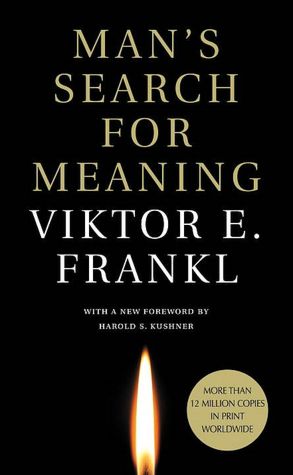
[Book Review] Man's Search for Meaning by Viktor E. Frankl

Courtesy bn.com
Every so often I read a book that really gets me thinking.  Man's Search for Meaning is one of those books.

For my birthday I received a gift card for a book store (yes, they still exist) and as I was perusing their website I discovered Man's Search for Meaning by Viktor E. Frankl.  The paperback version was quite affordable, so I ordered it along with some other books so that I would not have money left over on my card.  My wife, daughter and I recently went on a trip that involved a lot of flying, so I brought it along with some other books so that I could make good use of my time.  I ended up completing the entire book on that trip and highly recommend it.

Frankl, a Jewish psychiatrist who survived the concentration camps of WWII, describes in the first part of the book what goes through the head of those who found themselves on the wrong side of Hitler's final solution.  His personal involvement and active mind gives the reader a unique perspective of what happened on the inside.  He didn't seek to shock people with stories of brutality and violence, but rather showed how that one can maintain their humanity in such a dehumanizing situation.

The second part of the book dealt with his method of psychotherapy called logotherapy.  Merriam-Webster defines logotherapy in this way.
"a highly directive existential psychotherapy that emphasizes the importance of meaning in the patient's life especially as gained through spiritual values"
In contrast to the Freudian method which places most of the emphasis on what has happened in the past affects your present choices, Frankl focuses primarily on how one's present choices affect what happens in the future.  When reading this part I would recommend taking frequent breaks, or at least not reading it when you are tired (like I did) because some aspects of his therapy take some effort to process.

I would recommend this to anyone, especially to history buffs who want more than simply names and dates, and to those dealing with difficult situations.

Tuesday, September 27, 2011

[Book Review] Watching the War

Sometimes the importance of a situation prevents us from taking a big picture look at it.  In his book Watching the War, David B. Smith takes a big picture look the most important situation in the universe.

David B. Smith follows in the footsteps of  C.S. Lewis in this unorthodox view of what many call "the great controversy" or "the story of redemption", which begins with the origin of sin, and ends with its ultimate destruction.  Watching the War portrays this saga primarily from the perspective of Malachon and Pershia, rulers of the fictional planet Senteria.  Aside from giving the author a base from which to tell a story, what purpose does this change in view serve?

Perspective Increases Awareness

While Smith reveals that his personal intention for this perspective is an attempt to get answers for his many questions, another benefit comes as the result of this change; awareness.  Changing our perspective often makes us aware of aspects that we had previously overlooked.  An example from the book comes from the story the fall of Adam and Eve.  In this book Malachon and Pershia travel with God to talk with Adam and Eve, and Pershia gives an impassioned plea that whatever they do, they should not eat the fruit.

More Than Simply a Story

In addition to creative storytelling, Smith takes frequent breaks from the narrative to further unpack some of the concepts that occur in the story.  He draws from a variety of sources (including C.S. Lewis)  to help the reader understand these complex concepts, but he readily admits that he doesn't have all the answers.  At one point, in an attempt to explain how one Man's death on a cross can save an entire planet, Smith states that one doesn't have to know how it works, one simply has to know that it does work.

Conclusion

Many Christians may not learn anything new from this book, but you will be reminded of many important concepts including the most important concept of all, that God loves you.  This book can be purchased for a very reasonable price, and along with the limited amounts of paper copies available (see link above), you can also purchase a Kindle edition.  So what are you waiting for?  Pick your copy today.

What to do you think about this approach to explaining complex subjects?  Tell us your view in the comment section.

Thursday, September 22, 2011

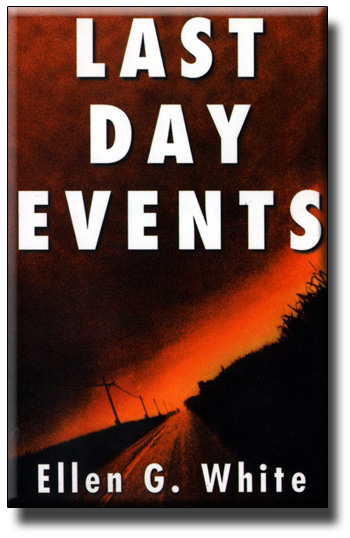
[Book Review] Last Day Events

Courtesy lmn.org
Ever since Jesus left this earth thousands of years ago believers have been watching for Him to come back.  The long delay has caused many to lose sight of this vision.  The purpose of the book Last Day Events is to help people get that vision back.

 As the title of the book implies, Last Day Events covers what will happen prior, during, and after the second coming of Jesus Christ.  By no means does this book attempt to be an exhaustive source on the subject, and coming in at slightly over 300 pages roughly the size of my hand (other printings may vary in size), it simply cannot be one.  The main purpose of this book is to raise awareness, and it does that quite well. 

Comprised of paragraphs from many sources (which it gives at the end of every quotation) and categorized by general then specific topic, this volume can be read as a typical book or used as a quick reference guide.  (For example, you could look in the chapter entitled "Signs of Christ's Soon Return" and then find the subheading "Earthquakes and Floods").  I chose to read this book as a daily devotional, reading two or three subheadings (most are only a few paragraphs long) a day, but you can read it in whatever way works best for you.

However you chose to read this book, you should read this book.  It will inspire you and help you become more aware of what is soon to come upon us all.


Have you read this book already?  Tell us what you thought of it.

Tuesday, August 16, 2011

Book Review: Faith That Works

Wanna make it into heaven, but don't know how to get there?  Morris Venden's book Faith That Works will tell you how, but don't simply take my word for it, read it for yourself.

According to an old saying one cannot judge the contents of a book by its cover.  While that may be true in many cases, by looking at the cover you can still get a good idea about what's inside.  When you read the back cover of this book, you will discover its theme.  Righteousness is not something you can achieve on your own.  It can only be achieved through Jesus.

When you look inside the book you will find that theme throughout.  This daily reader (one page for each day of the year) begins with pertinent title "What God is Like" and leads you on a journey into a deeper understanding of God, Jesus, the Holy Spirit, and the Christian life until you arrive at the last title "Jesus, Your Best Friend".   My wife and I started reading this book most of the way through the year last year, but the effect remained the same.  Despite our growing up in Christian environments, we found ourselves being challenged and encouraged to take a deeper look at our views on a variety of subjects.

For example, one does not overcome temptation with clenched fists and gritted teeth, you simply get to the point where temptation has no power over you at all (you can find a more detailed explanation here).

Whether you're a lifelong Christian, or you aren't even sure what Christianity is all about, you will benefit from reading this book.  Can one find similar thoughts in other books?  Absolutely, but Venden's style of writing makes complicated topics easy to understand.  Many times while reading this book I found myself thinking, "Hmm, I never thought about it that way before."  Venden's passion for the subject matter practically oozes from the pages, and will draw you into wanting to know more about this being called God, and this man named Jesus.

Being over ten years old, this book should be easy to get for relatively little money (I got mine for free, not sure why the previous owner gave it up).  So, what are you waiting for?  Get yours today.

Monday, August 15, 2011

Book Review: The Jesus I Never Knew

Photo courtesy goodreads.com
Phillip Yancey challenges the reader to take a second, third, and fourth look at Christianity's most talked about, yet most frequently misunderstood, subjects; the life and ministry of Jesus Christ.

Yancey starts off this book with his first encounter with the concept of Jesus.  A scene not too unfamiliar to those who grew up in a Christian environment.  Since I fall into that category, I can identify with it as well.  I used the word "fall" almost unconsciously, but it fits so well.  As children, we don't have much control over where we go, what we do, or what type of home we grow up in.  With our undeveloped skepticism, we believe whatever comes from the mouths of those in authority regardless of its truthfulness.  Sadly, as we grow older, we discover that those in authority have not been completely honest with us.  This was the case with Philip Yancey.

Yancey grew up believing Jesus to be one who had "no sharp edges at all--a Mister Rogers before the age of children's television."  Those of you who did not grow up in the United States, or simply did not watch "Mister Rogers' Neighborhood" most likely will not be able to fully grasp the power of that illustration.  As one who watched the program extensively growing up, I know exactly what picture Yancey tried to portray.  Mister Rogers was the ultimate nice guy, and his show followed his personality.  In researching for this post I came across the program's opening theme, something I hadn't seen for a very long time, and I couldn't help but feel a warm sense of peace as I watched it.  Young Philip felt that same peace thinking about Jesus, the problem being that was where his concept of Jesus ended.  As Yancey grew up his concept broadened, sometimes exponentially, and this book details what he discovered about this Man Who was God.  What did Yancey discover?

Yancey found out that Jesus is more than we think He is, and when you think you have Him figured out, something else comes along that completely contradicts what you first thought.  Jesus lived a life of apparent contradictions: the Sinless One Who was a Friend of Sinners, powerful men and evil angels would cower in His presence or simply run away, yet little children and outcast women were drawn to Him, and never wanted to leave His side.  A friend of mine described Jesus as a "human magnet", a fitting description indeed for those were seemingly His opposite were drawn to Him, yet those who were seemingly His equal were repulsed.

While other books exist about Jesus' life that I would place in higher esteem (namely one in particular), The Jesus I Never Knew helped to remind me that simply because we have learned something as a child doesn't necessarily make it true, and that we should keep our minds and hearts open to God's leading.  For although we most likely will have to give up long cherished ideas, the new ones that we accept will be much, much better.

Wednesday, June 8, 2011

Bucket List Book Number Two


If you have a "bucket list" for books, this book should be number two.

Now you may have two or three questions regarding the previous statement.  If you don't know what a bucket list is, I borrowed the phrase from the title of a movie by the same name in which two terminally ill men compile a list of things to do before they "kick the bucket."  I am basically saying that there are certain books people should read at least once in there lifetime.  I don't have a complete list, but the book I am reviewing today should be no lower than number two.

Number one on the list, is by no surprise to those who read this blog, the Bible.  The Bible is one book that people should read through in its entirety at least once in their life.  They should have a plan other than simply starting at Genesis, and there are many Bible reading plans out there that should make such an undertaking more palatable.  Find a version you like, and a plan that you like and then stick to it.  You won't regret it.

To avoid any further suspense, the book I am reviewing is none other than the book The Desire of Ages by E.G. White, which is a biography of Jesus Christ.  Now reading through this book is in itself a project.  It is definitely not a book I would recommend reading in a short amount of time.  This book is long by most standards (835 pages), and is not one for casual reading.  I started reading the book around Christmas time last year (2010), and I finished a few days ago.  My original plan was to read a chapter a day and be finished in a couple of months, but I found out that this was not to be the case.  The thoughts presented in this book challenged me quite a bit, and I often found myself having to stop part way through a chapter to let myself absorb what I had read.

Some of you may still be wondering why is this book number two on my list.  The simple answer is that if you let it, this book will change your life.  One cannot spend that much time pondering the life of Jesus and not have it affect their life in one way or the other.  So if you want a life-changing experience, pick up this book (there are many places you can find it) and start reading.  Don't rush through it, but take your time and let yourself absorb what you have read.  The only regret you may have is not having done it sooner.

Wednesday, March 16, 2011

Book Review: Emotional Intelligence

The subject of this book review is Daniel Goleman's Emotional Intelligence, a good book despite its flaws when looked at from a Christian perspective.

My wife introduced me to this book.  She had read it a number of years ago (it was first published in 1995), and one day as she was perusing a collection of second-hand books she found a copy and gave it to me because 1) she knows that I like to read and 2) she loves me.  I found it quite interesting although I had to read it through a filter of sorts, but more on that later.

The basic premise of the book is the our concept of human intelligence is flawed, or at least incomplete. Goleman stressed that we put too much emphasis on the type of intelligence that can be measured with an IQ test.  He places more of an emphasis on what he likes to call emotional intelligence which incorporates certain aspects such as self-discipline and compassion.  The two types of intelligence must go together in order to have a complete picture of the individual.

This book introduced me to some new concepts, or at least gave me a name for them and told me how they happen.  The one that I remember the most is the concept of a "emotional hijacking".  An emotional hijacking is when the emotional centers of the brain override the rational/cognitive centers.  You, no doubt, have experienced this in one way or another, such as when you got so angry/sad/excited that you ended up doing and/or saying things that you know cognitively that you should not do and/or say.  A very simple way to put it is that it's like being drunk without the liver damage.

There are a lot of positive aspects to this book, but its main downfall for me is that it comes from a very humanistic approach.  Evolutionary concepts are found throughout the book, mainly connected to how the human brain formed and why it functions the way it does.  He also heavily espouses the idea that people can be changed if given the correct education.

I, obviously, do not have the same world view as Goleman does, but that did not prevent me from learning a lot on how people, myself included, function in regards to our emotions.  So if you are interested in a good read and are able to tolerate the author's perspective, search around and pick up this book.  You'll feel more intelligent when you're done.

Monday, January 17, 2011

Something New, A Book Review (Roger Crowley's "1453")

I've decided to add a regular feature to this blog, and if you read the rhyming portion of the title, you've figured out what the feature is going to be.

A little over a month ago I stopped by a local bookstore in search of a book.  I was finally finishing up a book I was reading on the Spartans.  I say "finally" because it took me about 3 years to finish it (I had used the receipt as a bookmark).  I decided to search for another history book, but there were so many history books I had to narrow my search somewhat.  I wanted to read about something I had no significant knowledge about, which meant that U.S. history was out, and that narrowed my search quite a bit.  To make a long story short, I decided to purchase Roger Crowley's book 1453.  Needless to say, I was not disappointed.

One of the signs of a good story teller is the ability to to keep the listener/reader engaged in the story even when they already know how the story is going to end. One of the reviews on the back of the book said that the book "reads more like lively fiction" and that is definitely the case.  I read the book primarily at night, and I often had to force myself to put it down and go to sleep, which may not sound too unusual, but you have to remember that this is a history book.

So if you like reading, but find yourself a bit reluctant to pick up a history book that is not a novel.  Go to your local bookstore or follow the above link and pick up 1453.  I'm pretty sure that you will not be disappointed.