I found this video a couple of days ago and thought I'd share it with you. Whether you fully agree with the conclusion or not, I hope that it gets you thinking.
Showing posts with label doubts. Show all posts
Showing posts with label doubts. Show all posts
Monday, October 31, 2011


Thursday, August 25, 2011
Who Cares?
 |
| Image: kairsjoy/photobucket |
One important fact remains regarding whatever activities we do, whatever projects we work on, whatever dreams we have. Few people will be as excited, as involved, as we are. Why should they? They did not come up with the idea, they didn't make the plans, they didn't put the blood, sweat, and tears into it like we did. However, that should not discourage us from striving toward our goals.
In fact, that should make us want to push even more. The lack of caring most likely means that we are on to something. That lack of caring may be God's way of telling us what direction we should go. Our product, service, or work of art could fill a need and/or inspire people in ways that haven't been done before.
Don't let the masses tell you what you should or should not do. Go forward into uncharted territory, into the great unknown. As the words to a song go,
To hear with my heart,
To see with my soul,
To be guided by a hand I cannot hold,
To trust in a way that I cannot see,
That's what faith must be.
Have you ever stepped out in faith and been greatly rewarded? Tell us your story.
Monday, July 11, 2011
What is In Your Hand?
 |
| Courtesy Pitts Theology Library |
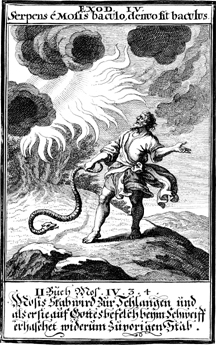
Moses answered, “What if they do not believe me or listen to me and say, ‘The LORD did not appear to you’?” Then the LORD said to him, “What is that in your hand?”
“A staff,” he replied.
The LORD said, “Throw it on the ground.”
Moses threw it on the ground and it became a snake, and he ran from it. Exodus 4:1-3
I had to laugh a little bit when I read that text, and I'll tell you why. God told Moses via the burning bush that He had decided to deliver His people from Egyptian bondage, and that Moses was to be the one to tell Pharaoh that this was going to happen. Moses wasn't excited about this new assignment, so he tried to convince God that He should look elsewhere. (You can find the entire conversation in Exodus 3 & 4.) One by one Moses kept making excuses, and one by one God kept knocking them down.
- Moses: Who am I to go and say these things to Pharaoh?
- God: You won't be alone. I will be with you.
- Moses: What if the Israelites ask "What is this God's name?"
- God: Tell them "I AM has sent me to you."
- Moses: What if they don't believe that You actually sent me?
- God: Throw your staff on the ground, and it'll turn into a snake then back into a staff. If that doesn't work, put your hand in your cloak and it will become leprous and then be healed. And, if those two don't work, take some river water and pour it on the ground and it will become blood.
- Moses: You know, I've never been a good speaker.
- God: Who made your mouth? I will help you speak and teach you what to say.
- Moses: I still would feel better if you sent someone else.
- God: Oh, alright! Take your brother with you. He's already on his way to meet you, and he will speak for you.
We may not be called like Moses to help deliver a nation from slavery, but we all could be doing more in regards to following God's plan for our lives. God has already promised that He will be with us. So stop making excuses, and do what He has asked you to do.
Thursday, May 12, 2011
The Honest Thief
We have much to learn from one of the most famous death-row inmates in history.
As I am reading the account of the events leading up to the death of Jesus, I have found myself drawn to what some may call the supporting players. In my last post, I focused on Judas and Pilate and how their selfish choices ultimately led to their own demise. In this post, I will focus on a person whose choices resulted in a much more positive outcome, the thief on the cross. Now as you may know, there were actually two thieves on crosses in this story. However one of them has gained the title of the thief on the cross because of his brief, yet all-important conversation he had with Jesus.
White gives a brief character sketch of him in this chapter. Turns out he wasn't as bad as some may think.
It is amazing the clarity of thought many people have when they think or know that their death is imminent. This clarity of thought is in many cases a last-ditch effort by the Holy Spirit to get the person to make that all-important choice.
As I am reading the account of the events leading up to the death of Jesus, I have found myself drawn to what some may call the supporting players. In my last post, I focused on Judas and Pilate and how their selfish choices ultimately led to their own demise. In this post, I will focus on a person whose choices resulted in a much more positive outcome, the thief on the cross. Now as you may know, there were actually two thieves on crosses in this story. However one of them has gained the title of the thief on the cross because of his brief, yet all-important conversation he had with Jesus.
White gives a brief character sketch of him in this chapter. Turns out he wasn't as bad as some may think.
"This man was not a hardened criminal; he had been led astray by evil associations, but he was less guilty than many of those who stood beside the cross reviling the Saviour. He had seen and heard Jesus, and had been convicted by His teaching, but he had been turned away from Him by the priests and rulers. Seeking to stifle conviction, he had plunged deeper and deeper into sin, until he was arrested, tried as a criminal, and condemned to die on the cross." pg. 749Before reading this passage, I had no idea that this man had had any prior contact with Jesus. This brings to mind an important point, the concept of a spontaneous turning to Christ is somewhat of a myth. The Holy Spirit works on people's hearts long before many people (even, in some cases, the person themselves) realizes it. God is constantly drawing people to Him. It is simply our part not to resist Him.
It is amazing the clarity of thought many people have when they think or know that their death is imminent. This clarity of thought is in many cases a last-ditch effort by the Holy Spirit to get the person to make that all-important choice.
"The Holy Spirit illuminates his mind, and little by little the chain of evidence is joined together. In Jesus, bruised, mocked, and hanging upon the cross, he sees the Lamb of God, that taketh away the sin of the world. Hope is mingled with anguish in his voice as the helpless, dying soul casts himself upon a dying Saviour. 'Lord, remember me,' he cries, 'when Thou comest into Thy kingdom.'" pg. 750A key thought to bring out at this point in the story is that this thief was the only one to acknowledge Jesus as Lord while He is hanging on the cross.
"Many were ready to call Him Lord when He wrought miracles, and after He had risen from the grave; but none acknowledged Him as He hung dying upon the cross save the penitent thief who was saved at the eleventh hour." pg 751Not the bystanders, not His disciples, not even His own mother acknowledged that fact. They all had their doubts, save this condemned criminal. Now a unusual hush came over the crowd.
"The bystanders caught the words as the thief called Jesus Lord. The tone of the repentant man arrested their attention. Those who at the foot of the cross had been quarreling over Christ's garments, and casting lots upon His vesture, stopped to listen. Their angry tones were hushed. With bated breath they looked upon Christ, and waited for the response from those dying lips." IbidWhat follows is undoubtedly the most powerful paragraph in the chapter.
"As He spoke the words of promise, the dark cloud that seemed to enshroud the cross was pierced by a bright and living light. To the penitent thief came the perfect peace of acceptance with God. Christ in His humiliation was glorified. He who in all other eyes appeared to be conquered was a Conqueror. He was acknowledged as the Sin Bearer. Men may exercise power over His human body. They may pierce the holy temples with the crown of thorns. They may strip from Him His raiment, and quarrel over its division. But they cannot rob Him of His power to forgive sins. In dying He bears testimony to His own divinity and to the glory of the Father. His ear is not heavy that it cannot hear, neither His arm shortened that it cannot save. It is His royal right to save unto the uttermost all who come unto God by Him." IbidThat "all" includes you and me.
Thursday, March 17, 2011
Featured Post: Seven Better Questions You Can Ask in the Midst of Adversity
I'm starting another addition to this blog. Every so often I will feature a post from someone else's blog that I'm currently following. This post comes from Michael Hyatt, Chairman and CEO of Thomas Nelson Publishers. You can find the original post here.

SEVEN BETTER QUESTIONS YOU CAN ASK IN THE MIDST OF ADVERSITY
Ihave several friends who are going through enormous uncertainty right now. Some are out of work. A few others are on the precipice of divorce. Still others have been diagnosed with cancer—one who is pregnant. In these situations, most of us ask, “Why is this happening to me?”
Photo courtesy of ©iStockphoto.com/Yuri_Arcurs
Years ago, two months after I became the publisher of one of our book divisions, we lost a major author to a competing company. This had a significant negative impact on our bottom line. At first, I was angry. Then I became discouraged. Finally, I realized I was asking the wrong question.
Instead of asking “Why did this happen?” I started asking, “How can this make us better?” Immediately, I sensed a shift in my spirit. It began energizing me. In retrospect, losing the author was one of the best things that could have happened to my division. We grew from the experience in ways that would have never happened otherwise.
I learned a valuable lesson: the answers we get are often determined by the questions we ask. If we ask bad questions, we will get bad answers. If we ask better questions—empowering questions—we will get better answers.
If you are going through a difficult, uncertain time, here are seven better questions you can ask yourself and your team:
- What if this isn’t the end but a new beginning?
- What if the answer to my prayer is just over the next hill?
- What if this is necessary in order for me to be prepared for the next important chapter in my life?
- What if God knows exactly what I need at this particular time?
- What if God is speaking to me through means I would not have chosen for a blessing I cannot see?
- What does this experience make possible?
- What will I be telling my grandchildren that I learned was so valuable in this season of my life?
How is this related to leadership? As I have written numerous times before, leaders must lead themselves first—even when they don’t feel like it. Sometimes it just starts with a better question.
Sunday, May 30, 2010
Dealing with Doubt

When we have doubts, a key word to know is "remember".
In this psalm I find Asaph having a rough time. He is crying out to God, losing sleep, refusing to be comforted, etc. Then he ask questions that many of us may have asked at one time or another. We start to doubt whether God is really out to help us or not. Thankfully, Asaph gives a solution to this problem, and that is remember. Remember the deeds of the LORD. Remember the miracles of long ago. Think about all that He has done. The psalm continues for many more verses in which Asaph remembers how God really is.
So, when I have a rough time, when I start to doubt, I need to remember who God really is, and then my perspective will change dramatically.
Subscribe to:
Posts (Atom)