Showing posts with label God. Show all posts

Friday, November 25, 2016

Focusing Our Energies


We only have so much time and energy. As Christians only one area deserves the bulk of those resources.

If you follow this blog, you know that I am concerned about how Christians as individuals and the church at large should be relating to government. Last night as I was scrolling through my Twitter feed, I found an article retweeted by Univision's Jorge Ramos. Written by a South African Journalist, it talked about what the press can expect from a President Trump, and how they should deal with it. This got me thinking once again about my role a Christian in this upcoming presidency. What should I be concerned with, and what should I do?

The Benefit of Focus


As I mentioned in my previous post, doing something is much better than doing nothing, but we still need to be intelligent as to how we use our time and energy. Better to put a lot of energy into one area, than to spread yourself too thin. Think of it this way, if you take a sewing needle and push it into a piece of fabric, it doesn't take a lot of force to push it through. When we focus even a small amount of energy into a precise area it can be quite effective. As a parent of small children, I don't have a lot of time to spare, and I would venture a guess that many of you also have some committments that are non-negoitable. So that being said, in what area should we focus our energies?

Where Should We Focus?


For me there is only one area that should receive the bulk of my energy, and that is the building up of God's kingdom. Sadly, I have to clarify what I mean by that statement. I say "sadly" because many people are under the dangerous misconception that expanding God's kingdom involves greater political influence. Their goals are to put "Christian" politicans into office and pass laws that enforce their personal beliefs. The Biblical view of God's kingdom tends to be quite different.

The passage in the Scriptures commonly referred to as The Gospel Comission goes as follows,
Then Jesus came to them and said, “All authority in heaven and on earth has been given to me. Therefore go and make disciples of all nations, baptizing them in the name of the Father and of the Son and of the Holy Spirit, and teaching them to obey everything I have commanded you. And surely I am with you always, to the very end of the age.” (Matthew 28:18-20 NIV)
As a Christian, that is my mandate, and that should be the focal point of my energies. All other goals should either be secondary or non-existent. How do we put that thought into practice? The answer is simpler that you may think.

How Do We Put Our Focus Into Practice?


Jesus told His first disciples, and us, to make people followers of Him, and to teach others what He has taught them. The only way we can truly accomplish those goals for others is to accomplish those goals first for ourselves. To be a follower of Jesus, one must first know Who He is. Where did He focus His attention? What did He do with His time? While there are many good books about Jesus, the best is, of course, the Bible. Begin first with those parts of the Bible that focus on His life and expand from there. With much of the world now turning their attention to the story of His birth, there is no better time than now to start striving for that goal.

So what are you waiting for?

Monday, April 6, 2015

Fighting the Bad Fight

Christianity's ongoing battle with atheism and secularism is not only misguided, but also not what God intended for His church.

I recently heard a story about the evangelist Billy Graham. What piqued my interest was how almost overnight he transitioned from relative unknown to household name. One day he showed up to the tent where he was holding a series of meetings and discovered a gaggle of news reporters who were eagerly writing down everything he said. When he inquired as to what caused all this interest, he discovered that he had caught the eye of media mogul William Randolph Hearst, and the rest, as we say, is history. Mr. Hearst never divulged the reason for his interest in Graham, but the historian who was telling the story stated that it had a lot to do with current world events, namely the rise of communism as a world power.

You see, the Soviet Union had successfully test fired a nuclear bomb, and Mao Zedong had recently taken over China. Communism now posed a real threat to the American way of life, or at least that is how many perceived it. Atheism being one of the main tenets of Communism, a key way to fight against it was a revival of religion in the United States. Hearst most likely saw in Graham a person who could spearhead such a revival. This revival that Graham participated in came about in a large part as a means to counteract the perceived encroachment of atheistic communism. Religion (i.e. the Judeo-Christian belief system) was essentially a weapon meant to ward off those who would seek to undermine American ideals.

The popularity of "this Christianity as a weapon" concept has in a large part caused the downfall of true Biblical Christianity because it has made the religion popular again on a grand scale. Christianity was never meant to be popular. The Roman emperor Constantine's supposed conversion did more damage than all the persecution up to that point because by making Christianity popular it brought in a sense of entitlement. This sense of entitlement causes adherents to the religion to do whatever it takes to preserve their popularity, including countless atrocities committed in the name of God, but more subtly it causes Christians to be on the continual lookout for battles to fight as a means of promoting the Christian brand.

One can hardly escape hearing about some ideological battle that Christians are fighting: creation vs. evolution, the "War on Christmas", abortion, gay marriage, the list goes on and on, all the while neglecting Jesus' words and example to the contrary. A prime example is His declaration to "be of good cheer, for I have overcome the world." That's right, Jesus said that He has overcome the world, meaning that we don't have to, so why do we insist on trying to accomplish such a feat?

When Jesus was on the earth, His focus was on relieving people from religious oppression, not secular oppression, so why do His professed followers focus so much on the secular aspect? The simple answer is that it is easier to look out than to look within. Personal attacks are much easier to accomplish than personal growth because growth requires sacrifice, and sacrifice is uncomfortable. Despite the fact that Jesus sacrificed not only His comfort, but also His very life, we would rather give up as little as possible and attack those who threaten our comfortable way of life.

You can probably see where I'm going here. For multiple reasons, the professed followers of Christ have decided to go against His teachings and as a result are trying to compensate for the church's shortcomings by attacking those outside of the church; the very ones Jesus told us we should be trying to reach.

Now is high time for Christians to stop fighting the bad fight of unbelief and start fighting the good fight of faith, and see what wonders God will work in our lives and in the lives of others.

Monday, February 9, 2015

To Be Loved

Courtesy y-axis.com
Satya Nadella wants love, but he's looking for it in all the wrong places.

Satya Nadella, the CEO of Microsoft, recently made a statement that caught my attention. He stated,
"We want to move from people needing Windows to choosing Windows, to loving Windows. That is our bold goal."
A bold goal, yes, but not an uncommon one. I'll follow that up with a bold statement of my own, Mr. Nadella has this love thing all wrong.

Now, to be fair, one can't get a full view of what someone thinks about a topic, (especially a complex topic such as love) from a couple sentences, but it's a start. You can't judge a book by its cover, but you can still get a general idea from that cover as to what is inside. So that being said, let's unpack Nadella's statement.

Nadella's Ladder
  • Needed: When we associate with someone out of necessity it means that we really don't want to, but we do it because we have to. An example is children choosing teams for a game, the last kid picked was picked simply because they were the only one left. Not a favorable position to be in.
  • Chosen: The next rung in Nadella's ladder is more favorable, but still not ideal. Someone in the chosen category is definitely liked, but is also interchangeable with others. Firmly in the middle of the pack, it's nice for them to be around, but we don't really miss them when they're gone.
  • Loved: The top of the ladder, and Nadella's goal for Windows. Someone in this category cannot be done without. The first one picked, they not only make life worth living, but also are sorely missed when they're gone.
That sort of progression may work with Mr. Nadella, but God's love turns that list around.

God's Love is Different

With God's list, the love comes first. In fact, God loves us even though we were/are His enemies. He doesn't need anything from us, but still wants to spend time with us. Not only does He love us, but He also showed that love by dying in our place.
You see, at just the right time, when we were still powerless, Christ died for the ungodly. Very rarely will anyone die for a righteous person, though for a good person someone might possibly dare to die. But God demonstrates his own love for us in this: While we were still sinners, Christ died for us. Romans 5:6-8 NIV
Let that sink in for a little bit. The best human relationship we can imagine pales in comparison with the relationship that God offers us. In essence, this unconditional love and acceptance is what sets Christianity apart from other world religions. Nothing is earned, it is only received, and anyone who states otherwise is not a true follower of God.

So as many people (at least in the United States) start talking about a holiday of love, don't be like Nadella and look for love simply from other people, look to the True Source because it is only from this Source will your desires be truly fulfilled.

Monday, July 14, 2014

Just A Game?

Courtesy blog.apimages.com
Why people, especially Christians, should rethink how they view sports.

They stood in stunned silence, some openly wept, while others cried silently. An elderly man comforted a small girl. Many who saw the event on television left the room in tears, unable to bear the sight. What had these people seen? A terrorist attack? A mass shooting? The assassination of a beloved dignitary? Sadly, none of the above. They witnessed the Brazilian football (soccer) team lose badly in the quarterfinals of the World Cup.

There was one picture of a woman that pushed me over the edge. Seen out of context one would have thought that she had received the news that her child had been brutally murdered. I thought that something is out of control here, something must be done. Therefore I decided to write this post because as the saying goes, better to light a candle than simply curse the darkness. The following are a few reasons why I think that people, especially Christians, should rethink how they view sports in general.

Loss of Perspective

I put this one at the top of the list because it provides a foundation for all the other issues. Sports easily becomes the highest priority in people's lives. So that if our favorite team or individual wins or loses, we win or lose. Everything else becomes less important then the game or match. Vince Lombardi, a famous coach of American football is quoted as saying, "Winning isn't everything. It's the only thing." Such an attitude goes completely against one of the primary tenets of Christianity (as well as Judaism) which is "Love the Lord your God with all your heart and with all your soul and with all your mind." God should be the primary focus in a person's life, anything that tries to take one's focus off of God should be avoided.

Waste of Time/Money


It's no secret that there is a lot of money in sports. CNBC reported that Brazil spent over 11 billion dollars (US) on its preparation for the latest World Cup. Sadly, such spending is not too far from normal. Alongside the massive spending of major organizations comes the individual spending of those who watch the games and/or buy sport-related merchandise. In a world with so much need on so many levels, can we honestly say that God is happy when we spend money on things that merely entertain ourselves?

Some may say that they don't spend any on sports. They don't buy merchandise, go to games, or even host game-watching parties, they simply watch the games for free. However, in so doing, they spend a much more valuable resource, time. Money spent can be earned back, but time spent is lost forever. Again, how can God be happy when we spend time on things that merely entertain ourselves?

Us versus Them

Finally, sports creates an "us vs. them" mindset with our favorite team being against your favorite team, and ultimately me against you. I've written on this mindset before (here and here), so I won't go into much detail other than to say that I have experienced this first hand both in person and via social media. What makes this worse is that all the people involved in the confrontations, taunting, and general unChristlike behavior I witnessed claimed to be followers of Christ. People already talk too much about the hypocrisy of Christians, do we really need to add fuel to the fire?

Think About It

I hope this post has gotten you thinking. What we see and do ultimately affects who we are. Do we really need to spend so much time, energy, etc. on sports? I'll let you come to your own conclusion on the matter. I hope that you come to the right one and start living a life less influenced by the sporting world.

Thursday, April 17, 2014

[Featured Post] Christ Entered Our Death Camp

In light of the Easter season being upon us, this week's featured post is "Christ Entered Our Death Camp" written by Lilianne Lopez, a regular contributor to the blog Sabbath School Net. Also since many of you may be more inclined to view religious movies during this period, be sure to check out the recent post on Christians in relation to Bible-themed movies "Whose Side Are We On".


If it had not happened, could we imagine a world in which God became a Man and lived among us? Although He could have come as a powerful and wealthy King, He chose to come as a newborn powerless and poor Baby. He lived like those around Him. He obeyed His parents and His government. He even allowed them to put Him to death.

http://www.goodsalt.com/details/lwjas0038.html?r=ssnet
Image © Lars Justinen from GoodSalt.com
We don’t know much about Jesus’ growing-up years … probably because it was much like everybody else’s who grew up at the same time. There was nothing that would make His childhood look different from the other children in Nazareth. He was a Jewish boy, from a Jewish family, in a Jewish village.


Then something startling happened. When He was twelve, in Jerusalem for His first Passover, He realized who He was. Think for a minute about how that moment of revelation must felt for Jesus. Can you imagine being twelve and finding out that you were the Creator of the planet that you were standing on and everything on it?

Even more mind-boggling though, is that after coming to that realization, Jesus went home with His earthly parents and continued to live, work beside, and obey them for the next 18 years. Our sinful, earthly minds rebel at the thought of being subject to anyone, especially someone we perceive as being somehow less important than we are. Yet Jesus knew He was God, and still obeyed His parents and lived as their Son.

From the time when Jesus and God the Father made the plan to redeem humanity, Jesus had been obedient to the laws that governed Him. Some people like to paint Jesus as a rebel, but if we look closely at His life, we realize that He never broke a rule He didn’t have to. In every way He lived the life of a devout Jewish baby, child, and man. His parents had Him circumcised just like every other Jewish boy. He didn’t eat any unclean meat. He kept all the Jewish feasts that pointed to Him as the Redeemer. He kept the Sabbath that pointed to Him as the Creator. He kept the Ten Commandments that He had written with His own finger.

In the stories of the mythological gods, all of them tried to “fly under the radar.” Most of them didn’t even attempt to live by the same rules that humans were expected to follow. Most of the mythological gods were immoral, jealous, and unprincipled beings, according to the stories written about them. They used whatever power they had to draw attention to themselves and to get what they wanted, no matter what it cost anyone else.

Jesus was different. He allowed Himself to be beaten and killed to save each one of us, even though He could have destroyed those who were mistreating Him.

Do you think you would be able to do what Jesus did, even on a smaller scale? Here’s the story of someone who did. His name was Witold Pilecki, a captain in the Polish army and a committed Christian. In September 1940, Pilecki did the unthinkable – he sneaked into Auschwitz!
Why would anybody sneak in to a Nazi death camp? Well, Pilecki was sure that very bad things were happening in that place and he wanted to get proof of what was going on. He could only get that information from the inside. So Pilecki came up with the plan. His superiors approved it and made sure he had a false ID card with a Jewish name. Then Pilecki went out and got himself arrested by the Nazis. He was sent to Auschwitz and tattooed as inmate number 4859.

Now, it wasn’t like Pilecki had nothing to lose, he had a wife and two kids. He said, “I bade farewell to everything I had known on this earth.”

Once inside the death camp, he didn’t go around telling people that he wasn’t Jewish and that he should be treated differently.
He “became just like any other prisoner—despised, beaten, and threatened with death. From inside the camp he wrote, ‘The game I was now playing at Auschwitz was dangerous…. In fact, I had gone far beyond what people in the real world would consider dangerous.’
“But beginning in 1941, prisoner number 4859 started working on his dangerous mission. He organized the inmates into resistance units, boosting morale and documenting the war crimes. Pilecki used couriers to smuggle out detailed reports on the atrocities. By 1942, he had also helped organize a secret radio station using scrap parts. The information he supplied from inside the camp provided Western allies with key intelligence information about Auschwitz.

“In the spring of 1943, Pilecki joined the camp bakery where he was able to overpower a guard and escape. Once free, he finished his report, estimating that around 2 million souls had been killed at Auschwitz. When the reports reached London, officials thought he was exaggerating. Of course today we know he was right.

“Here’s how a contemporary Jewish journal summarized Pilecki’s life: ‘Once he set his mind to the good, he never wavered, never stopped. He crossed the great human divide that separates knowing the right thing from doing the right thing.’ In his report Pilecki said, ‘There is always a difference between saying you will do something and actually doing it. A long time before, many years before, I had worked on myself in order to be able to fuse the two.’ The current Polish Ambassador to the U.S. described Pilecki as a ‘diamond among Poland’s heroes.’”1
Mr. Pilecki was not Jewish and didn’t need to worry about what was going on in those camps. As far as he and his colleagues knew they were work camps. But Pilecki wasn’t satisfied to stand by and watch. He had spent his life working for freedom and eventually gave his life because he refused to give up the names of the people with whom he worked.

Jesus was not human and He didn’t need to worry about anything here on earth. We blew it – he could have just created another world and forgotten about us. But Jesus couldn’t stand by and watch, either. He and His Father made a plan and snuck Him into our sinful existence. And just like Pilecki, Jesus risked all. He risked failure and eternal loss.
“In stooping to take upon Himself humanity, Christ revealed a character the opposite of the character of Satan. But He stepped still lower in the path of humiliation. ‘Being found in fashion as a man, He humbled Himself, and became obedient unto death, even the death of the cross.’ Philippians 2:8. As the high priest laid aside his gorgeous pontifical robes, and officiated in the white linen dress of the common priest, so Christ took the form of a servant, and offered sacrifice, Himself the priest, Himself the victim. ‘He was wounded for our transgressions, He was bruised for our iniquities: the chastisement of our peace was upon Him.’ Isaiah 53:5.
“Christ was treated as we deserve, that we might be treated as He deserves. He was condemned for our sins, in which He had no share, that we might be justified by His righteousness, in which we had no share. He suffered the death which was ours, that we might receive the life which was His. ‘With His stripes we are healed.’”(E.G. White, Desire of Ages, p. 25)
  1. Matt Woodley, managing editor, PreachingToday.com;  Rob Eshman, “The man who snuck into Auschwitz,” JewishJournal.com (12-5-12); Captain Witold Pileck, The Auschwitz Volunteer (Aquila Polonica, 2012)

Monday, April 14, 2014

Prosperous Followers of a Humble God

Courtesy hellemanworld.blogspot.com

Although still far from the ideal, when it comes to living simple lives, the leaders of the Roman Catholic Church and their Evangelical counterparts seem to be going in different directions.


An Early Contrast


A favorite story of mine from the Protestant Reformation talks about an anonymous painter who painted what could be considered an early form of a political cartoon. The painting made a comparison between the "Triumphal Entry" of Jesus and a papal procession. As many of you know the "Triumphal Entry" was the time when Jesus entered Jerusalem shortly before his crucifixion. At that time, Jesus rode in on a borrowed donkey wearing his relatively simple clothes while the people honored him by waving palm branches (from where we get the term "Palm Sunday"), and placing some of their clothes on the path in front of Him. Alongside this depiction, the painter showed a customary medieval papal procession with the many cardinals and bishops in their rich robes astride highly-adorned show horses surrounding the pope on a decorative cart wearing his tailor-made robe and golden triple-miter crown.

Papal Reforms


A lot has changed from those days when the papacy seemed quite content to show everyone how much riches and wealth it had acquired. With the installation of the newest pope, the papacy has taken a different tack in appealing to the masses. Much has been written regarding Pope Francis' aversion to pomp and extravagance, so I will not rehash the details other than to say he goes to great lengths to at least appear to be like one of us. The pope strives to apply this philosophy to all levels of Roman Catholic leadership, and led to the resignation of the infamous "Bishop of Bling", as well as an apology from an Atlanta, Georgia archbishop who built a $2.2 million Tudor-style mansion for himself. No such apologies will be coming from Evangelical leaders here in the United States. In fact, one would get quite the opposite response.

Proponents of Private Prosperity


In case you haven't already figured it out, I'm referring to proponent of the so called "Prosperity Gospel" or "Prosperity Theology". Wikipedia defines the belief in this way.
". . . a Christian religious doctrine that financial blessing is the will of God for Christians, and that faith, positive speech, and donations to Christian ministries will always increase one's material wealth. Based on non-traditional interpretations of the Bible, often with emphasis on the Book of Malachi, the doctrine views the Bible as a contract between God and humans: if humans have faith in God, he will deliver his promises of security and prosperity. Confessing these promises to be true is perceived as an act of faith, which God will honor."
What makes this even more interesting is that many of the major organizations that promote such theology are registered in the United States as a "church" which not only gives them tax-free status, but also frees them from any legal obligation to disclose how they use money that they receive. (This is compared to being registered as a "religious organization" which still allows them to be tax-free, but they would have to file an IRS Form 990 to disclose their financial information.) Some Christians went even further and formed the Evangelical Council for Financial Accountability (EFCA). Accreditation with the EFCA gives a church or non-profit an opportunity to be even more transparent because members are listed on its website. (In case you are wondering which organizations do what, you can view a list of the thirty leading religious broadcasters here.) Sadly the majority of these "churches" shun transparency which leaves many wondering what they have to hide, and which God they truly follow.

A Much Different Picture


More importantly, which God do we follow? The humble itinerant preacher who had no place to call home, or the God who supposedly states that we should get as much wealth on earth as we possibly can? Although we may shake our heads in disbelief at these examples of extravagance, do we secretly wish that we had more money and possessions? Do we strive to be comfortable or seek to sacrifice? If a painter were to paint a picture of our life in comparison to the lives of the majority of today's society, how would we compare?

Monday, April 7, 2014

Whose Side Are We On?

Courtesy unboxedwriters.com
Do Christians unintentionally do the devil's dirty work in promoting movies that tell lies about the character of God?

Have you ever had one of those moments in which it seems as though a topic you've been pondering for some time suddenly becomes clear? In case you're wondering what to call that moment, it's called an epiphany, and I had one recently in regards to Christianity's relationship to movies. Let me share with you the thought processes that led up it.

Negative Publicity


Many Christians made a big deal about the recently shown movie "Noah" and its apparent disregard for the biblical story of the same name. Not surprisingly, it ended up being the top movie by a large margin in terms of money generated for that weekend.  That last bit of news got me thinking as to if all the negative talk about that movie actually increased ticket sales somewhat as people wanted to see the source of all this controversy for themselves. I have heard that in Hollywood there is no such thing as negative publicity, and while we may never know for certain if that was true in this case, it did give me food for thought. However God can also be misrepresented in a different way, so to help round out the picture lets look at a movie which Christians viewed quite differently.

Son of a Different God


The movie "Son of God" based off of "The Bible" miniseries shown on the History Channel, depicts the story of Jesus Christ, and its creators apparently planned to have many people watch this because in some of it trailers display a number to call and purchase group tickets. This movie generated no negative publicity that I am aware of, and although it brought in much less money in its opening weekend ($25.6 million vs. $43.7 million) than "Noah" is still doing quite well for itself. The problem with "Son of God" comes from its creators going to the opposite extreme than those who put "Noah" together. One reviewer put it this way.
"If the producers only wished to film a good story, that would have been okay. After all, the life, death, and Resurrection of Jesus Christ really make a wonderful narrative, made all the more wonderful because it is true. But the producers have declared their wish that the movie and the miniseries would reach many people with the Word of God. Films can do that, and—while I hope this one does—I fear that biblically illiterate viewers will see nothing in the movie to help them understand how Jesus’s death should benefit them. Though grossing well at the box office, it remains nothing more than a fairly incomplete depiction of Christ as a happy smiling wandering miracle worker that made some downtrodden people feel good about themselves."

Smear Campaign


By emphasizing such extreme views of God and His teachings, many "biblically based" films lead many to adopt distorted views about God. It becomes so difficult to reconcile the extremes that many people simply choose the extreme that suits them best. God either becomes so vindictive that one cannot reason with Him, or so passive that one need not worry to disobey what He tells us to do. The devil is happy for us to believe either one of these lies because both fall under his smear campaign against God, and is even happier when God's professed followers do their best to spread these lies to all their friends and family.

The Christian's Response


So how should Christians deal with such movies? We cannot simply bury our heads in the sand and pretend biblically incorrect movies don't exist (and they do generate some witnessing opportunities), but at the same time we shouldn't spend so much of our time and energy on these films that we don't have the time or energy to devote to worthier causes. So next time a professedly Christian film starts generating some buzz, be careful that the cause you promote is of heavenly, and not diabolical, origins.

What do you think of this viewpoint? Be sure to share your views in the comment section.

Monday, March 31, 2014

Finding the Truth about God

The world is full of lies about God and the Bible.  A creative resource exists to help us find the truth.

Those opening sentences sum it up rather well.  It seems that almost everywhere we look we can find someone promoting false ideas and concepts. (a certain popular movie comes to mind).  Instead of simply cursing the darkness, I decided to light the proverbial candle.  Here is a resource that can help us find the truth about God and His word.

Take a look.  I'll post a link for it below the video.


Here is the link.  Let me know what you think of it in the comments section.

Tuesday, December 10, 2013

[Devotional] I am the Lord's Servant

I recently subscribed to an e-mail newsletter from Bible Gateway that focuses on the Advent season.  Here is one I particularly enjoyed.


I am the Lord's Servant
by Nancy Guthrie

It's hard to imagine how frightening it must have been for teenage Mary to see an angel and hear him speaking to her. The Bible says that "Gabriel appeared to her and said, 'Greetings, favored women! The Lord is with you!' Confused and disturbed, Mary tried to think what the angel could mean. 'Don't be afraid, Mary,' the angel told her, 'for you have found favor with God!'" (Luke 1:28-30). We can't help but wonder what the angel looked like and what he sounded like.

As frightening as it must have been to see and hear an angel speaking to her, it must have been even more frightening for Mary to process what the angel was telling her--that she was going to become pregnant, even though she had never been intimate with a man. This would be a scandal in her village. Everyone would whisper about her. She would be shunned and perhaps sent away by her fiance, Joseph, because he would think she had been unfaithful to him. And yet, even though she probably had a million questions and concerns, Mary responded to the angel by welcoming whatever God wanted to do. She said, "I am the Lord's servant. May everything you have said about me come true" (Luke 1:38). In a sense she said to God, "I'm yours. You can do anything you want with me," even though she must have known that this situation would be very hard for her, for Joseph, and for her whole family.

It's easy to label what we consider "good things" in our lives as gifts from God and to welcome them with gratitude. But when difficult things happen, we don't look at them as part of God's good plan for us. Mary's example shows us we can also welcome those things we would not necessarily label "good," confident that God's gifts sometimes come in perplexing and even painful packages. When we belong to God, we know he will use whatever he allows into our lives for good. Somehow, in God's hands, these things also become gifts of his grace toward us.

It takes faith--faith to rest in who God is and his love for us; faith to be confident that he is doing something good in and through our difficult circumstances--to see the hard things in our lives as gifts of God's grace.

Prayer

God, give us faith to surrender ourselves to you even in the hard places of life. We want to be your servants. We believe that anything you ask of us will be good and right because you love us. Fill us with faith to trust you with whatever you ask of us.

Wednesday, August 21, 2013

Unfinished Business

Courtesy wikipedia.com
There is nothing wrong with leaving a task unfinished.

This post continues along a similar theme as my last one in which I paused to consider accomplishing small tasks in favor of large ones.  Today I'm taking it one step further in asking you to consider accomplishing no task.  That's right, I'm talking about giving up.

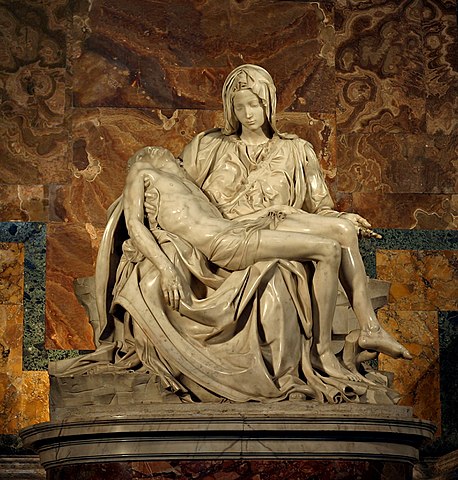
A long time ago, I came across a book about Michelangelo.  My favorite sculpture has to be the one picture above in which Mary cradles a recently crucified Jesus on her lap.  I marveled at how the folds and wrinkles in the fabric looked like actual folds and wrinkles in fabric and not in marble.  Then further along in the book I discovered something else altogether.  A collection of photographs of his many unfinished sculptures.  Yes, even someone as talented as Michelangelo gave up on a project once in awhile.

Michelangelo could have thought about all the time that he put into those sculptures, and finished them in order not to let that time go to waste, but he did not think that way.  The sculptures didn't go the way he wanted so he gave up on them and moved on to something else.  We can get a lot more accomplished if we follow a similar route.  Don't get me wrong, I'm not talking about giving up every time a project gets challenging.  However, I'm sure if we took a long, honest look at the projects we currently have on our "Unfinished Business" list, some of them could be erased with no real loss to our quality of life.

Let's face facts.  We only have a finite amount of time and ability to accomplish what we want/need to accomplish.  By giving up on some of the unfinished business in our lives it makes space to focus on other tasks and relationships.  The most important of these of course being our relationship with God.  We can rest from our unfinished business knowing that He always finishes what He starts, and what He finishes are always masterpieces.

Friday, May 31, 2013

A Matter of Life and Death

Courtesy aviancaflight52.com
Sometimes saying the right thing can make a difference between life and death.

On January 25, 1980 Avianca Flight 52 crashed into Cove Neck, Long Island because it ran out of fuel after a series of delays related to the weather.  One of the main reasons the flight ran out of fuel was that in its communication with the air traffic controllers the Avianca crew used the word "priority" instead of  "emergency".  The air traffic controllers had no idea as to the seriousness of the situation, and the airliner crashed into the countryside killing 73 of the 158 people on board.

Words Matter

This situation came to mind when I was thinking about how the words we use not only can make concept easier or more difficult to understand, but also can affect the way we live our lives.  I'm referring mainly to words that have similar, but not exactly the same, meanings.  Regarding the explanation of concepts, the word difficult is better than hard because hard has a broad set of definitions while difficult has a more narrow set.  In regards to how a word can affect the way in which we live our lives if we view problems as challenges then it frames the situation in a more positive light.

Spinning Until We're Sick

When typing that last sentence I couldn't help but think about what are commonly referred to as "spin doctors".  A spin doctor's job involves putting things into a more positive light than they truly are to help maintain the public image of a person or corporation.  I'm not talking about becoming like that where like a little child on a playground merry-go-round we want to spin faster and faster until we can't see straight and ultimately fall flat on our face (or worse yet, vomit, then fall).  I would classify such language as a euphemism where we make things sound nicer than reality.  What I am encouraging people to do is instead of making things seem better than they are, simply don't make them worse.

Making Canyons out of Culverts

Let's face facts, life on this earth can be quite discouraging.  To simply gloss over reality is not only annoying to most people, but also can be dangerous to our well-being because if everything is sunshine and rainbows then we won't seek help for the various situations in which we find ourselves.  In addition, "seeing the bright side of things" can be too much to ask of many people.  So as a first step, let's simply not to make things seem worse than they need to be.  However, as you probably expect, there is much more to it than that.

Speaking Faith

The 19th century Christian author E.G. White once wrote the following words.
"Take the word of Christ as your assurance. Has He not invited you to come unto Him? Never allow yourself to talk in a hopeless, discouraged way. If you do you will lose much. By looking at appearances and complaining when difficulties and pressure come, you give evidence of a sickly, enfeebled faith. Talk and act as if your faith was invincible. The Lord is rich in resources; He owns the world. Look heavenward in faith. Look to Him who has light and power and efficiency."  Christ's Object Lessons pg. 146
 "By the exercise of living faith you can separate from everything that is not in accordance with the mind of God, and thus bring heaven into your life here below. Doing this, you will have sunshine at every step. When the enemy seeks to enshroud the soul with darkness, sing faith and talk faith, and you will find that you have sung and talked yourself into the light"  Counsels to Parents, Teachers and Students pg. 233
That second quotation hit me especially hard (in a good way).  If we sing and talk faith, we can sing and talk ourselves out of the darkness and into the light, or from death unto life.  So let's make our words agents of life for ourselves and for all who will listen to us.

Saturday, February 9, 2013

How Much Do We Care?

Courtesy latimes.com

Many people want those who do wrong to be brought to justice, but often neglect the greater need of those same people being brought to Jesus.

A friend of mine recently said in reference to the Christopher Dorner manhunt that he hopes that Dorner is brought to justice, but more importantly that he is brought to Jesus.  This statement carries some weight to it given that this friend has been a part of the law enforcement community for about eight years.  This poses an important question in my mind.  How much do we truly care about people who we deem to have gone too far?

In his manifesto, Dorner wrote that he believes the Bible to be mainly a work of fiction.  While I strongly disagree with that sentiment, in a way I can understand it.  Many supposed followers of Christ and the Bible do not follow His teachings found therein. Among other wrongs, Christians often fail to be positive examples for those who do not profess to follow Christ.  In simple terms, we do not practice what we preach.  We discriminate, we oppress, we stand idly by as injustice upon injustice is heaped upon those we deem less fortunate than ourselves.

God is not happy with injustice, and His followers should follow suit. We need to stand up for those who are being discriminated against.  We should seek to correct and prevent the wrongs caused by evil men and women, and this correction and prevention begins with us.  Instead of seeking revenge against those who have wronged us we should seek reconciliation.  If they reject our efforts, then at least we did our part.  Often this act of kindness may not only diffuse the current situation, but also prevent future ones.

We often view people such as Christopher Dorner who commit terrible crimes and reject Christianity as being too bad for God to love.   However, that could not be further from the truth because while we were still sinners, Christ died for us.  As the saying goes, "While there is breath, there is hope."  Let us not give up on others for God has not given up on us.

Friday, June 29, 2012

[Featured Post] Marriage and Scooby-Doo (and the Freedom of Mystery)

This featured post comes from the blog Untangled: A Psychologist's Reflections on Therapy and Life
Marriage and Scooby-Doo (and the Freedom of Mystery)

Scooby Doo Mystery 
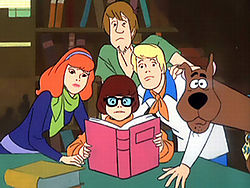
They’ve messed up Scooby-Doo. 

When I was young, you could always count on “the gang” to solve the mystery. The monster always turned out to be some rich-white-male capitalist trying to rip off somebody. I liked Scooby-Doo, because there was a mystery, followed quickly by solutions. In the newer episodes for a new generation, the monsters turn out to be…monsters. The mystery never really gets solved. The point of the show is to experience the mystery, rather than to solve it. 

But my kids love it. They prefer mystery to solutions.

Maybe I need to learn how to love mystery again. Maybe we all do. Our marriages and our world may even depend upon it…

I’m not alone in my quest for solutions.

Just last night, I sat in my living with a group of friends—our children playing outdoors in the June twilight, echoes of laughter drifting on the breeze through open windows—and we talked about the ways we try solve even the most uncertain and mysterious of human experiences. Does a particular feeling mean we made the best job decision? Does our children’s happiness confirm we moved into the right neighborhood? Does a sense of accomplishment mean I have used my time wisely?

Uncertainty everywhere. Mystery everywhere. And all of us on the endless hunt for solutions, for answers to the timeless, unanswerable questions.

While our kids played.

Why do we yearn to solve the mystery? I think we search for solutions because they bring the illusion of certainty, and certainty brings a sense of safety. And we will go to incredible lengths to feel safe. In fact, we have been encouraged to do so from the womb.

Before we were born, most of our parents were purchasing the safest, most disaster-proof crib on the market. They were installing plugs in the light sockets and putting mouth-sized things in cupboards out of reach.

And once we could speak, they plied us with questions, searching for answers. Our parents wanted us to explain our every emotion, and they wanted to know what possessed us to do this or that. Our teachers were always looking for a specific answer, because standardized tests don’t measure mystery.

And the world knows we will pay an awful lot to purchase a feeling of safety. From the moment we earned our first paycheck, businesses were selling us the solutions they create. So, we have become convinced that iPhones are the answer to our disconnectedness, or that a particular neighborhood is the answer to our children’s education and future. Or we settle on a particular theology or a particular church, so we won’t have to wonder anymore. Or we eat kale and expensive vitamins and we think we have found the answer for perfect health.

We seek solutions because they make us feel safe. For a while.

But, inevitably, something happens:

An accident.

Or a diagnosis.

Or an affair.

Or maybe nothing happens, and we simply notice the gnawing sense of unease has returned—the questions are back, and we resume our desperate scramble for answers.

You see, as it turns out, solutions do not bring the peace and freedom for which we are so desperately searching.

Last week, I was in the kitchen finishing the dinner dishes, when my eight-year-old son, Aidan, walked in to the room. He was wearing a flannel bathrobe, with eyeglasses slightly askew, and he was holding a book about the 9/11 terrorist attacks. (Parenting fail?)

A little gray hair and a pipe, and he might have been an elderly man enjoying his retirement.

Of course, what came out of his mouth only added to the effect. He said, “Daddy, the thing I love about God is that the more you think about him, the more questions you have. And I love questions and mysteries.”

Out of the mouths of babes.

His words ruptured me—they were truth and art and revelation, and they took my breath away. But even more than the words themselves, I was struck by the sense of peace and freedom with which they were uttered.

Because having solutions does not bring peace and freedom.


Peace and freedom come when we relinquish solutions and revel in the mystery.

When we stand on the threshold of mystery, we will be afraid at first, because it feels chaotic and dangerous. But if we can stay there, if we can dip our toe into the waters of mystery, we may be transformed. 

We may become like children again.

My two-year-old daughter, Caitlin, has just entered the “why stage.” She asks the question, “Why?” with impunity. And in the end, with dimples popping and a glimmer in her eye, she always answers herself in this way: “Because that’s the way it is supposed to be.”

That answer is enough for her. 
 
She’s not asking the question in order to find the answer—she’s asking because her eyes are opening up to a vast, glorious world, and her questions are an expression of wonder in the mystery of it all. Her questions don’t require answers. They only require asking. 

How might we enter into this kind of mystery and revel in it? I think we can begin by dipping our toes into the on-going, unsolvable mystery of the people to whom we’ve committed our lives. I think our marriages could be a training ground for a people learning to revel in the mystery. Because the truth is, we are all walking mysteries, even to ourselves. If we can never fully know our own depths, how can we expect to fully comprehend the depths of another? Our husbands and wives are bottomless mysteries that defy solving, and we are left no choice but to live in their mystery.

What would happen if we became like children again, reveling in the mystery of the people we are married to, rediscovering the joy of asking questions—not in order to nail down answers, but simply as a way to honor the glory in the people next to us and to acknowledge the wonder in the world around us?

I think we might be transformed into a childlike people, trading the safe harbor of feeble, temporary answers for the vulnerability and wonder of endless questions. I think we might live our relationships and our lives soaked in the freedom and peace of a child discovering. We might stare long at a spider web and wonder at its complexity. We might look at a night sky and marvel at the vastness. We might look into the rebellious eyes of our child and melt at the mysterious universe behind them. We might trade in the violence of certainty for the awe-inspiring peace of the mystery, and in doing so we may unleash freedom in our marriages, and in our families, and in our friendships, and in a world captivated by the need for certainty.

So, tonight, fall asleep next to your spouse. But in the morning, allow yourself to awake to a stranger. Awake to the mystery of another wondrous creature, and become like kids again, forsaking the safety of certain-answers and reveling in the multiplication of questions.

Tomorrow, unleash some mystery into the world, and live in the peace and freedom of it.

Wednesday, February 22, 2012

[SAHD] Parenting Lessons From Eden

Courtesy fanpop.com
Who better to learn parenting lessons from than humanity's Ultimate Parent?

As a new parent I have discovered that people often give you tips, books, etc. on how to be a better parent.  Naturally some advice is better than others, but the best guidance I have found comes from our Ultimate Parent, God Himself.  Here are some lessons I discovered from where it all began, the Garden of Eden.

Create the Best Possible Environment

This one falls in the "too obvious to be seen" category.  I didn't see it at first either, but it makes a lot of sense.  God wanted the best for His kids so he made them the best home possible.  Now many of us may not have a lot of options regarding where we live, but that doesn't mean we can't be creative in our current situation.  A great way to get creative is to get your kids involved in the process.  You may not get a lot of feasible ideas, but at least you're spending time with them.  While you're spending time with them, be sure to . . .

Maintain Their Innocence

This point may be a bit controversial for some.  So much is said how we should not shelter our children and how we should prepare them for the the "real world".  However, look at what God did with His kids.  God purposely told Adam and Eve to avoid the tree that would give them the knowledge of evil, which brings us to our next point.

Give Simple Rules to Follow

God gave three basic commands to His kids: Be fruitful and increase in number, Fill and subdue the earth, and especially Don't eat from this one tree.  A possible application of this principle is instead of getting our kids to follow a litany of rules, get them to follow one simple rule, Do what your parents tell you to do (I know, I know, easier said than done, but one dream, can't he?).  Ultimately God's kids didn't listen to Him, but there is a silver lining for us even in that situation.

Don't Treat Yourself Too Harshly

Hey, if even God's kids didn't listen to Him, if for some strange reason our kids don't listen to us, we shouldn't take that as an indictment against our parenting skills. Children ultimately make their own choices that are beyond their parents control.  However, there is one part where parents have a lot of control.

Don't Avoid Punishment

Now no good parent wants their children to suffer, but when God's kids disobeyed Him, He simply had no other choice. He could have simply excused them because He is God, and can do whatever He wants, but that didn't happen.  Without some punishment, from that point forward, nobody (esp. Satan) would have taken God seriously.  When for whatever reasons parents avoid punishment that only erodes their authority and emboldens their children to try something worse.  Notice also that the punishment was simply allowing them to experience the consequences of their actions.  Something to think about, and while you're thinking . . .

Think More About God
 
While you may not agree with all of my applications, I hope that I have gotten you to think more about what lessons we can learn from the Bible, and I also hope that you take more time to read it for yourself.

What lessons regarding parenting (or anything else for that matter) have you learned from the Bible?  Share your discoveries in the comments section below.

Tuesday, February 7, 2012

[SAHD] What I Learned From My Baby

Courtesy science-essentials.org
The title gives you a clue as to why I haven't posted in a while.

Not long ago in a place not far from where I live, my baby daughter was born.  As events sometimes go, I am now a stay-at-home dad (and no, I have not seen "Mr. Mom").  This prompted me to start a new element of this blog  (hence the acronym in the title).  I toyed with the idea of starting a new blog for the parenting stuff, but figured to stick with this one (although that may change in the future).

I had heard it said that parents learn as much from their children as their children learn from them.  A thought I did not fully understand until I had one of my own.  Here are a few of the lessons I have learned so far.

Realize Your Helplessness

In the Bible, God refers to Himself as our Father.  This name is not so much a means of depicting His gender, but more as a means of clarifying roles.  God takes care of us, and we get taken care of by Him. The main lesson I learned in this area is our utter helplessness without God.  My daughter is completely helpless, she cannot clothe herself, bathe herself, or feed herself.  She even occasionally has difficulty passing gas.  Such is the state of humanity without God's care.  We often deceive ourselves with delusions of self-sufficiency. We would have a much better life if we would let go of this delusion and let God be in control of our lives

Correct Communication is Crucial

Like many infants, my daughter has a very limited vocabulary, which makes understanding what she wants/needs quite challenging.  When she starts crying I often find myself playing a somewhat stressful guessing game.  If only she could tell me right away her need then everyone would be happier.  However, this is not possible given her limited skill set.  In the same way, we have to be understanding of other people if they don't communicate exactly the way we would like them to communicate.  Many people (both male and female) simply lack proper communication skills.  We need to be patient and do our best to understand what they are attempting to tell us.

Don't be Counterproductive

This one goes right along with the previous item because many times since I do not know what my daughter wants, she does not get fed exactly on her preferred time table.  Many times when this happens she will often gain such momentum with her crying that even though the food is there for the taking, she would rather cry than take it, which, of course, makes her more hungry which makes her more angry.  Too often I have to get her to calm down so that she can eat the food she so desperately wants.  How many times do we get so involved in our complaining that we waste valuable time and energy that could have been used to actually accomplish our goals?

So that's it for now.  I'm sure there will be more lessons in the future, so stay tuned.  In the mean time, what lessons have you learned from your (or other people's) children?

Monday, October 31, 2011

[Video] Should Christians participate in Halloween?

I found this video a couple of days ago and thought I'd share it with you.  Whether you fully agree with the conclusion or not, I hope that it gets you thinking.

Friday, September 30, 2011

Stealth Christianity

Courtesy en.wikipedia.org
To some the very thought of an unseen Christian would cause extreme negative emotions.  If you feel that way, calm down, and read the benefits of such a believer.

Interest Leads to Questions

I have been fascinated with flight since I was young.  My second-grade science project was on how the design of airplanes' wings (called "airfoil") caused them to fly.  Naturally, such an interest only intensified at the thought of jet aircraft, especially those of the military variety.

Due to this interest, I recently watched part of a video touting the prowess of the F-22 Raptor (pictured above).  One of the main advantages of this aircraft comes from its stealth capabilities.  In short, stealth technology enables the pilot to detect the enemy's aircraft without the enemy detecting theirs.  After watching the video, a thought started rolling around in my head, "Is the thought of a 'stealth Christian' an oxymoron?"

An Incomplete Picture

As mentioned earlier, the very thought of a Christian who would purposely avoid detection would cause some people to get very upset.  They would probably quote Bible verses such as Matthew 5:14-15 about being a light and not hiding lamps under baskets, and Romans 1:16 about not being ashamed of the of the gospel.  However, such a view is incorrect because it is based off an incomplete picture of the purpose for being unseen.  Let me explain.

Unseen with a Purpose

People that hold the view that a stealth Christian avoids detection as a result of being afraid neglect Jesus' example.  Many times during His ministry Jesus told people to keep a secret.  One example can be found in Luke 5:13-14 where Jesus heals a man then instructs him not to tell anyone what had happened.  Jesus' reason for secrecy can be found in verse 15.  He didn't want people to crowd Him for physical healing, when they should be coming for spiritual healing as well, as found in the following account of Jesus and the paralyzed man.  Then the question remains how can we use this principle?

The Use of Stealth

The F-22 uses its stealth capabilities to take lives.  They're meant to get past the enemies defenses and killing them.  Stealth Christianity involves getting past a person's defenses and saving them through God's grace.  Stealth Christianity isn't about going around proclaiming your identity, it's about showing it through your life.  By living it people will often come to you.  However, it's not the only approach we can use.

Balanced Approach

Stealth Christianity involves getting entrance into people's lives, a "tip of the spear" to put one way.  Sometimes we need to be open about what we believe, and we must be sensitive to the Holy Spirit telling us when those times arise.  It all comes down to balance, and that only comes from God.


Can you think of other benefits of stealth Christianity?  Let us know in the comments section.

Wednesday, September 28, 2011

Taking the Hard Road

Courtesy jerichoschools.org
Many times we equate difficulty with value.  The more effort we put into accomplishing a task, the more value we give to it.  However, that value system doesn't always apply to our spiritual life.

I recently have been experimenting with a different version of the Bible.  I decided to try a more easy-reading version than the one I have currently been using.  As I read the newer version, I found myself thinking that something must be wrong because of how easy it was to read it.  That got me thinking.  Can believing that harder is better take us down the wrong path regarding our spirituality?

Struggle a Part of Life

The Bible often speaks about struggles.  When Adam and Eve made their dreadful choice to eat the forbidden fruit, God said that their (and therefore our) lives were going to be filled with pain and struggles.  Later in history, God commended the patriarch Jacob for struggling with Him, and finally the writer of the book of Hebrews scolded the believers for not struggling enough.  It appears that struggle is simply a part of life, but what happens when we misapply this call to struggle?

Sisyphean Spirituality

Sisyphus, a character found in Greek and Roman mythology, committed a crime.  His punishment  was to roll a large boulder up a hill, watch it roll back down the hill, then roll it back up again, for eternity.  A "sisyphean" task therefore is one that goes on and on and accomplishes nothing.  Many believers throughout history have been practicing a sisyphean spirituality.  They try and try to be a better person, yet they don't get anywhere.  What is the solution to such a fruitless endeavor?

The Grace Solution

The words of a song sung by Larnelle Harris entitled "Were It Not for Grace" puts it well.
Were it not for grace
I can tell you where I'd be
Wandering down some pointless road to nowhere
With my salvation up to me
I know how that would go
The battles I would face
Forever running but losing this race
Were it not for grace
So if you find yourself "forever running but losing the race", take the time to learn more about God's grace.  More importantly, take the time to experience it for yourself. You'll be glad you did.

What has experiencing grace done for you?  Share your story in the comment section.

Tuesday, September 27, 2011

[Book Review] Watching the War

Sometimes the importance of a situation prevents us from taking a big picture look at it.  In his book Watching the War, David B. Smith takes a big picture look the most important situation in the universe.

David B. Smith follows in the footsteps of  C.S. Lewis in this unorthodox view of what many call "the great controversy" or "the story of redemption", which begins with the origin of sin, and ends with its ultimate destruction.  Watching the War portrays this saga primarily from the perspective of Malachon and Pershia, rulers of the fictional planet Senteria.  Aside from giving the author a base from which to tell a story, what purpose does this change in view serve?

Perspective Increases Awareness

While Smith reveals that his personal intention for this perspective is an attempt to get answers for his many questions, another benefit comes as the result of this change; awareness.  Changing our perspective often makes us aware of aspects that we had previously overlooked.  An example from the book comes from the story the fall of Adam and Eve.  In this book Malachon and Pershia travel with God to talk with Adam and Eve, and Pershia gives an impassioned plea that whatever they do, they should not eat the fruit.

More Than Simply a Story

In addition to creative storytelling, Smith takes frequent breaks from the narrative to further unpack some of the concepts that occur in the story.  He draws from a variety of sources (including C.S. Lewis)  to help the reader understand these complex concepts, but he readily admits that he doesn't have all the answers.  At one point, in an attempt to explain how one Man's death on a cross can save an entire planet, Smith states that one doesn't have to know how it works, one simply has to know that it does work.

Conclusion

Many Christians may not learn anything new from this book, but you will be reminded of many important concepts including the most important concept of all, that God loves you.  This book can be purchased for a very reasonable price, and along with the limited amounts of paper copies available (see link above), you can also purchase a Kindle edition.  So what are you waiting for?  Pick your copy today.

What to do you think about this approach to explaining complex subjects?  Tell us your view in the comment section.

Thursday, August 25, 2011

Who Cares?

Image: kairsjoy/photobucket
Few people will ever care as much about our projects as we do, but that's a good thing.

One important fact remains regarding whatever activities we do, whatever projects we work on, whatever dreams we have.  Few people will be as excited, as involved, as we are.  Why should they?  They did not come up with the idea, they didn't make the plans, they didn't put the blood, sweat, and tears into it like we did.  However, that should not discourage us from striving toward our goals. 

In fact, that should make us want to push even more. The lack of caring most likely means that we are on to something. That lack of caring may be God's way of telling us what direction we should go.  Our product, service, or work of art could fill a need and/or inspire people in ways that haven't been done before.

Don't let the masses tell you what you should or should not do.  Go forward into uncharted territory, into the great unknown.  As the words to a song go,
To hear with my heart,
To see with my soul,
To be guided by a hand I cannot hold,
To trust in a way that I cannot see,
That's what faith must be.

Have you ever stepped out in faith and been greatly rewarded?  Tell us your story.