Showing posts with label surrender. Show all posts

Tuesday, July 26, 2011

Red Monkeys

As in many things in life, some keys to dealing with temptation are so obvious we tend to overlook them.

I have been reading through the book Faith that Works by Morris Venden (a full review will come sometime next month), and it has gotten me think about many topics.  Recently, the book has been talking about temptation, and it has reminded me of aspects related to temptation and sin that have been logged in my memory and were gathering dust on the shelves of my mind.

I remember back in high school, a teacher of mine was trying to convey to the class the perils of over-thinking about a task.  The teacher told the class a story about red monkeys, and said whatever we do, do not think about the red monkeys.  The concept was that the more you try and not think about something, the more you actually think about it.  I remember one of my classmates saying that she wouldn't think about the monkeys, and she didn't regardless of how many times they were mentioned throughout the class period.  Now what do red monkeys have to do with temptation?

Simple, she couldn't care less about the red monkeys.  They were of no interest to her, and hence she was not tempted to think about them.  Now if the teacher had told the class not to think about what we were going to have for lunch, and it was the last period before noon, then it might have had some effect especially if the aforementioned student had skipped breakfast. Temptation works in much the same way.

For example, I am not tempted to get involved in insider trading, especially the illegal variety (it wasn't until today that I realized that there was a legal way to do insider trading, shows how much I know on the subject) because I am not even close to being in a position to even consider it.  However, I may be tempted to eat that second piece of cake even though I could easily do without it.  The point being that the strength of a given temptation is directly related to our exposure to, and choices regarding, whatever object, action, or way of thinking is tempting us.  So then, how can we be free from the temptation, and, more importantly, the sin that can result?  The answer is quite simple, yet often difficult to implement.

We need to come to the point where we couldn't care less about whatever is tempting us.  How does that happen?  Do we simply grit our teeth and make the right moral choice when confronted by something tempting?  For many people that answer to that question would be a simple "Yes", but by doing so they would be walking into a very dangerous trap.  The trap of doing things with our own power.

Now if even Jesus, the Son of God, did not do things on His own, what hope do we have of succeeding on our own?  The only way to ward off temptation's power is to be so closely connected with God, so intensely focused on what He focuses on, that we couldn't care less about those temptations.  If we do that, we will even go beyond not caring and get to the point where those temptations are repulsive.  The words to an old hymn say it well.
Turn your eyes upon Jesus,
Look full in His wonderful face,
And the things of earth will grow strangely dim,
In the light of His glory and grace.
So when we find ourselves confronted by temptations, think more about Jesus, less about ourselves, and by all means, do not think about the red monkeys.

Monday, July 11, 2011

What is In Your Hand?

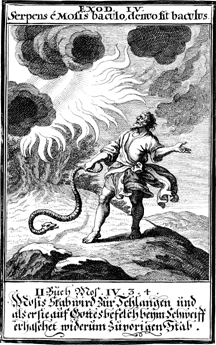
Courtesy Pitts Theology Library
We make a lot of excuses not to follow God's plan for our lives, and those excuses mean very little to God.

Moses answered, “What if they do not believe me or listen to me and say, ‘The LORD did not appear to you’?”   Then the LORD said to him, “What is that in your hand?”
   “A staff,” he replied.
  The LORD said, “Throw it on the ground.”
   Moses threw it on the ground and it became a snake, and he ran from it.  Exodus 4:1-3

I had to laugh a little bit when I read that text, and I'll tell you why.  God told Moses via the burning bush that He had decided to deliver His people from Egyptian bondage, and that Moses was to be the one to tell Pharaoh that this was going to happen.  Moses wasn't excited about this new assignment, so he tried to convince God that He should look elsewhere.  (You can find the entire conversation in Exodus 3 & 4.)  One by one Moses kept making excuses, and one by one God kept knocking them down.

  • Moses:  Who am I to go and say these things to Pharaoh?   
  • God:  You won't be alone.  I will be with you.
  • Moses:  What if the Israelites ask "What is this God's name?"   
  • God:  Tell them "I AM has sent me to you."
  • Moses:  What if they don't believe that You actually sent me?   
  • God:  Throw your staff on the ground, and it'll turn into a snake then back into a staff.  If that doesn't work, put your hand in your cloak and it will become leprous and then be healed.  And, if those two don't work, take some river water and pour it on the ground and it will become blood.
  • Moses:  You know, I've never been a good speaker.   
  • God:  Who made your mouth?  I will help you speak and teach you what to say.
  • Moses:  I still would feel better if you sent someone else.   
  • God:  Oh, alright!  Take your brother with you.  He's already on his way to meet you, and he will speak for you.

We may not be called like Moses to help deliver a nation from slavery, but we all could be doing more in regards to following God's plan for our lives.  God has already promised that He will be with us.  So stop making excuses, and do what He has asked you to do.

Tuesday, May 10, 2011

Judas and Pilate: Parallel Paths to Perdition

The parallel lives of two of history's most infamous men bear solemn warnings for us today.

As some of you may know I have been making my way through the definitive book on the life of Jesus, The Desire of Ages by E.G. White.  I am almost finished (when I'm done I'll do a full review), which, as you may have guessed, means that I am reading about the final events of Jesus' life here on earth.  In the past two chapters I have read, White has gone into more detail about two of the darker players in the drama, Judas Iscariot and Pontius Pilate.  As I was out on a walk I was struck with the thought how similar the life path's of these two men were, and how those paths ultimately ended in a premature death.

White devotes an entire chapter of the book to Judas, and paints a very solemn picture in regards to his life.  I was struck with how far gone this man really was even before his betrayal of his alleged master (I'll get to the "alleged" part in a moment).  The chapter opens in this way.
"The history of Judas presents the sad ending of a life that might have been honored of God. Had Judas died before his last journey to Jerusalem he would have been regarded as a man worthy of a place among the twelve, and one who would be greatly missed. The abhorrence which has followed him through the centuries would not have existed but for the attributes revealed at the close of his history. But it was for a purpose that his character was laid open to the world. It was to be a warning to all who, like him, should betray sacred trusts." pg. 716

I find it interesting that nobody would have known what he was capable of if he had died an earlier death.  It is difficult for many to comprehend that people could have seen Judas as a good guy because we all look backwards through the lens of the betrayal.  Those living and interacting with him could easily have been fooled by the charade that he was acting out to make himself seem righteous.  However, beneath the veneer was something much more sinister.
"Judas had naturally a strong love for money; but he had not always been corrupt enough to do such a deed as this. He had fostered the evil spirit of avarice until it had become the ruling motive of his life. The love of mammon overbalanced his love for Christ. Through becoming the slave of one vice he gave himself to Satan, to be driven to any lengths in sin." Ibid
This is what I was referring to earlier when I stated that Jesus was his "alleged master".  The role of conscientious disciple was simply a cover to further his own gains.

Judas was constantly chafing at Jesus' humility and refusal to set up an earthly kingdom.  Jesus, of course, was quite aware of what was going on even if nobody else was.
"In all that Christ said to His disciples, there was something with which, in heart, Judas disagreed. Under his influence the leaven of disaffection was fast doing its work. The disciples did not see the real agency in all this; but Jesus saw that Satan was communicating his attributes to Judas, and thus opening up a channel through which to influence the other disciples. This, a year before the betrayal, Christ declared. "Have not I chosen you twelve," He said, "and one of you is a devil?" John 6:70."  pg. 718
We often look at that statement in light of the betrayal, but Judas was working against Jesus the entire way.  However, as hard as his heart was there were still chances to repent.  He did not take advantage of them, and as we know from the biblical account, Judas went out and hanged himself.

Pontius Pilate also gets a chapter in the book.  This chapter is less of a character study as the previous one, but still deals a fair amount with how one's choices can cause their life to go horribly wrong.  In contrast to Judas, there was much less mystery regarding Pilate's true character traits.  People knew what he was like.
"The priests thought that with the weak and vacillating Pilate they could carry through their plans without trouble. Before this he had signed the death warrant hastily, condemning to death men they knew were not worthy of death. In his estimation the life of a prisoner was of little account; whether he were innocent or guilty was of no special consequence."  pg. 725
Despite the weakness, vacillation, etc. Pilate could not bring himself to condemn Jesus.  He was impressed with the way He carried Himself in the midst of the mob.  That, coupled with the positive reports Pilate had previously heard, did not match with the accusations being hurled at Him by the priests.  He asked for a private interview.

Jesus took full advantage of this time to try and win Pilate over to the side of truth, but Pilate did not surrender himself to the prodding of the Holy Spirit, and as White put it, "Pilate's golden opportunity had passed."  This wasn't the only opportunity he missed.
"If at the first Pilate had stood firm, refusing to condemn a man whom he found guiltless, he would have broken the fatal chain that was to bind him in remorse and guilt as long as he lived. Had he carried out his convictions of right, the Jews would not have presumed to dictate to him. Christ would have been put to death, but the guilt would not have rested upon Pilate. But Pilate had taken step after step in the violation of his conscience. He had excused himself from judging with justice and equity, and he now found himself almost helpless in the hands of the priests and rulers. His wavering and indecision proved his ruin."  pg. 732
He chose to save himself instead of saving Jesus.  A choice that always backfires.
"Pilate longed to deliver Jesus. But he saw that he could not do this, and yet retain his own position and honor. . . . Pilate yielded to the demands of the mob. Rather than risk losing his position, he delivered Jesus up to be crucified. But in spite of his precautions, the very thing he dreaded afterward came upon him. His honors were stripped from him, he was cast down from his high office, and, stung by remorse and wounded pride, not long after the crucifixion he ended his own life."  pg 738
So here are two men, both came in contact with the Son of God, both chose to live for themselves rather than live for Him, and both ultimately ending dying by their own hand.  Every moment of every day we must make the choices that they did not make, lest our fate be similar to theirs.

Thursday, March 31, 2011

Featured Post: Mark, I am recalculating route now

This featured post comes from Mark Brown, who is the former CEO of Bible Society New Zealand, as well as the founder of Global Scope Media and Global Scope Ministries.  More info. about him can be found here.


Mark, I am recalculating route now

And Jesus answered them, “Those who are well have no need of a physician, but those who are sick.  I have not come to call the righteous but sinners to repentance.” Luke 5:31-32
I was recently in the US and had a hire car.  Thankfully it has GPS to help keep me on the right path, but I cannot count the number of times the patient GPS voice reported, ‘recalculating route now..’  And thankfully even though I had accidentally taken the exit 10 miles too early, the nice GPS machine was able to get me back on track.  I could almost hear it sigh and quietly mutter under its breath ‘oh not again.. recalculating route now’. The greek behind the word ‘sinners’ talks of one who deviates from the path towards God.  To sin is to get lost, to be distracted, to stray off the path God intends for us.
My GPS is my Bible.  It shows me not only that when I am off route, but it displays to me what I need to do to get back on track.  But what would happen if I had put the GPS machine in the trunk of the car?  I would be in big ‘where am I?’ trouble. In the same way, I need to spend time with my Bible often.  Not just once a day, but often, making it part of my approach to life, being guided along the right path consistently.  Reflecting on passages throughout the day.
And repentance: when I come before Jesus and confess my sin and am washed anew, well that is when God says, Mark, I am recalculating route now, you are back on the path towards me.
Praise God!
Mark Brown

Thursday, October 28, 2010

Defining Ourselves

How we define ourselves is just as, if not more, important than how we define other people.

So often when we were growing up did we get told not to call other people names.  This was most likely done with the (unspoken) hope that we would outgrow such behavior as we got older.  While our name-calling regarding others may have lessened as we matured, many of us still fall into the trap of calling ourselves names that we shouldn't be called.  I said in my opening statement that this may be the more important behavior of the two, and here's why I made that statement.

How we define ourselves often distorts how we view the world, and therefore affects our interactions with it.  For example, if we are constantly telling ourselves that we are a failure, then we will most likely will never be truly successful.  On the flip side, if we constantly tell ourselves that we are successful then there is a distinct possibility that we will only try to accomplish things that we know we can succeed at, and not try to really push ourselves to accomplish truly great things.  In short, when we define ourselves in a certain way there is a danger that we will limit our behaviors to fulfill that definition.

This defining, or labeling (as it is sometimes called) is a symptom of our quest to understand everything which is a condition that goes back to Eden when Eve decided she had to know everything good and evil.  When we define something that means we understand it.  The problem is that understanding is often quite limited making the definition flawed.  Some have said that it is impossible to fully understand somebody else because we have not experienced all the things that they have, but that statement wouldn't apply to ourselves would it, especially considering that we have experienced everything that we gone through in life?

The problem with understanding ourselves is that we often have massive blind spots when it comes to our own behavior and being.  We often say that we are a good person, but reality says otherwise.  So how do we deal with this problem of faulty understanding and flawed definitions?  The answer to that question can be summed up into one word, surrender.  When we surrender ourselves to God, we acknowledge that He is the only One that understands everything.  Those flawed definitions then fade away and are replaced with the only definition that truly matters, "I have called thee by thy name; thou art mine."

Wednesday, July 14, 2010

How to Obey

Psalm 119:9-16

Beth

   9 How can a young man keep his way pure?
       By living according to your word.
 10 I seek you with all my heart;
       do not let me stray from your commands.
 11 I have hidden your word in my heart 
       that I might not sin against you.
 12 Praise be to you, O LORD;
       teach me your decrees.

 13 With my lips I recount
       all the laws that come from your mouth.

 14 I rejoice in following your statutes
       as one rejoices in great riches.

 15 I meditate on your precepts
       and consider your ways.

 16 I delight in your decrees;
       I will not neglect your word.


We tend to overlook the key element that enables us to obey God's law.

In my previous Psalms post, I stated that this one would talk about how to continue on this journey of keeping God's law. The first three verses of the "Beth" section (Beth is the next letter in the ancient Hebrew alphabet), gives three guidelines. One keeps God's law by: 1) living according to His word, 2) seeking Him with the entire heart, and 3) hiding His word in the heart. You may think that since it's only three steps that obedience is a simple matter of a checklist. Once you complete those three steps, then you're on your way. Sadly, we tend to make things even more difficult then they need to be.

One of the reasons it is so difficult is that we tend to do steps one and three while neglecting number two. We need to seek God with our entire heart. The point of His word, the Bible, is to draw us to Him. Living a righteous life comes as a result of seeking God. Neither the Bible nor living a righteous life are ends in and of themselves.

To seek God with our entire heart we must surrender our will to His will. This must be a consistent, constant surrender. Once we start along this path, we will become increasingly aware of our need to surrender, and the more we surrender the more of our heart is open to Him. I could go into details as to what we need to surrender, but I'm sure we all have an idea as to where each of us needs to begin. Surrendering involves a struggle, but take heart, the more we surrender, the easier surrender becomes.

Tuesday, July 13, 2010

The Trial at Caesarea

We should never pass up opportunities to forsake our sin and turn to Christ.

In this chapter, we find out that after leaving Jerusalem, Paul was brought to Caesarea, and some days after his arrival there he was brought before the Roman governor Felix. Paul's accuser, Tertullus, not surprisingly stated that Paul was guilty of bogus charges, and after he had said his piece, Felix asked Paul to respond.
. . . Paul's plain statement of the facts in the case enabled Felix to understand still more clearly the motives by which the Jews were governed in attempting to convict the apostle of sedition and treasonable conduct. The governor would not gratify them by unjustly condemning a Roman citizen, neither would he give him up to them to be put to death without a fair trial. Yet Felix knew no higher motive than self-interest, and he was controlled by love of praise and a desire for promotion. Fear of offending the Jews held him back from doing full justice to a man whom he knew to be innocent. He therefore decided to suspend the trial until Lysias should be present, saying, "When Lysias the chief captain shall come down, I will know the uttermost of your matter." pg. 422
Not long after this Paul was summoned to a private interview with Felix and his wife Drusilla.
Paul regarded this as a God-given opportunity, and faithfully he improved it. He knew that he stood in the presence of one who had power to put him to death or to set him free; yet he did not address Felix and Drusilla with praise or flattery. He knew that his words would be to them a savor of life or of death, and, forgetting all selfish considerations, he sought to arouse them to a sense of their peril. pgs. 423, 424
 Felix and Drusilla were convicted of their wrongdoing, and although they had slightly different responses (Drusilla let her hatred of Jesus get in the way, while Felix listened more earnestly), the end result was still the same.
But instead of permitting his convictions to lead him to repentance, he sought to dismiss these unwelcome reflections. The interview with Paul was cut short. "Go thy way for this time," he said; "when I have a convenient season, I will call for thee." pg. 426
After that, nothing consequential happened for two years. Paul remained under house arrest (he was given some freedom, but not too much). Felix unsuccessfully tried to secure a bribe from Paul to be released, but he didn't have the money and wouldn't have paid it if he did.
Felix was finally summoned to Rome because of gross wrongs committed against the Jews. Before leaving Caesarea in answer to this summons, he thought to "show the Jews a pleasure" by allowing Paul to remain in prison. But Felix was not successful in his attempt to regain the confidence of the Jews. He was removed from office in disgrace, and Porcius Festus was appointed to succeed him, with headquarters at Caesarea. pg. 427
Like the Jewish leaders in Jerusalem, E.G. White had a sobering epitaph for Felix as well.
A ray of light from heaven had been permitted to shine upon Felix, when Paul reasoned with him concerning righteousness, temperance, and a judgment to come. That was his heaven-sent opportunity to see and to forsake his sins. But he said to the messenger of God, "Go thy way for this time; when I have a convenient season, I will call for thee." He had slighted his last offer of mercy. Never was he to receive another call from God. Ibid
 May something like this be never written about us. Let us take hold of every opportunity to turn away from our sins and turn to Christ.

Monday, July 12, 2010

Paul a Prisoner

Paul ended up in chains, but it was the Jewish leaders who were truly prisoners.

This chapter details the events that led up to Paul becoming a prisoner. I found this chapter to be quite interesting because the story told here is filled with danger and intrigue, but it was disappointing to read that all these events could have been avoided.

What started these events in motion was that the leaders of the Christian church in Jerusalem were stuck in their old ways of thinking.
In the earlier years of the gospel work among the Gentiles some of the leading brethren at Jerusalem, clinging to former prejudices and habits of thought, had not co-operated heartily with Paul and his associates. In their anxiety to preserve a few meaningless forms and ceremonies, they had lost sight of the blessing that would come to them and to the cause they loved, through an effort to unite in one all parts of the Lord's work. Although desirous of safeguarding the best interests of the Christian church, they had failed to keep step with the advancing providences of God, and in their human wisdom attempted to throw about workers many unnecessary restrictions. Thus there arose a group of men who were unacquainted personally with the changing circumstances and peculiar needs met by laborers in distant fields, yet who insisted that they had the authority to direct their brethren in these fields to follow certain specified methods of labor. They felt as if the work of preaching the gospel should be carried forward in harmony with their opinions. pg. 400
I had mentioned in an earlier post about the need for God's workers to adapt there methods to their target audience. These leaders refused to change, and deceived themselves into thinking that their way was the best way to do things.
These men had lost sight of the fact that God is the teacher of His people; that every worker in His cause is to obtain an individual experience in following the divine Leader, not looking to man for direct guidance; that His workers are to be molded and fashioned, not after man's ideas, but after the similitude of the divine. pg. 401
The leaders that asked that Paul go through a process in which he should become ceremonially pure so as to not arouse negative feelings among the Jews. Paul wanted so much to reconcile these parties that he went through with this needless process, and it was while he was doing this that things really went awry.
 Those who advised Paul to take this step had not fully considered the great peril to which he would thus be exposed. At this season, Jerusalem was filled with worshipers from many lands. As, in fulfillment of the commission given him by God, Paul had borne the gospel to the Gentiles, he had visited many of the world's largest cities, and he was well known to thousands who from foreign parts had come to Jerusalem to attend the feast. Among these were men whose hearts were filled with bitter hatred for Paul, and for him to enter the temple on a public occasion was to risk his life. For several days he passed in and out among the worshipers, apparently unnoticed; but before the close of the specified period, as he was talking with a priest concerning the sacrifices to be offered, he was recognized by some of the Jews from Asia. pg. 406
This recognition brought about a flurry of events that included his binding in chains, ministering to the mob, a hearing in front of the Sanhedrin, avoiding forty Jewish assassins, and being transported out of the city by heavy Roman guard.

E.G. White writes a sobering epitaph for those Jewish leaders.
. . . Had the leaders in the church fully surrendered their feeling of bitterness toward the apostle, and accepted him as one specially called of God to bear the gospel to the Gentiles, the Lord would have spared him to them. God had not ordained that Paul's labors should so soon end, but He did not work a miracle to counteract the train of circumstances to which the course of the leaders in the church at Jerusalem had given rise. pg. 417
 Then she had this to say about us in modern times.
The same spirit is still leading to the same results. A neglect to appreciate and improve the provisions of divine grace has deprived the church of many a blessing. How often would the Lord have prolonged the work of some faithful minister, had his labors been appreciated! But if the church permits the enemy of souls to pervert the understanding, so that they misrepresent and misinterpret the words and acts of the servant of Christ; if they allow themselves to stand in his way and hinder his usefulness, the Lord sometimes removes from them the blessing which He gave. pgs. 417,418
Lord help us to appreciate those who sacrifice themselves for Your work.

Sunday, July 11, 2010

Paul's Last Journey to Jerusalem

Those who work for God should not have any fear.

The title of this chapter indicates that most likely it's story comes from near the end of Paul's life because of his willingness to travel it would take a lot for something to be his last journey anywhere.  He had high hopes for the work there.
Paul greatly desired to reach Jerusalem before the Passover as he would thus have an opportunity to meet those who should come from all parts of the world to attend the feast. Ever he cherished the hope that in some way he might be instrumental in removing the prejudice of his unbelieving countrymen, so that they might be led to accept the precious light of the gospel. He also desired to meet the church at Jerusalem and bear to them the gifts sent by the Gentile churches to the poor brethren in Judea. And by this visit he hoped to bring about a firmer union between the Jewish and the Gentile converts to the faith. pg. 389
However, he soon found out that such hopes would be quite difficult to achieve.
 Having completed his work at Corinth, he determined to sail directly for one of the ports on the coast of Palestine. All the arrangements had been made, and he was about to step on board the ship, when he was told of a plot laid by the Jews to take his life. Ibid
Therefore, he decided to take his time in getting to Jerusalem, and made what turned out to be a farewell tour.

Upon reaching the city of Miletus, he discovered that he had some time before the next ship, and took the time to speak to the believers there. His message there is one all workers of Christ can apply to their lives.
"Wherefore I take you to record this day, that I am pure from the blood of all men. For I have not shunned to declare unto you all the counsel of God." No fear of giving offense, no desire for friendship or applause, could lead Paul to withhold the words that God had given him for their instruction, warning, or correction. From His servants today God requires fearlessness in preaching the word and in carrying out its precepts. The minister of Christ is not to present to the people only those truths that are the most pleasing, while he withholds others that might cause them pain. He should watch with deep solicitude the development of character. If he sees that any of his flock are cherishing sin he must as a faithful shepherd give them from God's word the instruction that is applicable to their case. Should he permit them in their self-confidence to go on unwarned, he would be held responsible for their souls. The pastor who fulfills his high commission must give his people faithful instruction on every point of the Christian faith, showing them what they must be and do in order to stand perfect in the day of God. He only who is a faithful teacher of the truth will at the close of his work be able to say with Paul, "I am pure from the blood of all men." pgs. 393, 394
All those who work for God, not only just pastors, should seek to give a complete message. Too many times, I hear about ministers who only give messages that people like to hear. Messages that promise prosperity and peace without any real sacrifice on their part. I am reminded of an interview from some years ago between a prominent preacher of this kind of gospel and Larry King. Note the following exchange.
OSTEEN: I have thoughts. I just, you know, I don't think that a same-sex marriage is the way God intended it to be. I don't think abortion is the best. I think there are other, you know, a better way to live your life. But I'm not going to condemn those people. I tell them all the time our church is open for everybody.

KING: You don't call them sinners?

OSTEEN: I don't.

KING: Is that a word you don't use?

OSTEEN: I don't use it. I never thought about it. But I probably don't. But most people already know what they're doing wrong. When I get them to church I want to tell them that you can change. There can be a difference in your life. So I don't go down the road of condemning.
 Paul, in contrast, did not mince words in regards to sin as anyone who even just skims his writings can discover. He wasn't afraid to call sin by it's right name, but always did it with love and the guidance of the Holy Spirit.

Paul wasn't afraid to point out sin, and he definitely wasn't afraid to suffer for the sake of the gospel. His friends sought to prevent him from going to Jerusalem, but to no avail.
"When we heard these things," Luke continues, "both we, and they of that place, besought him not to go up to Jerusalem." But Paul would not swerve from the path of duty. He would follow Christ if need be to prison and to death. "What mean ye to weep and to break mine heart?" he exclaimed; "for I am ready not to be bound only, but also to die at Jerusalem for the name of the Lord Jesus." Seeing that they caused him pain without changing his purpose, the brethren ceased their importunity, saying only, "The will of the Lord be done." pg. 397
Lord, help me to be as fearless in my Christian duty as Paul was.

Thursday, July 8, 2010

Not to Us

Psalm 115:1  Not to us, O LORD, not to us but to your name be the glory, because of your love and faithfulness.


We should seek to bring glory to God, and not to ourselves.

Psalm 115 is a psalm about God. It's purpose is to bring Him glory. Too often in our lives we seek to bring glory, or at least recognition, to ourselves. We are often like little children who go around saying, "Look what I did!" This is a practice, an attitude, that needs to go away.

It feels good to get recognition for the things that we do and say. I'm not going to deny that. However, why do we need that recognition in order to feel good? The Bible is full of people who did not seek recognition for themselves. John the Baptist, that fiery preacher who no doubt drew large crowds, said that he must decrease so that Christ would increase. The apostle Paul, another man who garnered a lot of attention, respect, and sometimes even fear called himself the chief of sinners,  the lowest of the low because of his encounter with Christ. Of course, there is also Jesus Himself who when someone called Him "Good Teacher" stated that there is no one good save God in Heaven. 

We, as Christians, need to be very conscious of our need to be humble and bring glory to God. We need to do this in action and in attitude. We need not only to act humble, we also need to be humble. The reason given in this psalm that God should be the true recipient of glory is because of His love and faithfulness. His love and faithfulness have never wavered. How many times have our love and faithfulness wavered, not only to our God but also for our fellow human beings?

To consistently, constantly bring glory only to God is not something that happens over night. It is the product of a continual surrender to His will. By surrendering to Him, we lose sight of ourselves, and bringing Him glory becomes as natural as breathing.

Friday, July 2, 2010

Let God Take Care of It

Psalm 109:1-5  1 O God, whom I praise, do not remain silent, 2 for wicked and deceitful men have opened their mouths against me; they have spoken against me with lying tongues. 3 With words of hatred they surround me; they attack me without cause. 4 In return for my friendship they accuse me, but I am a man of prayer. 5 They repay me evil for good, and hatred for my friendship.


Life got you down? Have you been falsely accused by wicked and deceitful people? Has your friendship been repaid with evil? Don't get even. Let God take care of it.

While other psalms have been about praise or the natural world, Psalm 109 is about payback. However, this is not payback in the usual sense. This is about divine payback. David, the author, has had people treat him very poorly, and in return he asks God to do some things to these people. Here are the things that he asks God to do.
  • Appoint an evil man to stand against him so that he will be found guilty in a court of law
  • Have his prayers condemn him
  • Shorten his life so another takes his place of leadership
  • Make his children fatherless
  • Make his wife a widow
  • Make his children become wandering beggars
  • Have all his property seized by creditors and plundered by strangers
  • Have all his descendants cut off and blotted out from the next generation
  • Remember the iniquity of his fathers
  • Never blot out the sin of his mother
  • Always remember their sins so that their memory may be cut off from the earth
A little extreme? Probably, but the key point I want to make here is that these are all things he asked God to do. These are not things that he said he would do to them. We are not given the exact time in his life when he wrote this psalm, but it is safe to say that he was in a position to exact some sort of revenge upon his enemies at this time. However, he left it to God to take care of the situation.

David's attitude stands in direct contrast to the prevailing attitude of society where those who exact revenge upon evil people are glorified. This attitude is most notably reflected in popular movies, especially action movies where an individual or a team of individuals take the law into their own hands against evildoers. However, we should not think that we can avoid partaking in this attitude simply by avoiding watching movies and television. The desire for revenge comes from within the human heart, and the only way to silence it is to surrender our hearts to God.

Help me Lord to fully surrender my heart to you, so that when I am mistreated I will not look to myself, but to You, for help.

Wednesday, June 23, 2010

Being a Sheep

Psalm 100 1 Shout for joy to the LORD, all the earth. 2 Worship the LORD with gladness; come before him with joyful songs. 3 Know that the LORD is God. It is he who made us, and we are his; we are his people, the sheep of his pasture. 4 Enter his gates with thanksgiving and his courts with praise; give thanks to him and praise his name. 5 For the LORD is good and his love endures forever; his faithfulness continues through all generations.


Only by being His sheep can we truly find rest.

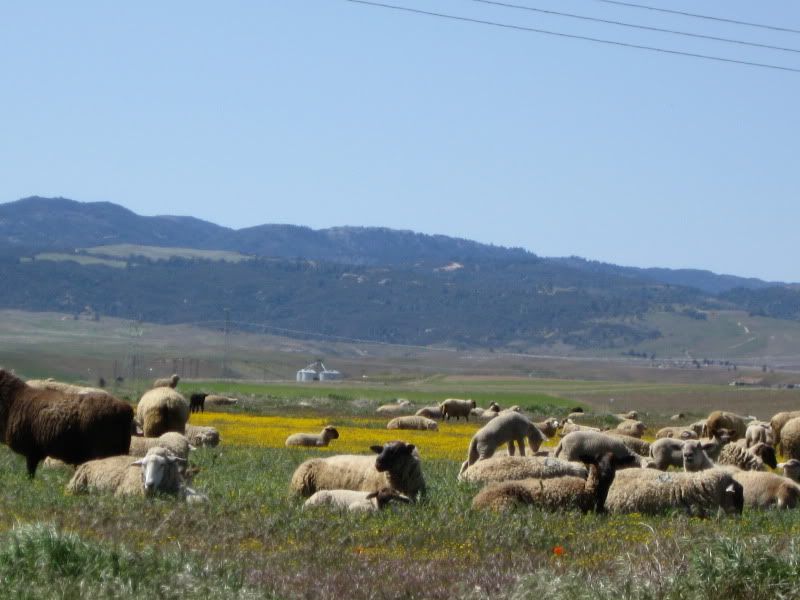
Even though I included the entire psalm, one verse stood out above the rest, and that is verse three. I recently did a little studying about sheep, as well as the concept of us being His sheep. The author lived in an area where sheep were an important part of the livelihood and economy, and therefore knew about sheep (esp. if the author was David, who was, in fact, a shepherd). The more I know about sheep, the less flattering the illustration becomes.

You see, sheep are definitely not the smartest animal out there. In fact, they are probably near the bottom of the intelligence scale. It's a little humbling as an intelligent human to be compared with such an animal, but the illustration fits when I compare myself to God. There are so many times when I haven't acted intelligently esp. where my spiritual life is concerned. I need to realize that I need God to take care of me as a shepherd would take care of his sheep. When I am in His pasture I have little to be concerned with because I know that I am under His care.

To be in His pasture, I must constantly surrender to His leading; something I am not inclined to do. I understood the concept of a general surrender to God, but more recently I have discovered that surrendering to God meant surrendering the little things of life. The process of surrendering is not the easiest thing to do, but it's the only way I can truly find the rest that comes from being the sheep of his pasture.

Thursday, February 18, 2010

Preventing (and Solving) the Polarization Problem

I hate to say it, but sometimes the church can have striking similarities with the current U.S. Congress.  Thankfully, there is a solution to that problem.

A few days ago, as I was looking at the website for a local newspaper, I saw the name "Evan Bayh" as one of their featured topics.  I had never heard that name before so I clicked on the link to see why this guy was newsworthy.  It turned out that he is a U.S. senator representing the state of Indiana who decided that it was time for him to retire from politics.  As I read the article, I came across a quotation from Mr. Bayh, that I am sure that many Americans would agree with.  He said,
"For some time, I have had a growing conviction that Congress is not operating as it should.  There is too much partisanship and not enough progress -- too much narrow ideology and not enough practical problem-solving. Even at a time of enormous challenge, the people's business is not being done."
Simply stated, he is leaving because he believes that Congress isn't doing the job it was put in place to do, which is to serve the people.  Sometimes when I look around, I wonder if God's church is suffering from excess partisanship, and narrow ideology as well.  However, instead of merely neglecting to do "the people's business", we are neglecting to do God's business, which has much more serious consequences.

When Simone and I took the pre-wedding classes required by the church we were eventually married in, we learned that one of the things to beware of in a marriage is polarization.  Polarization is essentially becoming an extreme version of yourself.  For example, a spontaneous man marries a methodical woman, and instead of coming together on some sort of workable middle ground, they go in opposite directions.  The spontaneous man becomes radically impulsive, and the methodical woman becomes unbearably rigid.  Then whatever plans God had for them are seriously undermined.

We have to be very careful in both our local churches, as well as in the church at large, to avoid polarization; one group becoming extremely "liberal" and the other becoming extremely "conservative", all the while each faction believes they have cornered the market on the correct way to be.  The results of this behavior are lost souls, and a happy devil.

The only real solution to this problem is for everyone one to stop looking at themselves, and each other, and to start looking at Jesus.  I saw an exercise one time where a group of people stood in a circle.  The center of the circle represented the cross.  Everyone was instructed to take one step towards the center, and as you may have guessed, they drew closer to one another.  So if you want to avoid your church becoming like the U.S. Congress, focus on the cross.  You might be amazed at what can happen.