Thursday, July 21, 2011

Featured Post: "Why wasn't I informed?"

This featured post comes from Seth Godin who is an accomplished writer, speaker, and entrepreneur (bio here).

"Why wasn't I informed?"


Information is tricky. Sometimes it's delivered to you. Often, you need to go find it.
There's no blame in not being aware of something you had no idea you ought to be looking for. If you've been using the same brand of aftershave for five years, you're forgiven for not Googling it regularly to find out if it contains a carcinogen. That's information we'd like to come find us, not something we need to be on the alert for.

On the other hand, I'm stunned when someone enters new territory without doing a modicum of research. Consider the yutz who goes on vacation to a foreign land, only to discover on arrival that they're in the middle of monsoon season (happens every year around this time!) or that there's a civil war going on.

Or perhaps the small businessperson who launches an expensive marketing campaign without investing a few hours in reading up on what works and what doesn't.
 
Or the email novice who forwards an incredible email to her entire address list without checking Snopes first.

The rules are now clear: no one is going to inform you, but it's easier than ever to inform yourself. Before you spend the money, the time or the attention of your friends, look it up.

Thursday, July 14, 2011

The Divine Hitman

The Death of Jezebel
Courtesy Orientalism in Art
Truth may not always be stranger than fiction, but it can be as dramatic.

The horseman rode off to meet Jehu and said, “This is what the king says: ‘Do you come in peace?’”
   “What do you have to do with peace?” Jehu replied. “Fall in behind me.”
   The lookout reported, “The messenger has reached them, but he isn’t coming back.”  2 Kings 9:18

As I am reading through the Bible, I am constantly amazed at how many great stories exist in the Old Testament.  Those who neglect that portion of the Scriptures miss out on many stories involving colorful characters.  Jehu is one such character.  There are two Jehus in the Bible, the first one, Jehu son of Hanani, was a prophet, and while I'm sure that he had an interesting life, the one I'm talking about is Jehu the son of Nimshi, who was a military leader who became king of Israel.

Jehu son of Nimshi comes onto the scene during the time when Elijah was the main prophet in Israel.  Shortly after the Mount Carmel experience, God gives Elijah a "to do" list which involves anointing two kings and his prophetic successor.  Apparently, Elijah didn't complete the list before being taken to heaven, so we find Elisha being the one to set Jehu's reign in motion.

I'm not going to retell Jehu's entire story (which you can read in 2 Kings 9-10), but I will say that his story reads like some sort of action movie (hence the provocative title for this post).  After being anointed king by an anonymous young prophet described as a "maniac", Jehu, formerly a military commander, becomes the leader of what amounts to a death squad hunting down and eliminating all those connected with the now-deceased evil king Ahab and the worshipers of the false god Baal.

One of my favorite parts of this story shows that there was something special about Jehu (if I was making a movie, this clip would be in the trailer).  As he was approaching the hideout for number one on his hit list, Ahab's son Joram, Joram sends out a messenger to see if Jehu has come in peace, and as all good action-movie stars go, he has definitely not come in peace.  Jehu had such a way about him (I would compare him to Leonidas of Spartan fame), that with two short sentences (see text above), he convinces not one, but two of Joram's messengers to switch sides and fight against their former leader.

After eliminating Joram and Ahaziah, Jehu goes after the prophet-killer Jezebel, Ahab's widow.  What happens next says something about both Jehu and Jezebel.  When Jezebel heard that Jehu was on his way, she did her hair and put on makeup, and stood by a window waiting for him.  When he arrived she asked him if he came in peace (you know the answer to that question), and once again, with a few words, Jehu was able to convince some on the other side to do his bidding.

The remainder of the story involves more action as Jehu makes his way through his divine hit list (incidentally, nobody after this point asks if he came in peace), and God commends him of his services even though Jehu didn't get everything right.  While I am not advocating the glorification of bloodshed, I'm writing about Jehu's story for the purpose of getting people to pay more attention to the entire Bible.

So if you take the time and read some of the great stories of the Old Testament, you will find that the truth in the Bible can be as interesting as the fiction you'd find elsewhere.

Tuesday, July 12, 2011

Hoping but Not Receiving

One of the reasons we don't receive God's power in our lives is that we are looking for the wrong kind.

The chief priests and our rulers handed him over to be sentenced to death, and they crucified him; but we had hoped that he was the one who was going to redeem Israel.  Luke 24:20-21a

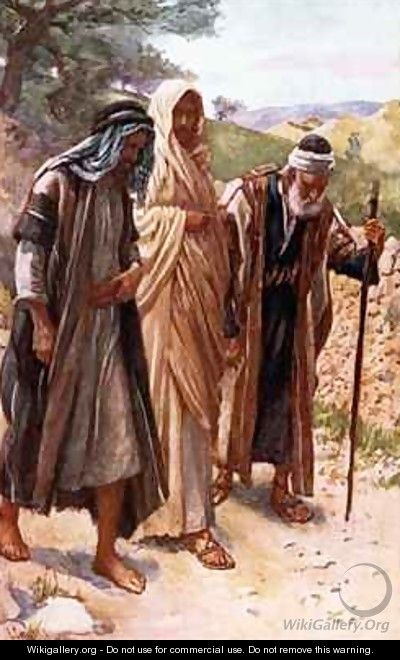
This statement comes from the conversation between Jesus and the two disciples on the road to Emmaus (read it in its entirety here).  People often overlook this part of the conversation in a rush to focus on other aspects of the story like "the good part" where Jesus reveals His identity and everyone gets all excited.  However, we do the story a disservice by neglecting the hoping part because therein lies the reason for the "downcast" faces, and, in a way, the reason they were so excited after the reveal.  They misunderstood the reality of Jesus' mission, but why?

These disciples, along with most of the Jewish people at that time, which, sadly, included the twelve, thought that the Messiah was to come and deliver the nation of Israel from Roman bondage so that they could have the easy life like back in the good old days of David and Solomon.  Despite Jesus' many statements regarding the true nature of "the kingdom of heaven", and His refusal to be crowned as an earthly king, they couldn't rid themselves of the idea that He "was going to redeem Israel", and set up an earthly kingdom.  Sadly, that concept, and ones similar to it, still hold sway among many of the current professed followers of Christ.

One modern departure from Jesus' true mission on earth exists in "prosperity theology" which promotes the belief  that all one needs to do to receive anything is "name it and claim it".  Adherents to this belief system use texts from the Bible as a means to receive anything from good health to a new house.  Interesting thoughts coming from professed followers of one who was essentially homeless, and spoke of riches as a hindrance to entering God's kingdom after telling a rich man to sell all of his possessions.

A more subtle, and therefore more dangerous, variation on this theme also exists.  That being the concept that the life of a Christian should be for the most part, free from problems and sacrifice.  This view continues despite statements from Jesus to the contrary like the one found in Luke 9:23-24 which states that His true followers "must take up their cross daily."  Apparently many of his followers today suffer from the same tendency towards selective hearing as did His disciples back then.  I say this because prior to making that statement, He told His disciples, "The Son of Man must suffer many things and be rejected by the elders, the chief priests and the teachers of the law, and he must be killed and on the third day be raised to life." (v. 22)  It doesn't get much plainer than that, yet not long after hearing that statement, we find the two disciples walking to Emmaus all downcast and such, saying "The chief priests and our rulers handed him over to be sentenced to death, and they crucified him; but we had hoped . . ."

In short, we don't receive God power in our lives because we look for His power to eliminate our problems (something He never said He would do) instead of to help us through them (something He often said He would do).

So if you start sensing the lack of God's power in your life, you should stop and ask yourself, "Am I looking for the right kind?"