Monday, July 11, 2011

What is In Your Hand?

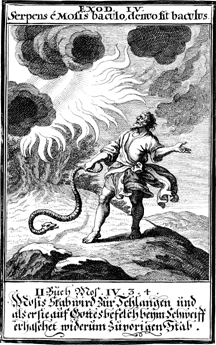
Courtesy Pitts Theology Library
We make a lot of excuses not to follow God's plan for our lives, and those excuses mean very little to God.

Moses answered, “What if they do not believe me or listen to me and say, ‘The LORD did not appear to you’?”   Then the LORD said to him, “What is that in your hand?”
   “A staff,” he replied.
  The LORD said, “Throw it on the ground.”
   Moses threw it on the ground and it became a snake, and he ran from it.  Exodus 4:1-3

I had to laugh a little bit when I read that text, and I'll tell you why.  God told Moses via the burning bush that He had decided to deliver His people from Egyptian bondage, and that Moses was to be the one to tell Pharaoh that this was going to happen.  Moses wasn't excited about this new assignment, so he tried to convince God that He should look elsewhere.  (You can find the entire conversation in Exodus 3 & 4.)  One by one Moses kept making excuses, and one by one God kept knocking them down.

  • Moses:  Who am I to go and say these things to Pharaoh?   
  • God:  You won't be alone.  I will be with you.
  • Moses:  What if the Israelites ask "What is this God's name?"   
  • God:  Tell them "I AM has sent me to you."
  • Moses:  What if they don't believe that You actually sent me?   
  • God:  Throw your staff on the ground, and it'll turn into a snake then back into a staff.  If that doesn't work, put your hand in your cloak and it will become leprous and then be healed.  And, if those two don't work, take some river water and pour it on the ground and it will become blood.
  • Moses:  You know, I've never been a good speaker.   
  • God:  Who made your mouth?  I will help you speak and teach you what to say.
  • Moses:  I still would feel better if you sent someone else.   
  • God:  Oh, alright!  Take your brother with you.  He's already on his way to meet you, and he will speak for you.

We may not be called like Moses to help deliver a nation from slavery, but we all could be doing more in regards to following God's plan for our lives.  God has already promised that He will be with us.  So stop making excuses, and do what He has asked you to do.

Monday, July 4, 2011

Featured Post: The Revolutionary Power of Words

This featured post comes from Jeff Goins whose blog, Jeff Goins: Writer is "a blog on writing, ideas, and making a difference in the world."  Jeff is also the author of The Writer's Manifesto: Stop Writing to Be Read & Adored.

The Revolutionary Power of Words


Never, ever, ever underestimate the power your words have.

Take today, instance. In America, we call July 4 “Independence Day”, because it marks the beginning of our freedom.

Revolutionary Words - Declaration of Independence
Photo credit: Flickr (Creative Commons)

And just how did this revolution begin? With a Declaration, of course:
When in the Course of human events it becomes necessary for one people to dissolve the political bands which have connected them with another and to assume among the powers of the earth, the separate and equal station to which the Laws of Nature and of Nature’s God entitle them, a decent respect to the opinions of mankind requires that they should declare the causes which impel them to the separation.
Powerful, right? I like that scene in National Treasure where Nicolas Cage says, “People don’t talk like that anymore.”

I wish they would. It’s time to reclaim the revolutionary power of words.

Whoever said “talk is cheap” is a liar.

Words are powerful, painful, awful, and amazing tools. They can hurt, help, hinder, and heal. But they are not cheap. They are quite expensive.

Words cost something. Like your time and money. Sometimes, they even cost your patience or self-worth. Words have a price tag.

Words can change the world.

They have before. Here are some examples to remember:
  • When Martin Luther tacked his 95 theses to the church door.
  • When Gutenberg created the printing press and gave the power of thought back to the people.
  • When JFK asked us what we could do for our country.
  • When MLK wrote letters from Birmingham.
  • When Gandhi spoke and staged nonviolent protests.
  • When Jesus gave a little speech on a hilltop.
  • When Neil Armstrong took his first steps (and spoke his first words) on the moon.

Words matter.

You know this already. You have felt it. Sometimes, it was subtle, but you knew it was there.

The potency of words. It’s immeasurable and unmistakeable.

If you listen to your life you can recall moments when you felt the brutal sting of words:
  • When the other kids called you “fat.”
  • When that boy dumped you for no reason.
  • When your dad called you “stupid.”
  • When you received that letter of rejection.
  • When your boss told you that you were fired.
  • When someone told you that cancer is “God’s will.”
  • When your wife asked when you were going to get a real job.
You personally know the impact words can have.

It’s your turn now.

Say something worth saying. Don’t give in to the temptation to just fight back, to return an angry voice by raising your own. Don’t join the crowd of hurt people hurting other people.

Instead, use your words for something else. Something powerful, something subversive.

Better yet, let the words of your mouth reflect the actions of your life. Act first, speak second. But please, speak up. Say something.

Silence has often ushered evil into the world. There is a reason why Hitler gained power so quickly. He could speak. And there is a reason why he didn’t win the war. Someone else spoke up.

Be the person who says something when no one else is. Be brave. Dare to speak and have something worth talking about. Start a revolution with your words.

Talk is not cheap. It doesn’t have to be, anyway. Talk can be valuable. Talk can be rich and worthwhile and a gift to the world.

So do us all a favor and open up your mouth.

Speak.

Wednesday, June 29, 2011

Seeking but not Finding

If Christians claim to read the same Scriptures and follow the same God, why does it seem that so many are lacking the truth?


The book Christ's Object Lessons, which is a relatively small book on the parables of Jesus, contains a chapter on "The Parable of the Hidden Treasure" (you can find the parable in Matthew 13:44).  The chapter, aptly titled "Hidden Treasure" contains subtitles covering various aspects of the parable.  As I read the section subtitled "Search for the Treasure" I came upon the answer to the aforementioned question.

The treasure in the parable represents God's word, and more importantly, a correct understanding of His word.  Why then do so many Christians lack an understanding of the Bible truth?  One could say, "That's simple, not everyone actually reads and understands the Bible even though they say that they do."   However, such an answer only contains part of the truth.  Why don't people truly read and understand God's word?  The answer to that question may be difficult for many people to accept.  The author of the book answers it in this way.
"[The word of God] is an inexhaustible treasure; but men fail to find this treasure because they do not search until it is within their possession. Very many are content with a supposition in regard to the truth. They are content with a surface work, taking for granted that they have all that is essential. They take the sayings of others for truth, being too indolent to put themselves to diligent, earnest labor, represented in the word as digging for hidden treasure. But man's inventions are not only unreliable, they are dangerous; for they place man where God should be. They place the sayings of men where a 'Thus saith the Lord' should be." pgs. 109, 110
 Very few people want to have such words as superficial, gullible, and indolent, associated with their character, yet such associations will exist if they do no put forth the diligent effort necessary to truly understand God's word.  So many professed teachers and spiritual leaders attempt to explain the Scriptures using their faulty human reasoning.  The author likens that to trying to give light to the sun with a torch.  God's holy word needs no such addition to make it truths known, and we need not to follow such leaders.  As Jesus once said, "Can the blind lead the blind?  Will they not both fall into a pit?" Luke 6:39

Thankfully, the effort to understand God's word does not go without assistance.
"The Holy Spirit, sent from heaven by the benevolence of infinite love, takes the things of God and reveals them to every soul that has an implicit faith in Christ. By His power the vital truths upon which the salvation of the soul depends are impressed upon the mind, and the way of life is made so plain that none need err therein. As we study the Scriptures, we should pray for the light of God's Holy Spirit to shine upon the word, that we may see and appreciate its treasures" pg. 113
 Help us, Lord, to trust in You, and You alone to lead us into all truth.